Premier League 2023/24: A Season of Change and Opportunity
The Premier League is back. Not quietly, not gently, but with a sense that the whole thing might be about to tilt on its axis.
Pep Guardiola has gone. Jurgen Klopp has gone. Nine clubs have changed managers. Five of the traditional “Big Six” are starting again. Amid the chaos, one question hangs over everything: who is ready to rule a league that suddenly feels wide open?
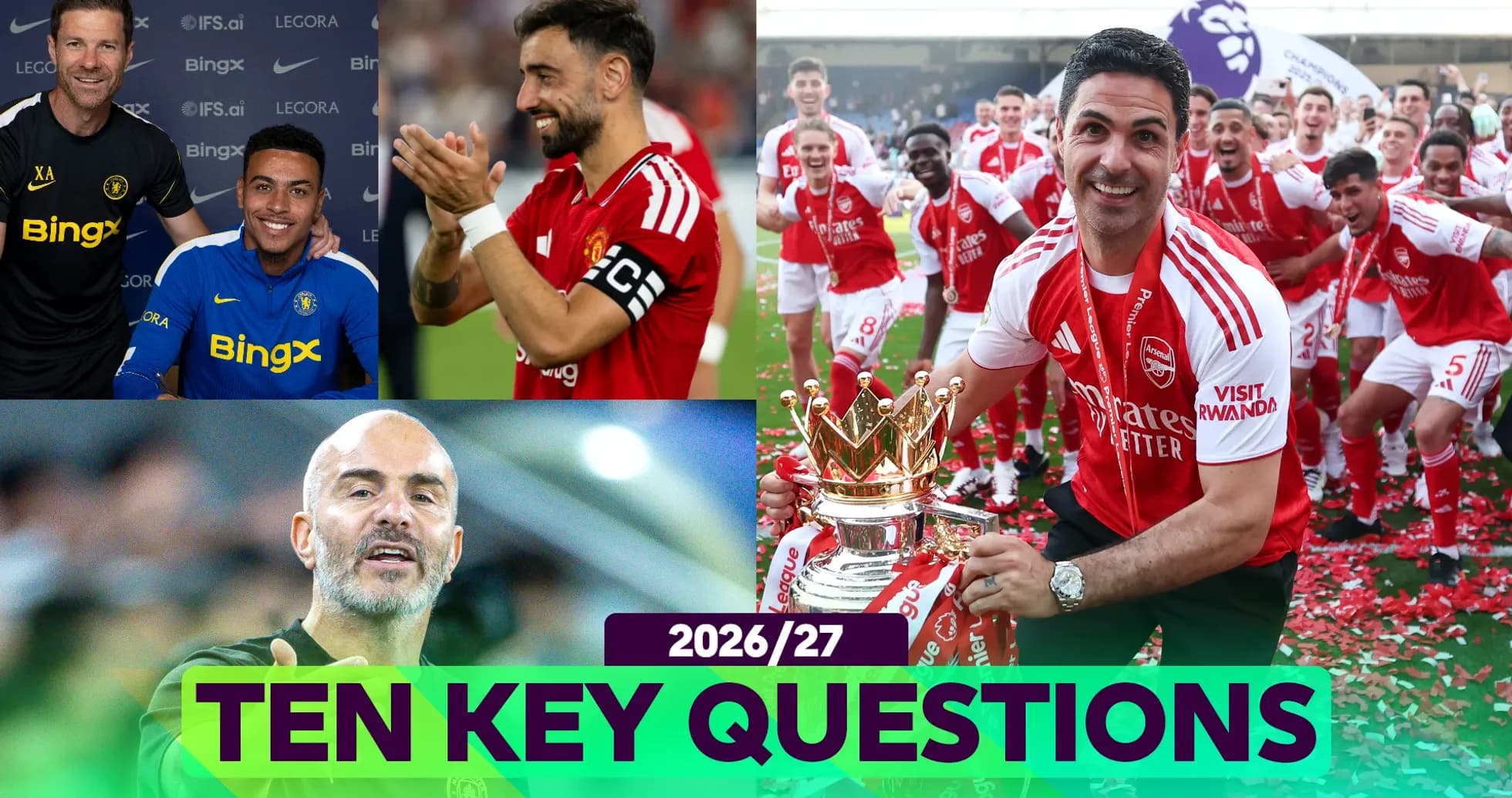
Arteta, the champions… and a rare shot at dominance
Only three managers have ever retained the Premier League title: Pep Guardiola, Sir Alex Ferguson, Jose Mourinho. That’s the company Mikel Arteta now keeps in the history books – and the challenge in front of him.
Retaining the crown in this era, with the depth of competition and money and pressure, is brutal. Yet this season, the landscape looks unusually kind to Arsenal.
While everyone else rips it up and starts again, Arsenal stand still in the best possible way. The squad is settled. The system is embedded. The title – five years in the making – has finally been won. The tension that gripped the club for so long has eased.
Around them, it’s turbulence. Michael Carrick at Manchester United and Roberto De Zerbi at Tottenham Hotspur begin their first full campaigns. Liverpool, Chelsea and Manchester City are all under new management. The “Big Six” suddenly looks like a collection of experiments.
In the middle of it all, Arsenal are calm. Arteta is the only manager in the division who has actually lifted the Premier League trophy. With Guardiola gone, that matters. City’s aura has cracked. The door to a mini-era of Arsenal dominance is at least ajar. It’s up to Arteta to walk through it.
Life after Pep: Maresca steps into the glare
Manchester City have been here before in league tables. They have never been here before in identity.
The Guardiola era was not just about winning. It was about building a club in his image from top to bottom. Now Enzo Maresca walks into a job that feels less like a succession and more like a referendum on the Guardiola way.
This season could define City’s modern history. Either Maresca becomes City’s version of Arne Slot at Liverpool – a smooth continuation of the old order – or he follows the path of Unai Emery after Arsene Wenger and David Moyes after Ferguson: smart managers swallowed by the shadow of a legend.
City’s hierarchy have tried to reduce that risk. They have doubled down on the Guardiola model, hiring a protégé steeped in the same possession-heavy, positional play that reshaped English football. Maresca is Guardiola football with a new voice.
But the voice matters. So does the dressing room. Bernardo Silva and John Stones have gone, taking leadership and experience with them. The structure remains, the style remains, the expectations remain. What’s gone is the man who made it all feel inevitable.
City are still eight-time Premier League champions. The question is whether the magic was in the system, or in the manager.
Alonso at Chelsea: a new star on the touchline?
Of all the new faces, one appointment crackles with intrigue more than any other: Xabi Alonso at Chelsea.
He arrives with the glow of that extraordinary 2023/24 season at Bayer Leverkusen, where he delivered the unthinkable – an unbeaten league campaign – and quickly became one of the most coveted coaches in the world. Now, with Guardiola and Klopp gone, he steps into a Premier League that is searching for its next great tactician.
The conditions for a fast start are there. Chelsea have no European football, the same advantage that helped Antonio Conte blitz the league in 2016/17. That was the last time Chelsea won the title. Conte joined an elite group of managers who lifted the Premier League in their debut season; six have done it, three of them at Stamford Bridge.
Alonso could be the fourth in blue.
He inherits a talented squad that has finally been given something it sorely lacked: experience. Danny Welbeck and Jordan Henderson are the first over-30 signings of the BlueCo era, a symbolic break from the youth-only obsession. It hints at a club that has decided it needs grown-ups as well as prospects.
Give Alonso free midweeks and a training ground full of quality, and Chelsea suddenly look like a team that could jump the queue.
The return of chaos: De Zerbi, Iraola and the attacking wave
Last season, some supporters looked at the numbers and didn’t like what they saw. Goals per game dipped slightly from 2.40 to 2.36, but the real story was in open-play Expected Goals. After peaking in 2023/24 at 865.8 xG – 2.28 per match – the league slid back to 692.1 and just 1.82 per game in 2025/26.
The spectacle narrowed. Set-pieces took centre stage. Open-play chaos faded.
This year, the dugouts promise something different. De Zerbi at Spurs, Andoni Iraola at Liverpool, Alonso at Chelsea, Marco Rose at Bournemouth, Pierre Sage at Crystal Palace – that’s a wave of managers who don’t just tolerate risk, they embrace it.
De Zerbi’s football is all about high pressing, brave build-up, and relentless attacking patterns. He didn’t have the time or conditions to fully impose that style at the end of last season, but with a full summer at Spurs, the expectation is clear: they will play on the front foot.
Iraola brings the same energy to Anfield. His Bournemouth side lit up the league with their “heavy-metal” intensity, the kind of end-to-end, high-octane football many Liverpool fans pined for after Klopp.
Alonso’s Leverkusen and Real Madrid teams scored freely. Rose arrives from the RB Leipzig/Borussia Dortmund school of aggressive German football. Sage is all about quick transitions and hard pressing.
Put them together and the league looks ready to swing back towards that 2023/24 high: fast, wild, and gloriously open.
Can Carrick drag Manchester United back into the title race?
Manchester United have spent a decade talking about “being back”. Michael Carrick has given them something more tangible: numbers that actually stack up.
He took over as caretaker on 14 January. Three days later, United beat Manchester City 2-0. That result didn’t just buy him time; it launched a run that changed his job title and, potentially, the club’s trajectory.
Across his 17 league games in charge – almost half a season – United topped the table. The form table from that period is blunt:
- Man Utd: 17 played, 12 wins, 3 draws, 2 defeats, 39 points.
- Arsenal: 36 points.
- Man City: 35.
- Bournemouth: unbeaten, but drawing their way to 21.
- Liverpool: inconsistent, 25 points from 17.
Carrick doesn’t need a tactical revolution to justify belief. He just needs to repeat himself. Replicate that 17-game form over a full season and United win the league for the first time since 2013.
Football rarely follows such neat lines. Injuries, Europe, pressure – they all intervene. But for the first time in years, United have recent evidence, not just nostalgia, to cling to.
A season for second chances
New managers mean new eyes on old players. This could be the year of the comeback star.
Phil Foden and Cole Palmer, both off the pace last season and both absent from England’s World Cup squad, will feel they have points to prove. Marcus Rashford and Mason Mount are fighting for relevance and minutes at United under Carrick.
Harvey Elliott, Omar Marmoush and Andy Robertson all endured frustrating campaigns with limited game time. Each now has a realistic route back into prominence.
Yoane Wissa will hope a fresh voice on the training pitch sparks a revival. From the injury list, Levi Colwill and Alexander Isak stand out as players whose absence made people forget just how good they can be.
With so many managerial resets, reputations are being rewritten everywhere. The stage is set for at least a few of those “forgotten” names to define the season.
Villa, Newcastle and the cost of change
Twelve months ago, Aston Villa and Newcastle United were held up as models of continuity, poised to push deeper into the Champions League places. That stability has vanished.
At Newcastle, the upheaval is stark. Eddie Howe has gone. Matthias Jaissle steps in, tasked with reshaping a team that has lost three of its biggest figures: Bruno Guimaraes, Anthony Gordon and Sandro Tonali.
In their place: Lukas Hornicek, Bazoumana Toure, Aladji Bamba, Sean Steur and Ewen Jaouen. All arrive for serious money. All come with strong reputations. None has yet proved they can replace what has been lost in Premier League terms.
Villa’s shift is less dramatic but still significant. Unai Emery remains, which anchors the project, yet the sense is of a squad moving into a new phase. Youri Tielemans, Morgan Rogers and Lucas Digne have departed. Alejandro Garnacho, Johan Manzambi and Joao Gomes arrive with buzz and expectation.
Both clubs look exciting. Both also look like they are stepping into the unknown after years of carefully controlled evolution.
Europe: dream or distraction?
Nine Premier League clubs made it into Europe last season. For some, it was a springboard. For others, a weight.
Aston Villa showed what is possible, winning the UEFA Europa League and still finishing fourth. Crystal Palace proved that sacrificing league position can be worth it; they dropped to 15th but took home the UEFA Conference League trophy, and no one at Selhurst Park is complaining.
Nottingham Forest, Spurs and Newcastle felt the other side of the coin, sliding into the bottom half under the strain of extra games and stretched squads.
This year, Brighton & Hove Albion enter the Conference League for the first time, just their second-ever European campaign. They will look at Palace and see a template: a winnable competition, a chance to grow, and a fanbase desperate for those nights under the lights.
Palace themselves now step up to the Europa League, better equipped for the demands after last season’s run. Bournemouth and Sunderland, both in the Europa League, have reason to worry about depth but will not want to waste a rare opportunity.
Below them, Leeds United sense an opening. Strong summer business and the knowledge that many rivals must juggle Thursday nights could tilt the race for ninth or better. Brentford, who narrowly missed out last season, again have empty midweeks and a full calendar for Keith Andrews to drill his methods.
Europe will create winners and losers. The middle of the table has never felt more volatile.
Mid-table muscle and a league with no soft spots
Leeds and Brentford are not the only ones aiming upwards.
Fulham have turned to Alvaro Arbeloa, a former Real Madrid defender now in the dugout, and handed him two signings from Real. That alone is enough to energise a fanbase that watched Marco Silva push them to within a point of the European places last season.
Nottingham Forest now have Oliver Glasner, the coach who delivered both the Conference League and FA Cup to Crystal Palace. Even after selling Elliot Anderson to Manchester City, Forest will expect something closer to their seventh-place finish from two years ago than last season’s struggles.
Everton, meanwhile, look like a club finally settling. They are bedding into their new stadium and, crucially, have continuity in David Moyes that very few others can match. Hayden Hackney, Christian Norgaard and Brennan Johnson all look like clear upgrades.
Put it all together and the Premier League starts to resemble a league without obvious weak links. The floor is rising. Every “mid-table” side seems to think it can punch higher.
The promoted trio: bold, busy and hard to read
Coventry City, Ipswich Town and Hull City have watched Sunderland’s blueprint and taken notes.
Last summer, Sunderland spent aggressively and were rewarded not just with survival, but with European qualification. Along with Leeds, they ended a two-year run of promoted sides going straight back down. This year’s newcomers have responded in kind.
All three have been busy. All three have leaned heavily towards signing established internationals from mainland Europe rather than stacking up on Premier League veterans. Ipswich have dipped into the top flight with Issa Diop and Sasa Lukic. Hull have added Matt Targett and Jack Butland.
Coventry, who strolled to the Championship title, have Frank Lampard’s experience in the dugout. Ipswich have recent Premier League memories and Gary O’Neil, a manager who has already kept Bournemouth and Wolverhampton Wanderers up.
Hull look the most vulnerable. Their Expected Goals numbers last season painted a worrying picture: in Opta’s “Expected Points” Championship table, they sat 23rd out of 24. Yet this is their first time back in the Premier League since 2017, and with that comes energy, noise and belief.
Predicting their fate is a fool’s game. Many assumed Sunderland and Leeds would go straight back down in 2025/26. They didn’t.
Every club, from champions to newcomers, walks into this season with a story they believe can end in success. The league looks deeper, sharper, more aggressive than it has in years.
The only certainty is that someone’s dream will crack under the strain. The real question is whose.