Premier League Insights: Teams Establishing Identity Early
The Premier League has barely cleared its throat and already the division is splitting into those who look like they know exactly what they’re doing, and those trying to spend their way out of an identity crisis.
Some clubs have landed on something coherent. Others are throwing money at a mentality problem no signing can fix.
Hull: Structure over stardust
Hull were meant to be the latest punchline. Another promoted side whose season would be measured against Derby 2007/08, then ultimately filed under “brave, but doomed”.
They’ve ignored the script.
Only three promoted clubs before them had ever won their first two Premier League games. Two stayed up. The one that didn’t? Hull, in 2016/17. That inconvenient bit of history dulls the omen, but it doesn’t touch the present.
Sergej Jakirovic has gone back to basics and doubled down. A solid goalkeeper. Three physical centre-halves in a back five. A hard-working, stubborn midfield. Width everywhere. A plan built on repetition, organisation and sheer collective graft.
It’s not glamorous. It works.
Hull are already more than halfway to the old Derby points total with 36 games left. They look like a side who know exactly what they are: compact, combative and ready to punish mistakes on the break and at set pieces. With more attacking additions expected before the deadline, they’re not just here to make up the numbers. They’re here to irritate the life out of better-funded clubs who thought this would be easy.
Chelsea: Chaos, goals and a familiar feeling
Xabi Alonso has walked into Chelsea and, somehow, smuggled in a bit of Kevin Keegan.
His only real on-pitch brush with Keegan came in 2008, 90 minutes of a 3-0 Liverpool win over Newcastle. That afternoon seems to have stuck. Because this Chelsea side are running on the old “we’ll score one more than you” current, and Stamford Bridge hasn’t felt this unhinged in years.
Last season, Chelsea won just one league game in which they conceded at least twice. This season, they’ve already done it twice: 3-2 and 4-3. Each time they flirted with disaster, threatened to implode, then just about remembered how to manage a game.
The attack is the show. Fluid, varied, constantly interchanging. It looks built to score, almost regardless of the opponent. The question is whether the back half of the pitch can grow up around it.
The issues there feel solvable with time. Emi Martinez needs to settle with new team-mates. Romeo Lavia needs to stop being the senior man in a pivot and start being part of a proper structure. If that clicks, the comparison that keeps whispering around them – mid-process Arsenal from four years ago – won’t feel completely ridiculous.
Arsenal at the Emirates next week is the first real examination of that theory. Chelsea have been front-runners so far; we still don’t know what happens when they fall behind. Those cushions they built against Fulham and Brighton won’t always be there. That’s when we’ll see if this is a title project or just a very expensive thrill ride.
The quiet genius of Brighton’s model
Malick Yalcouye is the latest reminder that the rest of the league should probably just set up a standing order for hijacking Brighton’s scouting department.
At this point, if Brighton sign an obscure midfielder and you’re not at least trying to barge into the deal, you’re not doing your job.
Rashford and the Old Trafford redemption loop
Harry Maguire knows exactly what it looks like when Manchester United turn on one of their own. He’s worn it, lived it, survived it.
“Marcus has been part of a rough ride for Manchester United, and when that happens and the team doesn’t deliver, players get dug out and he was one of them at that stage,” he said. “I’ve been through it. Everyone’s been through it at this club.”
He’s not wrong. Luke Shaw, Kobbie Mainoo, even Bruno Fernandes have all been dragged through storms whipped up by managers, pundits and fans, only to re-emerge as pillars again.
Marcus Rashford’s situation felt more extreme. Under Ruben Amorim, the disconnect between player and boyhood club looked close to terminal. Then football did what it always does: it left the door open.
Sometimes, it’s not a hat-trick that turns things. Sometimes it’s a hard track back, a clean tackle, a roar from the crowd that says: all right, then. Show us. The road back is long, but the first step is rarely glamorous.
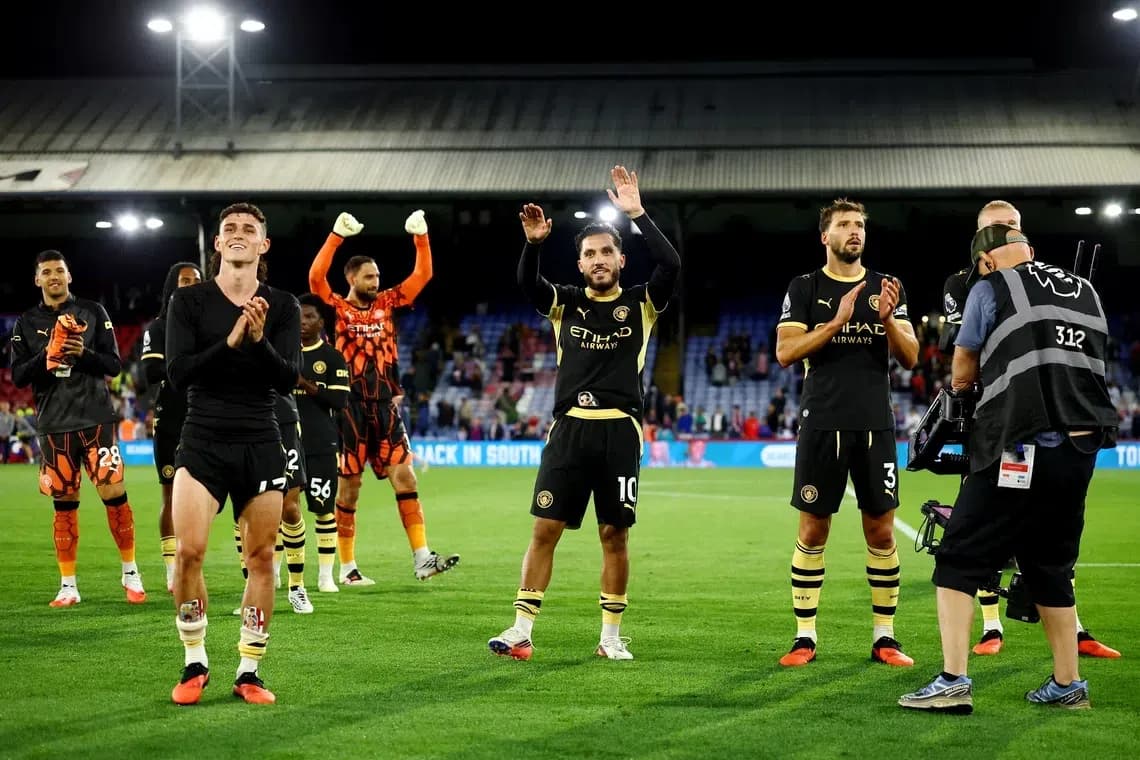
Manchester City and the value of chaos
Rayan Cherki cost Manchester City less than a string of recent attacking signings elsewhere in the division: Savio, Yoane Wissa, Jamie Gittens, Anthony Elanga, Brennan Johnson, Kevin, Emile Smith Rowe, Dan Ndoye, Dilane Bakwa. All moved for higher fees in the past year.
Cherki has already produced more combined goals and assists in 109 minutes this season than any of those players managed across the whole of 2025/26.
He’s been described as “chaotic”, a player who doesn’t fully buy into Enzo Maresca’s safe zones. That might be the point. This City side, so heavily drilled and patterned, occasionally need someone to scribble over the lines.
McAtee and Forest’s accidental succession plan
James McAtee arrived at Nottingham Forest to help plug the gaps left by Anthony Elanga and, before his golden handshake, Morgan Gibbs-White. He may end up replacing someone far more expensive.
Oliver Glasner, ever the tinkerer, decided not to chase a like-for-like replacement for Elliot Anderson, who left for Manchester City in a £116m move. “It’s not target No. 1 to replace Elliot because maybe we can do it from our own squad and spend the money on other positions,” he said.
McAtee was the in-house experiment.
Signed from Manchester City in 2025, he had to wait for Anderson to make the opposite journey a year later for the picture to clear. Now, two games into his second season at the City Ground, Glasner has already given him 164 Premier League minutes – more than all four of his previous Forest managers combined.
Nuno Espirito Santo, Ange Postecoglou and Sean Dyche never really found the right role for him. Glasner has pushed him deeper, trusted him on the ball and asked him to knit things together. Squint at his performance at Anfield and he looked a little like an Adam Wharton type, minus the backflips.
It turns out that playing a technically sharp Etihad academy graduate in a more reserved role and letting him dictate isn’t the worst idea.
Everton: chaos, cash and old habits
At Everton, the brief illusion of unity has evaporated. The club’s stakeholders have snapped back into their familiar state of mutual loathing, the fragile truce sacrificed at the £40m altar of Harrison Armstrong.
They are suddenly the most watchable soap opera heading into deadline day. An attack that could have featured Kiernan Dewsbury-Hall, Iliman Ndiaye, Lewis Barry and George might instead morph into something like Richarlison and Folarin Balogun, with Jack Grealish floating between the lines. That’s a staggering shift in a matter of weeks.
And yet, amid the chaos, David Moyes still finds ways to drag points out of games. His Everton landing in the European places early in a season is one of the Premier League’s longest-running traditions. They may be collapsing in on themselves off the pitch, but on it they remain stubbornly functional.
Brentford and Leeds: different clubs, same steel
Brentford remain exactly what they’ve been under Thomas Frank: a bloody good team with a bloody good manager. No fuss, no noise, just a clear plan executed well.
Leeds, meanwhile, have lost once in 11 – and that defeat came on the final day away to already-relegated West Ham in a game that barely counted. They’ve embraced the oldest survival rule in the book: if you can’t win, don’t lose.
Le Bris and the bench that bites
Regis Le Bris has already ticked off a quirky milestone: the first manager this season to send on substitutes who combined for a goal – one assisting, one scoring.
It’s a small thing. It also hints at a coach who understands how to change a game from the touchline. You’ll never sing that, but it matters.
The Losers
Spurs: spending big, thinking small
Roberto De Zerbi didn’t sugar-coat it.
“You can’t find the right mentality in the transfer market,” the Spurs manager said after their defeat. For a club on course to challenge the all-time record for spending in a single window, that is a brutal truth.
“It’s the biggest problem, it’s the biggest challenge and the biggest target is to find the right mentality,” he added. “After the goal we conceded, I think we lost the confidence. The reaction was not good enough, not the reaction I want to see on the pitch… the solution is not to put down the head, but to react, because we had 20 minutes again to score one, two or maybe three goals.”
He identified the mentality issue four months ago when he walked in. It still lingers.
Spurs have spent enormous sums. Against Newcastle, five new signings started, including two Premier League champions and a Serie A winner. On paper, this is a squad built to hit the ground sprinting.
On grass, they looked the least prepared side in the division. At home. Against a club they’d just taken a £92.5m midfielder from, whose new manager has been in the job for less than a month.
You can’t buy your way out of a soft underbelly. Spurs are finding that out the expensive way.
Crystal Palace: 60-minute football
Pierre Sage cut a frustrated figure. His Palace side “played well during the first half” against Everton, but he admitted they “gave up a little” and couldn’t “do it for the duration of the game”.
It was the same pattern in his first match: strong for a spell, then the lights dimmed. Against Manchester City, they lasted about an hour before essentially clocking off. Fulham next week might be in for a 75-minute examination, not a 90-minute one.
The summer has been brutal for preparation. Palace were heavily represented at the World Cup, have been squeezed by UEFA squad cost rules, and are trying to turn the page on a cycle that has seen key players and their manager depart.
Oliver Glasner has joked he’ll “have a pint of beer and celebrate the transfer window being closed”. His successor will likely raise the same glass. So will most managers in the league.
Liverpool: problems no winger can fix
Liverpool fans have seen this film before.
Back in January 2016, they won a wild 5-4 at Norwich, a match that screamed of attacking potential and defensive chaos. The question then was framed around Alex Teixeira: could one signing fix so many structural flaws?
He never arrived. Liverpool improved through coaching, time and smarter long-term planning instead.
This summer’s debate circles Bradley Barcola. He is a far better player than Teixeira ever was and a more compelling market opportunity, especially if Cody Gakpo is edging towards the exit. But the echo is hard to ignore.
Watching Liverpool concede from a goalkeeper’s punt and a penalty given away from a quick throw-in, then respond with two slick, well-crafted equalisers, told its own story. The attack is not the problem. The rest of the pitch is.
Yes, £123m of business before the deadline feels necessary. But not in attack, and not all on one player. The issues are broader, baked into the structure. Andoni Iraola needs more tools, not just another forward to decorate an already dangerous front line.
Bournemouth: cursed by clichés
Some teams pull one nightmare card in pre-season. Bournemouth managed two.
They look like a side destined to “struggle to defend set pieces” and “lose points from winning positions” – the two clichés no manager wants on their bingo card.
They have one point from two games despite leading in the 83rd and 90th minutes. All three goals conceded so far have been scored by defenders. Both equalisers came from corners.
It’s a tiny sample size. It’s also the kind of start that can burrow into a squad’s psyche if they don’t slam the door shut soon.
Gary O’Neil: an unwanted footnote
Ipswich’s defeat at Old Trafford will sting. For Gary O’Neil, the real embarrassment sits in the record books.
He remains the only manager to lose a Premier League game to Frank Lampard since October 2022, across 19 matches. That’s a statistic no coach wants their name pinned to.
Coventry: Premier League, ready or not
Coventry have waited a long time to get back to this level. The return has exposed just how unprepared they are, on and off the pitch.
Their schedule hasn’t helped. Opening away at the champions is as hard as it gets. Following that with a home game against the Championship play-off winners demands a complete tactical pivot in a matter of days. No team has had to flip their approach quite so drastically to start a season.
Next up: Manchester City.
It may get uglier before it gets better. Frank Lampard talks about moving from “the basics” to “the details”, but his side look like they’ve mastered neither in this league.
The early weeks always lie to us a little. Form spikes, narratives harden too quickly, and the table flatters and deceives in equal measure. But some themes already feel stubborn.
Hull know exactly who they are. Chelsea are thrilling and fragile. McAtee is being trusted, Spurs are still searching for a backbone, and Liverpool are staring at problems that won’t be solved by another shiny forward.
The window is about to slam shut. The excuses are about to disappear. Who’s really built something, and who’s just spent a fortune hoping it would all magically click?