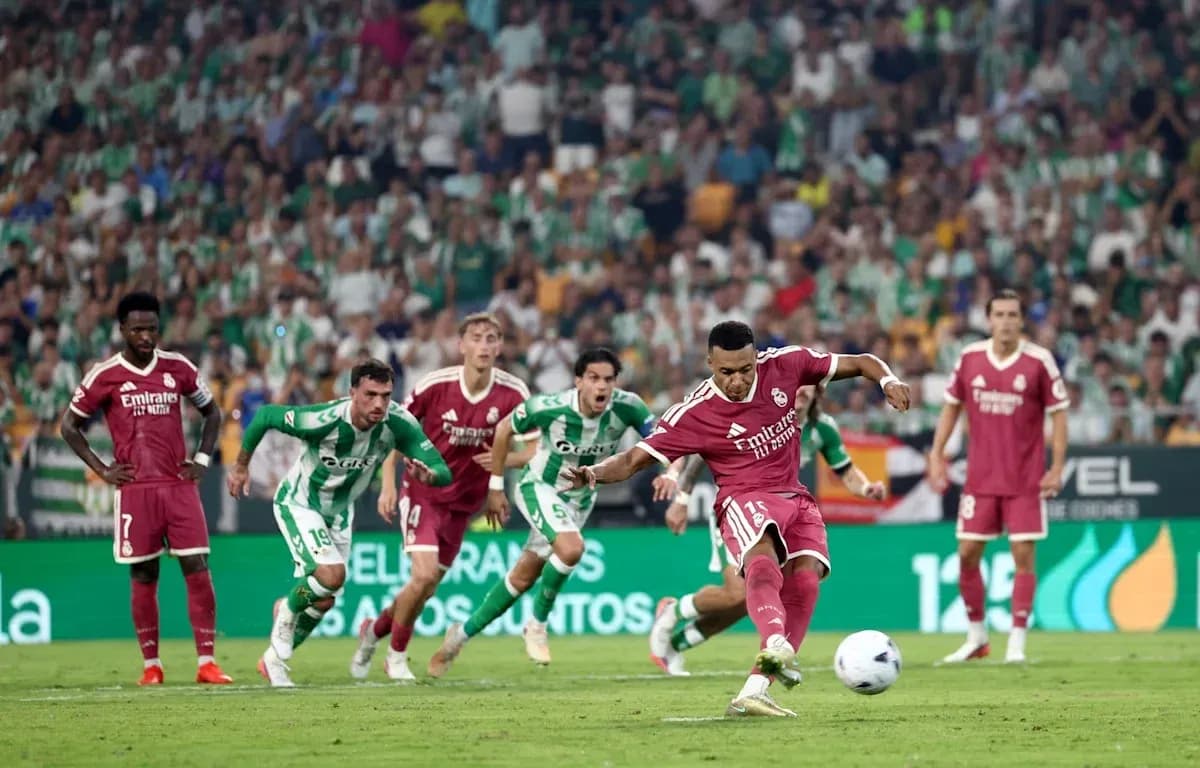
Real Madrid's First Defeat Under Mourinho: The Controversial Penalty
Real Madrid’s first defeat under Jose Mourinho was always going to be dissected from every angle. In the end, the loudest argument came down to a single step inside the box.
Late on against Real Betis, with Los Verdiblancos already in front, Madrid were staring at a first loss of the season. They needed two goals in ten frantic minutes. They barely got a clear sight of one.
Vinicius Jr. finally forced the issue in stoppage time, driving into the area and winning a penalty that felt like a lifeline more than a chance. Up stepped Kylian Mbappe, the man Madrid would have chosen in this moment a thousand times over.
Alvaro Valles read it. Dove. Saved cleanly.
The Bernabeu bench exploded in protest, not at Mbappe, but at Marc Bartra. Replays showed the Betis defender appearing to enter the area before Mbappe struck the ball. For Madrid, it looked like the simplest of calls: encroachment, retake, another shot at salvation.
It never came.
Inside the rulebook
The debate has raged since the final whistle, but the refereeing bodies have now drawn their line. As reported by Mundo Deportivo, Spain’s CTA has reviewed the incident and believes the decision on the pitch was correct.
Two sets of laws frame the argument: IFAB’s Laws of the Game and the CTA’s own CARD manual.
IFAB’s text is clear on when a penalty must be retaken for encroachment by a defender. The kick is repeated only if the encroaching player:
- directly affects the penalty taker,
- plays the ball after the kick,
- or challenges an opponent.
There is a further nuance that caught attention on this occasion. If a player is in the air when the ball is struck, the law says their position is judged by where their feet would be projected to land, but only if their entire body is off the ground. That detail framed some of the slow-motion scrutiny around Bartra’s movement.
The CTA’s CARD manual runs along the same lines. It also ties a retake to a clear impact: the defender must either influence the taker, make a play for the ball, or challenge an attacking player after the kick.
Encroachment alone is not enough. Encroachment that matters is.
Why the penalty stood
Applied to Mbappe’s miss, the interpretation is ruthless but simple.
For the spot-kick to be retaken, Bartra’s early step into the area had to change something tangible: disturb Mbappe, contest the rebound, or challenge a Real Madrid player in the immediate phase after the shot.
He did none of that. Valles saved the penalty cleanly. Bartra did not touch the ball straight after the kick, did not interfere with Mbappe’s strike, and did not prevent a Madrid player from attacking any potential rebound.
His position looked ugly on freeze-frames, and it fuelled Madrid’s anger in real time, but by the letter of both IFAB and CARD, it did not alter the outcome of the play in a way that demands a retake.
On that basis, the CTA has backed the officials: the decision to let Mbappe’s miss stand was, in their view, the correct call.
Real Madrid leave with their first loss of the Mourinho era, a night defined not just by a saved penalty, but by how tightly the modern game now draws the line between what feels unfair and what the law actually punishes.