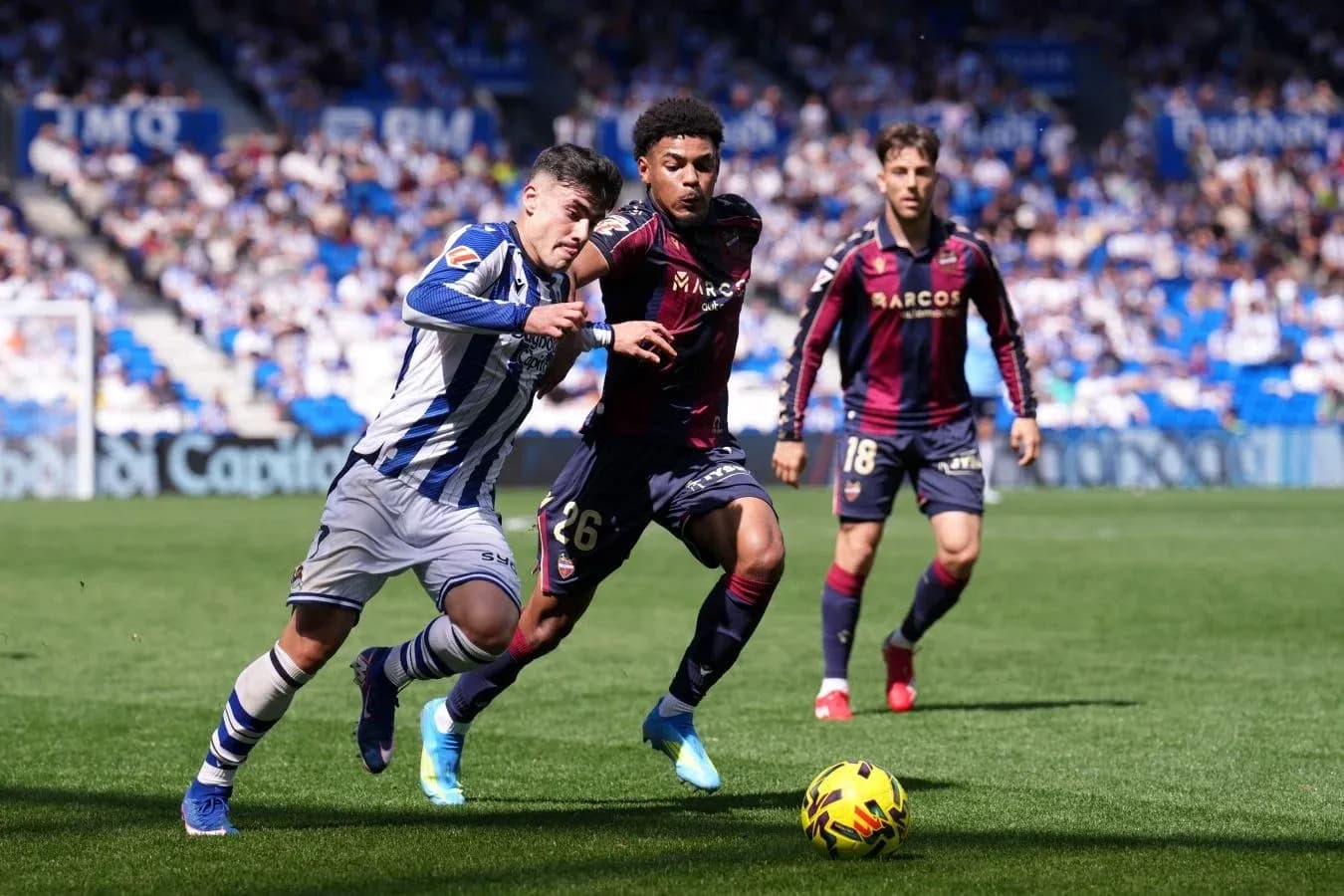
Real Sociedad's Identity Revealed in 2–0 Victory over Levante
The Reale Arena has seen Real Sociedad in many guises this season, but this 2–0 win over Levante felt like the clearest expression yet of their current identity: a high-variance, front‑foot side that lives on the edge defensively but increasingly trusts its attacking talent to dictate games.
I. The Big Picture – Clash of Identities
Coming into this Round 30 La Liga fixture, the numbers painted a stark contrast. Real Sociedad sat seventh on 41 points after 30 matches, with a razor‑thin +1 goal difference (46 scored, 45 conceded). At home, though, they had been closer to a European contender: 8 wins from 15, 29 goals scored at 1.9 per game and 21 conceded at 1.4 per match. This is a team that turns the Reale Arena into a game of trading punches.
Levante arrived 19th, locked in the relegation zone on 26 points and a −16 goal difference. Their 34 goals for and 50 against told a simple story: they concede at 1.7 per match across the season and don’t score often enough (1.1 per game) to offset that fragility. Even their away profile – 3 wins but 9 defeats in 15, 16 for and 24 against – suggested volatility without control.
On the day, the full‑time scoreline of 2–0 matched the underlying direction of travel. Real Sociedad, already averaging 1.5 goals per game overall, leaned into their attacking core. Levante, who have failed to score in 11 league matches so far, again found themselves neutralized by a better‑drilled side, their 4‑3‑3 unable to stretch the home defence for long enough.
Mauricio Pellegrino Matarazzo’s decision to start in a 4‑2‑3‑1, a shape his side have used eight times this campaign, was significant. It allowed him to stack creative talent between the lines – “Gonçalo Guedes”, “Luka Sucic”, “Ander Barrenetxea” – behind “Mikel Oyarzabal”, while keeping a double pivot to protect a back four that has been far from watertight.
Luis Castro, by contrast, opted for a 4‑3‑3 that has only appeared twice in Levante’s league season. It was an aggressive call for a side that has often defaulted to 4‑2‑3‑1 or even 5‑4‑1 when under siege, and it left his full‑backs “J. Toljan” and “Manu Sánchez” exposed against Real Sociedad’s wide overloads.
II. The Butterfly Effect – Absences and Tactical Voids
Real Sociedad’s squad sheet was shaped by a cluster of absences in defensive and rotational roles. “J. Gorrotxategi” (muscle injury), “J. Ochieng” (muscle injury), “A. Odriozola” and “I. Ruperez” (both knee injuries), plus “I. Zubeldia” (thigh injury) and “Y. Herrera” (calf) all missed out. Zubeldia’s absence in particular removed a calming organiser from the back line and a defender who, over the season, has combined 13 defensive blocks with strong passing security. Without him, “D. Caleta‑Car” and “J. Martin” had to shoulder more responsibility stepping into midfield and defending the box.
That forced Matarazzo to lean heavily on “J. Aramburu” at right‑back. Aramburu, one of La Liga’s most card‑prone defenders this season (9 yellows, ranked third in the league by disciplinary rating), walks a constant disciplinary tightrope. His 58 fouls committed and 91 tackles underline how aggressively he defends the wide channel. For a Levante front line that wanted to isolate him 1v1, there was always the possibility of drawing cards – but also the risk of being physically overwhelmed.
Levante had their own structural gaps. “R. Brugue” and “U. Elgezabal” (both knee injuries) were missing, along with the inactive “D. Varela Pampin” and “U. Vencedor”. That stripped Castro of a couple of rotation options in defence and midfield, pushing more minutes onto “M. Moreno” and “O. Rey”. For a team that already concedes too many chances, the lack of alternative profiles on the bench limited his ability to adjust once Real Sociedad took control.
From a disciplinary standpoint, both clubs arrived with warning lights flashing. Real Sociedad’s yellow‑card distribution is skewed heavily towards the second half: 22.95% of their bookings come between 46–60 minutes, with another spike (19.67%) from 76–90 and 14.75% in both the 31–45 and 61–75 windows. Levante’s profile is similarly back‑loaded: 20.29% of their yellows land between 76–90 minutes, with notable bands at 46–60 (17.39%), 61–75 (15.94%) and 31–45 (14.49%). This match was always likely to grow more frantic and scrappy after the break – exactly when Real Sociedad tend to accelerate their attacking rhythm.
III. Narrative Matchups – The Chess Match
The Hunter vs. The Shield
At the heart of Real Sociedad’s attacking plan was Oyarzabal. With 12 league goals and 3 assists in 27 appearances, he is among the highest‑ranked forwards in Spain this season (rating 7.11). His shot volume – 55 attempts, 31 on target – and penalty reliability (5 scored from 5, a flawless record so far) make him the focal point of the home side’s threat.
Levante’s “shield” has been porous. Fifty goals conceded in 30 league matches, with 24 of those away from home, reflects a back line that bends and often breaks. Even their best days – a 0–4 away win – are outliers against a pattern of 3–0 and 4–1 defeats. On Saturday, the 4‑3‑3 left “Dela” and “M. Moreno” repeatedly exposed to Oyarzabal’s movement off the front, especially when Guedes drifted inside from the left and “L. Sucic” attacked the half‑spaces.
Guedes himself, with 8 league goals and 4 assists, has evolved into the secondary “hunter”. His 28 shots (18 on target) and 24 key passes make him a dual threat. Against a Levante side that allows 1.7 goals per game and has only 5 clean sheets all season (3 away), the combination of Oyarzabal’s penalty‑box instincts and Guedes’ carry‑and‑shoot profile was always likely to dismantle their defensive block.
The Engine Room Duel
Without a clear league‑leading assist specialist in the data, Real Sociedad’s creativity is spread across their attacking midfield line. Sucic, Barrenetxea and Guedes rotated positions behind Oyarzabal, constantly asking questions of Levante’s central trio “J. A. Olasagasti”, “O. Rey” and “I. Losada”.
Rey’s role as Levante’s enforcer is crucial. This season, their midfield has had to absorb wave after wave of pressure, reflected in the team’s heavy yellow‑card loads in the middle and late phases of games. Sánchez, their left‑back and one of the league’s more carded defenders (8 yellows, ranked 13th by disciplinary rating), often had to step inside to help, leaving space for Barrenetxea to receive on the outside and drive at him.
On the other side, Aramburu’s defensive metrics underline how Real Sociedad wanted to neutralize Levante’s wide forwards. With 91 tackles, 39 interceptions and 8 defensive blocks this season, he is a volume defender who repeatedly steps out to shut down transitions. His duels (311 contested, 176 won) are not just numbers; they explain why Levante’s front three of “V. Garcia”, “C. Espi” and “K. Tunde” struggled to sustain attacks. Aramburu doesn’t just contain; he actively dismantles wide build‑up, even if it means flirting with another yellow.
Depth & Game‑Changers
Where Real Sociedad truly separated themselves was on the bench. Matarazzo could call on “Brais Mendez” – 6 goals, 2 assists and among the league’s top red‑carded players with one dismissal – as a high‑impact, high‑risk interior. His 23 key passes and 42 dribble attempts make him an ideal late‑game controller, capable of both slowing the tempo and delivering the final ball.
Beyond Mendez, “Takefusa Kubo”, “A. Zakharyan”, “J. Karrikaburu” and “Wesley” formed a bench unit that could completely reshape the front line. In a match where Real Sociedad already average 1.9 home goals and have failed to score in only one league match at the Reale Arena so far, that depth allowed them to keep pressure on a tiring Levante defence deep into the second half – exactly the window where Levante’s card profile (20.29% of yellows from 76–90) suggests they lose control.
Levante’s bench, by comparison, was functional rather than transformative. “J. Morales” and “I. Romero” offered fresh legs up front, “P. Martinez” and “C. Alvarez” options in midfield, and “A. Matturro” defensive cover. But there was no single game‑changer with the statistical footprint of Oyarzabal, Guedes or Mendez. For a side that has failed to score in 11 league games and relies heavily on structure rather than individual brilliance, chasing a deficit away to a strong home attack was always going to be a problem.
IV. The Statistical Prognosis – Why It Tilted Real Sociedad’s Way
Strip away the names and this match looked, on paper, like a meeting between a mid‑table attack‑heavy side and a relegation‑threatened defence. Real Sociedad’s 46 goals from 30 games, combined with a home scoring rate just under two per match, faced a Levante unit conceding 50 in the same span. The most critical tactical intersection was late in games: Real Sociedad’s tendency to push aggressively after the interval, and both teams’ spikes in yellow cards between 46–60 and 76–90 minutes, pointed towards a chaotic second half that would favour the side with more attacking quality and bench depth.
Add in Real Sociedad’s flawless penalty record this season (6 from 6, with Oyarzabal perfect from 5 attempts) against a defence that frequently ends up making last‑ditch challenges in the box, and the margins narrowed even further in the home side’s favour. Levante’s occasional away clean sheets – 3 so far – were never likely to hold if Real Sociedad established territory and rhythm.
In the end, the 2–0 scoreline felt like the logical extension of the season‑long data. Real Sociedad exploited Levante’s structural weaknesses, used their wide overloads and creative depth to dictate the tempo, and leaned on a defensive line that, while far from impermeable over the campaign, was solid enough on the day to neutralize a limited attack. For Levante, the story remains the same: too easy to break down, not incisive enough to punish mistakes, and running out of road in the relegation fight.