South Africa Meets Canada in Historic World Cup Knockout
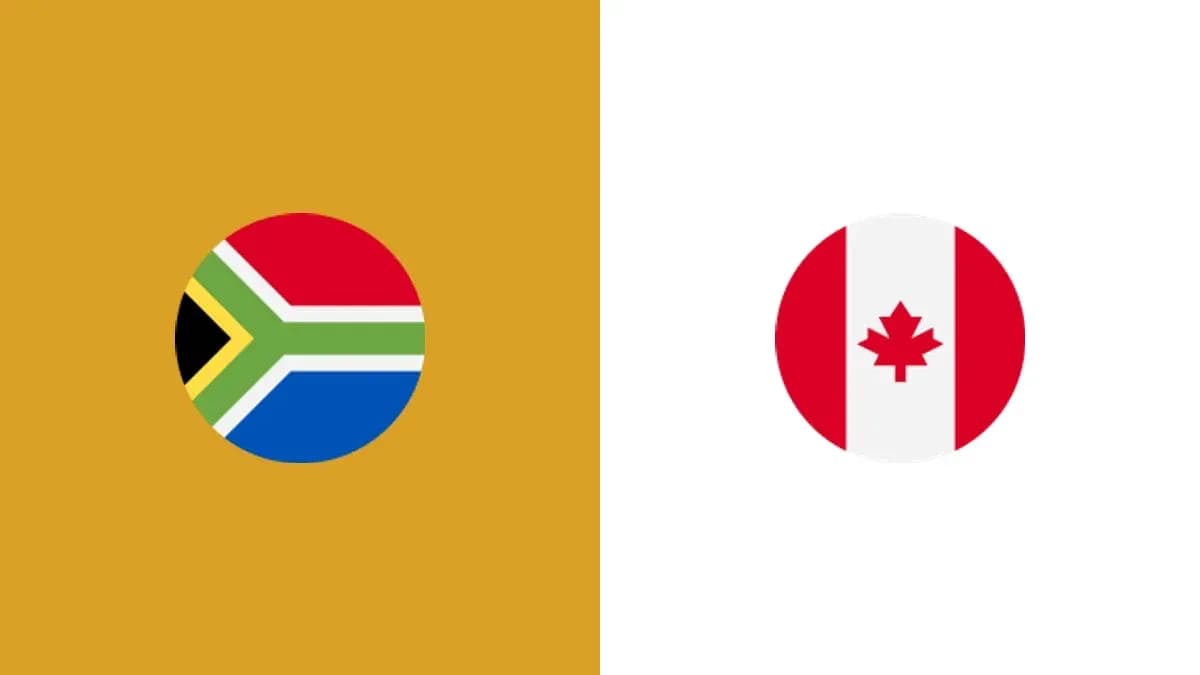
On June 28, under the California sun and the glare of a World Cup knockout stage, two very different journeys collide. South Africa, in the round of 32 for the first time in their men’s World Cup history, face co-hosts Canada in Los Angeles at 15:00 EST (20:00 GMT) with a last‑16 place on the line.
For Bafana Bafana, simply being here already tears up an old script. For Canada, anything less than progress on home soil would feel like a step backwards. One of them walks into a new chapter. The other is left wondering what might have been.
Canada: smooth start, brutal setbacks
Canada’s route to the knockouts looked almost routine at first glance. Four points from their opening two games, the job essentially done with a match to spare.
They opened with a solid 1-1 draw against Bosnia and Herzegovina, then tore Qatar apart 6-0. That second game felt like a statement, a co-host flexing its muscles. Jonathan David, the Juventus forward, ran riot with a hat-trick, the kind of performance that shifts a striker’s tournament from hopeful to ominous.
But the night came with a fracture—literally. Sassuolo midfielder Ismael Kone left that Qatar demolition with a broken leg. A key link in Jesse Marsch’s midfield was gone, the balance of the side suddenly altered.
Canada’s final Group B outing, a 2-1 defeat to Switzerland, stung but didn’t derail them. Qualification was already secured. The loss, though, underlined a truth: this is a good team, not an untouchable one.
They’ve also done it all without the player who usually defines them.
Alphonso Davies, the Bayern Munich star and face of Canadian football, has watched this World Cup from the sidelines. He fought his way back from a long injury to feature in Bayern’s Champions League semi-final against PSG in April, only to suffer a recurrence. At this World Cup, ‘Phonzy’ hasn’t played a single minute.
Marsch has leaned instead on a settled defensive unit. Maxime Crepeau in goal, with Alistair Johnston, Luc de Fougerolles, Derek Cornelius and Richie Laryea forming a back four that has started every game together. There’s familiarity there, a platform for the likes of Stephen Eustaquio, Tajon Buchanan, Liam Millar and David to build on.
Canada arrive with a recent record of W2 D2 L1 from their last five, nine goals scored and four conceded. Strip out the Qatar thrashing and the numbers look more modest, but the threat is obvious: if David catches fire again, they can blow games open.
South Africa: chaos, red cards and a breakthrough
South Africa’s journey has been anything but serene. It has been wild, fraught and, in the end, historic.
They opened their World Cup with a 2-0 defeat to Mexico, a flat performance made worse by red cards for midfielders Themba Zwane and Sphephelo Sithole. One game in, they were bottom of the group, down two key players and staring at another early exit.
Hugo Broos responded with changes. Three of them. The team that walked out for the second match against the Czech Republic looked more assured, more purposeful. They ground out a 1-1 draw, Teboho Mokoena nerveless from the penalty spot.
That kick kept them alive. His yellow card in the same game almost killed the dream. Suspended for the decisive clash with South Korea, South Africa went into Monterrey without their midfield metronome.
They responded with steel.
In a raucous Estadio Monterrey, with news of Mexico’s goals against the Czechs crackling through the stands, Bafana Bafana produced a defensive performance to remember. They absorbed wave after wave from South Korea, then sliced back on the counter.
Thapelo Maseko, operating as an inverted winger on the right, tormented the Korean back line. The AEL Limassol loanee struck in the 63rd minute, the decisive goal in a 1-0 win that sent South Africa through. On another night, he might have walked away with the match ball.
Relebohile Mofokeng, the Orlando Pirates livewire, shone too. Quick thinking, sharp decision-making, passes that broke lines, direct runs that forced defenders to turn and chase—he looked every inch a player built for knockout football.
Behind them, the foundation has been surprisingly mature for such a young core. Twenty-year-old Mbekezeli Mbokazi, already talked about as a future captain, has anchored central defence alongside 22-year-old Ime Okon. Full-backs Khuliso Mudau and Aubrey Modiba, plus captain and goalkeeper Ronwen Williams, have started all three games as a tight back-five unit.
Mokoena returns from suspension now, expected to slot back in front of that defence, likely displacing Sithole. His presence adds calm and control in a team that has had to live on the edge.
Across their last five, South Africa’s record reads W1 D1 L2 D1, with just two goals scored and three conceded. It’s not glamorous. It is, however, stubborn. They finished second in Group A, and they arrive in Los Angeles battle-hardened.
Two settled spines, one knockout test
Strip away the narratives and you find two sides built on similar ideas: continuity at the back, clear roles, and a reliance on a few difference-makers.
For South Africa, that likely means Williams in goal; a back four of Mudau, Okon, Mbokazi and Modiba; Mokoena shielding with Thalente Mbatha alongside; Maseko, Mofokeng and Oswin Appollis supporting Evidence Makgopa up front.
Canada’s probable shape mirrors that stability. Crepeau in goal; Johnston, De Fougerolles, Cornelius and Laryea across the back; Buchanan, Nathan Saliba, Eustaquio and Millar in midfield; David and Tani Oluwaseyi leading the line.
Both coaches have leaned on repetition. Both teams know their patterns. The difference may lie in how they handle the moments when those patterns break.
South Africa will happily sit deep, compress space, and spring Maseko and Mofokeng into the gaps Canada leave. Canada will look to pin them back, work Eustaquio onto the ball and feed David between the lines.
The head-to-head history offers almost nothing to cling to. These nations have met just once before, a friendly back in November 2007, when South Africa won 2-0 at home. Nineteen years later, in a World Cup knockout tie in Los Angeles, that result is little more than a footnote.
Stakes, pressure and a shifting World Cup map
South Africa have already broken new ground. This is their first men’s World Cup knockout appearance, a milestone for a nation that has often watched the latter stages from afar. The question now is whether they treat this as a bonus or a springboard.
Canada, co-hosts and group runners-up from Group B, carry a different weight. They’ve already been forced to leave their home base after that defeat to Switzerland. The comfort of home soil is gone. So is the margin for error.
In one corner stands a young, improving Bafana side that just survived a rollercoaster group and emerged stronger. In the other, a Canadian team missing its brightest star but powered by a prolific striker and a settled core.
Kick-off in Los Angeles will decide more than a last‑16 place. It will show whether South Africa’s resilience can outlast Canada’s ambition, and whether this World Cup is ready to redraw its football map once again.