South Africa's World Cup Journey: A Promising Future
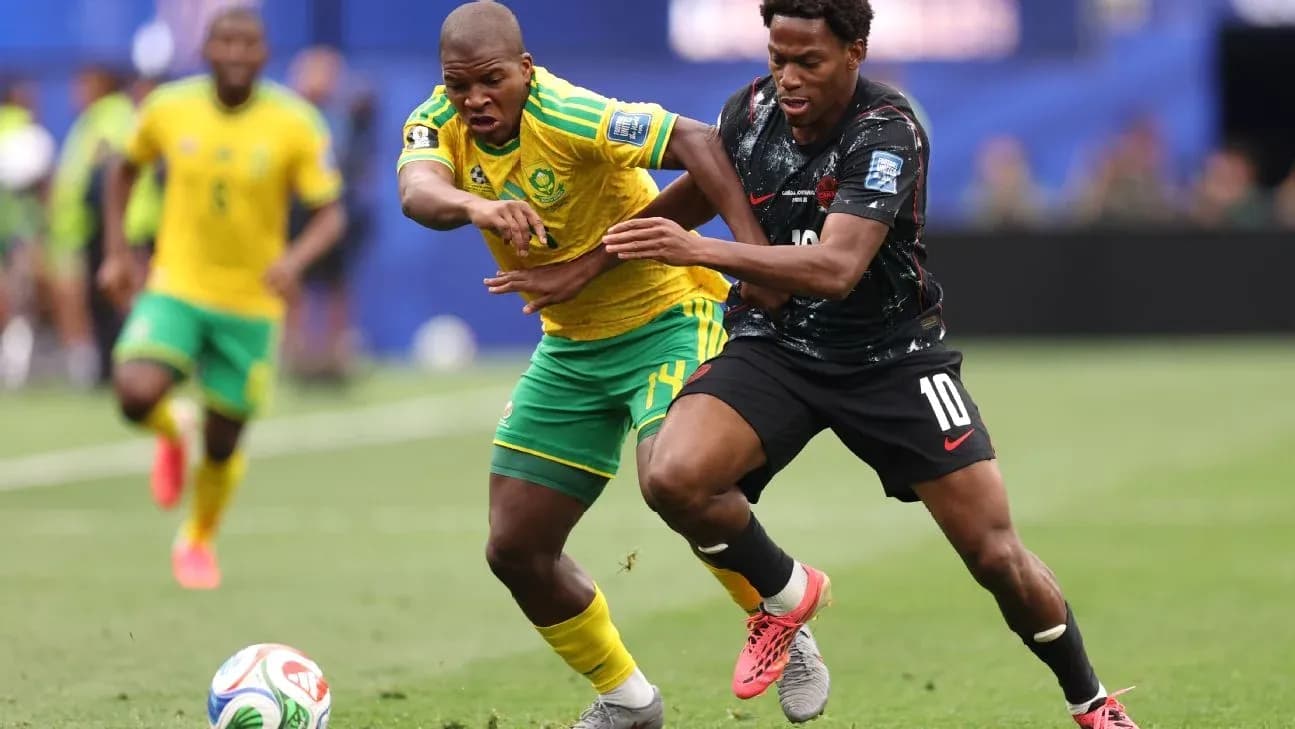
South Africa’s World Cup exit hurt. It had to. A 1-0 defeat to Canada in the round of 32, a first knockout match in 16 years, and the dream stopped just as it was starting to feel real.
But this time, the pain came with a promise.
For the first time, Bafana Bafana walked away from a World Cup not just with memories, but with a roadmap. The tournament answered some old questions, raised new ones, and hinted at a future that feels less like blind hope and more like a plan.
Centre-backs for a generation
If there is one department South Africa can stop worrying about, it is the heart of their defence.
At this World Cup, the pairing of Mbokazi and Okon did more than just hold their own. They owned their space. Both stepped into the global spotlight and did not flinch; Mbokazi, in particular, emerged as one of the standout centre-backs of the tournament, reading danger early, winning duels, and playing with a calm that belied the occasion.
Behind them, the production line looks healthy. Olwethu Makhanya, Khulumani Ndamane, Tylon Smith, Malibongwe Khoza, Aden McCarthy and others are already pushing from beneath. If either “TLB” or Okon ever need replacing, temporarily or permanently, there are genuine options ready to step up.
Whoever coaches Bafana in the next World Cup cycle inherits something every national team craves: stability at centre-back. That alone can shape a team’s identity.
Mofokeng: the ace still in the deck
Not everything clicked in 2026. One frustration for many South African supporters was Hugo Broos’ reluctance to lean fully into the talent of Relebohile Mofokeng.
The Orlando Pirates attacking midfielder did not get the unshakeable trust from the dugout that the stands were crying out for. Yet he is only 21. Time is firmly on his side.
When he did get his moment, he made it count. His performance in the 1-0 win over South Korea was a statement: this is a player who can live at World Cup tempo, who can look global stars in the eye and demand the ball. That night felt less like a cameo and more like a trailer.
By 2030, if he grows anywhere near his potential, the Bafana coach will have a genuine game-changer at their disposal, the kind of player you save for the tightest nights and the biggest stages.
Reports suggest Mofokeng is close to a move to Royale Union Saint-Gilloise in Belgium. If that transfer is confirmed, it offers him exactly what he needs now: a competitive European platform, without the glare and chaos of a superclub. South Africa may look back on that move as the moment a local talent turned into a global name.
Homegrown, world-class
One of the quiet triumphs of this World Cup for South Africa lay in the stories of those who never left home.
Teboho Mokoena, the heartbeat of Mamelodi Sundowns’ midfield, carried his club authority straight into the international arena. Thalente Mbatha of Orlando Pirates matched the level, snapping into tackles, using the ball with maturity, proving he belongs at this stage.
Out wide and in the channels, Sundowns fullbacks Khuliso Mudau and Aubrey Modiba underlined the strength of the domestic game. They defended honestly, attacked with conviction, and never looked out of place against players whose weekly reality is the Champions League or Europe’s top five leagues.
Behind them all, Ronwen Williams once again became the calm in the chaos. The captain produced big saves in big moments and reminded the world why his reputation has soared despite spending his entire club career in South Africa, first with SuperSport United and now with Sundowns.
Their collective impact sent a clear message: the South African Premiership is not a backwater. It is a proving ground. Young players will still benefit from moves abroad, but this World Cup showed that you do not have to leave home to become a serious professional, or to earn respect on the global stage.
Maseko and the goal that changed everything
Some stories cut beyond tactics and systems. Thapelo Maseko’s is one of them.
Hugo Broos saw something in him early. The winger scored his first Bafana goal at the delayed 2023 Africa Cup of Nations in early 2024, just 20 years old and seemingly on a steep upward curve.
Then came the stall.
After swapping SuperSport United for Mamelodi Sundowns, Maseko slipped down the pecking order. When Miguel Cardoso arrived as Sundowns head coach in December 2024, the winger drifted even further from the spotlight. He was often left with the reserves, his trajectory suddenly uncertain.
By January 2026, the situation had turned bleak enough for Maseko to write publicly about losing his love for football. Five months later, he was on loan at AEL Limassol in Cyprus, a move that looked like a lifeline more than a launchpad.
That lifeline changed everything. By March, he had fought his way back into the Bafana squad. This month, he wrote his name into South African football history.
His goal against South Korea did not just win a match. It carried a nation into the World Cup knockout rounds for the first time ever. From reserve-team exile to national hero, Maseko’s journey became a mirror for a country that has known both disillusionment and defiance.
For South Africans, his story is not just about football. It is about coming back from the brink.
SAFA’s second chance
The brink is where the South African Football Association has been living for some time.
Heading into the World Cup, SAFA’s finances were under intense scrutiny. Players had been paid late after the previous African Nations Championship. Year after year, operating expenses outstripped revenue. The questions were no longer about growth, but survival.
This World Cup changed that equation, at least in the short term.
Just by reaching the group stage, SAFA were guaranteed at least $9 million in performance-based payouts, excluding preparation fees. Bafana’s historic march into the round of 32 added another $2 million, taking the total to $11 million.
That money does not erase years of mismanagement. It does not fix structures overnight. But it buys time. It offers breathing space.
It also changes the conversation with sponsors. A federation associated with late payments and missed tournaments is a hard sell. A federation whose team has just reached the World Cup knockouts for the first time looks very different in a boardroom. Doors that were closed a year ago will now at least open.
The responsibility is clear. This cannot be treated as a windfall to patch over old cracks. It has to become the foundation of something more sustainable: better planning, stronger development pathways, real investment in coaching and youth structures.
South Africa’s World Cup run has dragged SAFA away from the cliff edge and back onto solid ground. The question now is whether the people in charge can step out of survival mode and build something worthy of the talent, resilience and hope their players have just shown the world.
Because for the first time in a long time, the future of South African football does not just feel possible. It feels within reach.