Sweden's Unlikely World Cup Qualification Journey
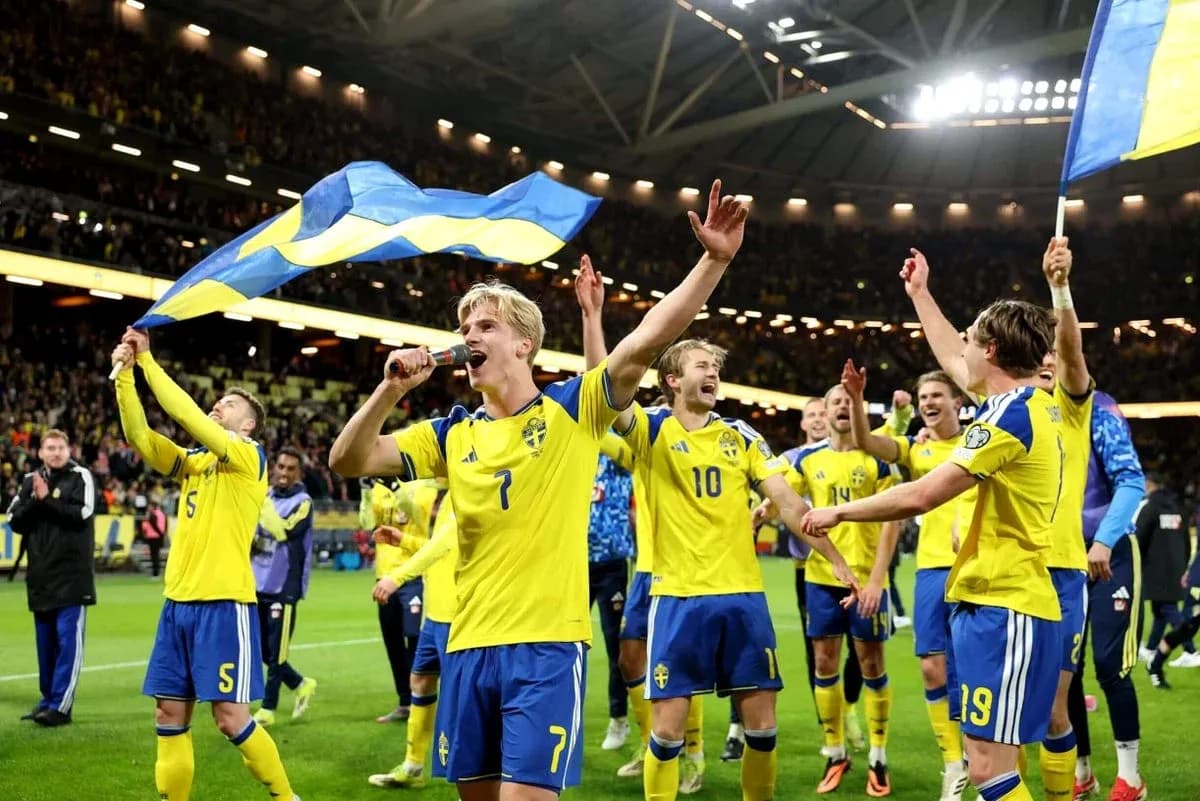
Sweden are going to the World Cup by accident. Or at least, that is how it feels.
The most important goal in this whole crooked journey might be one that technically has nothing to do with World Cup qualifying at all, scored by a player who hasn’t kicked a ball in 2026. Back in November 2024, in a low-key Nations League C game, Alexander Isak took a pass, killed it with his right, rolled it onto his left and thumped in a winner against Slovakia for a 2-1 victory.
Third tier. Nations League. Cold autumn night. Nobody thought it would matter.
Sweden celebrated topping a modest group and moved on. At that stage, no one was poring over UEFA regulations. Certainly not Anthony Elanga, who would later admit he had no idea that winning that 2024 Nations League C group came with a golden ticket: a back-door route into the World Cup playoffs. Sweden’s qualifying campaign proper? A shambles. No wins. Two draws. Four defeats. Bottom of a group behind Switzerland, Kosovo and Slovenia.
You can forgive the players for assuming they were done.
The irony runs deep. Sweden’s salvation in 2024 came partly from failure in 2022. Relegation from Nations League B — finishing last behind Serbia, Norway and Slovenia again — dumped them into Nations League C. That drop, grim at the time, gave them a winnable group against Slovakia, Estonia and Azerbaijan. They topped it, and with that, booked a playoff place that their qualifying record absolutely did not deserve.
Then the luck kept coming.
Unseeded for the playoff semi-final, Sweden were braced for a hostile away tie. The draw gave them Ukraine, nominally the home side. But with Ukraine still unable to host games, the one-off tie went to a neutral venue. Valencia. On Thursday night, there were more Swedish flags than Ukrainian ones in the stands. The atmosphere felt closer to Stockholm than to Kyiv, and Sweden took full advantage, running out 3-1 winners.
The draw smiled on them again. The winner of that semi-final would host the playoff ‘final’.
So Poland came to Stockholm. On paper, Poland had the stronger squad and, on the night, played the cleaner football. Sweden, though, threw bodies in front of everything. They blocked shots, hacked clear off the line, survived a couple of near-disastrous deflections that almost became own goals, and clung on. Then they struck.
Elanga, the winger who hadn’t known the rulebook, produced a thunderous drive. Gustaf Lagerbielke rose at a set piece and buried a header. Deep into the chaos of the closing stages, Viktor Gyokeres bundled in a third, a pinball goal that looked more like a training-ground rebound drill than a World Cup decider. It was scruffy, frantic, almost comic.
It was also the goal that sent Sweden to North America.
Look at the numbers and this might be the strangest, least merited World Cup qualification of the century from a UEFA nation. By June, none of that will matter. Nobody in Monterrey, Houston or Dallas will be dwelling on how they got there.
Part of the sense of distance from that dreadful qualifying group comes from the change in the dugout. Jon Dahl Tomasson, a Danish icon trying to win over a Swedish public, never really stood a chance once results turned. Performances were flat, results worse, and eventually he was dismissed.
What came next shocked plenty of people. Graham Potter, the former Swansea City, Brighton & Hove Albion, Chelsea and West Ham United manager, resurfaced not in the Premier League but in charge of Sweden. On one level it made sense. Potter built his reputation in the country, turning Ostersund from obscurity into a club playing European football and even beating Arsenal. He has always spoken warmly about his time there.
That affection pulled him back. Initially, it looked like a short-term rescue mission. Instead, before these playoffs had even kicked off, he signed a four-year deal, tying him to the job through World Cup 2030. He did that without winning either of his first two friendlies.
His squad for this week’s playoff drama was patched together. Isak, the man whose Nations League strike had quietly underpinned the whole story, has been out since breaking his leg just before Christmas. Dejan Kulusevski, captain and chief creator, has not played all season. Goalkeeper Viktor Johansson and right-back Emil Krafth were missing. Against Ukraine, Atalanta defender Isak Hien limped off before half-time.
The side that faced Ukraine and Poland looked cobbled together, but it carried a thread of logic from Potter’s past. In goal, 36-year-old Kristoffer Nordfeldt, a national-team understudy for 15 years, suddenly found himself centre stage. Potter had trusted him at Swansea back in 2018-19. He trusted him again. Nordfeldt repaid him with two huge saves against Poland and a series of booming kicks and throws that turned defence into attack in both playoff ties.
Up front, Gyokeres became the trump card. His season at Arsenal has not always convinced, yet he remains the top scorer for the leaders of what many still call the strongest league in the world. Given the chance to dominate the forward line rather than work around Isak, he tore Ukraine apart with a hat-trick, repeatedly surging in behind and bullying defenders.
Poland contained him better. For long spells he laboured, wrestling with centre-backs, chasing long balls, feeding on scraps. Then, when it mattered most, he arrived in the right place. His late winner detonated around the Strawberry Arena, a roar from fans who had almost stopped believing a World Cup was possible.
Strip away the chaos and there is a more serious question: how dangerous could this Sweden actually be if everyone is fit?
Isak is the third-most expensive player in football history for a reason. Kulusevski, at the start of last season, was posting attacking numbers in the Premier League bettered only by Mohamed Salah. Behind them, Yasin Ayari and Lucas Bergvall are emerging as potentially elite central midfielders, technical and ambitious, the kind of players Sweden have not produced in such numbers for years.
Inside the country, there is a feeling that this might be their best generation in a long time. That makes the route they have taken all the more bizarre. A supposed golden age, sneaking in through the servants’ entrance.
Potter, who holds a Master’s degree in leadership and emotional intelligence, seems to have leaned into the psychology of that. After the grey days under Tomasson, he has focused on unity and belief, stitching together a group that had looked fractured and joyless. The football is still imperfect, the results still uneven, but the mood has shifted.
The last time North America staged a World Cup, in 1994, Sweden finished third. Tomas Brolin, Martin Dahlin, bronze medals, a summer of sunshine and swagger. This time, they could not even finish third in their qualifying group.
Yet here they are, booked in to face Tunisia in Monterrey, the Netherlands in Houston and Japan in Dallas. On paper, they are outsiders to go deep. On the pitch, with Isak and Kulusevski back, with Gyokeres charging, with a manager who knows how to build something from the margins, who would dare to write them off now?