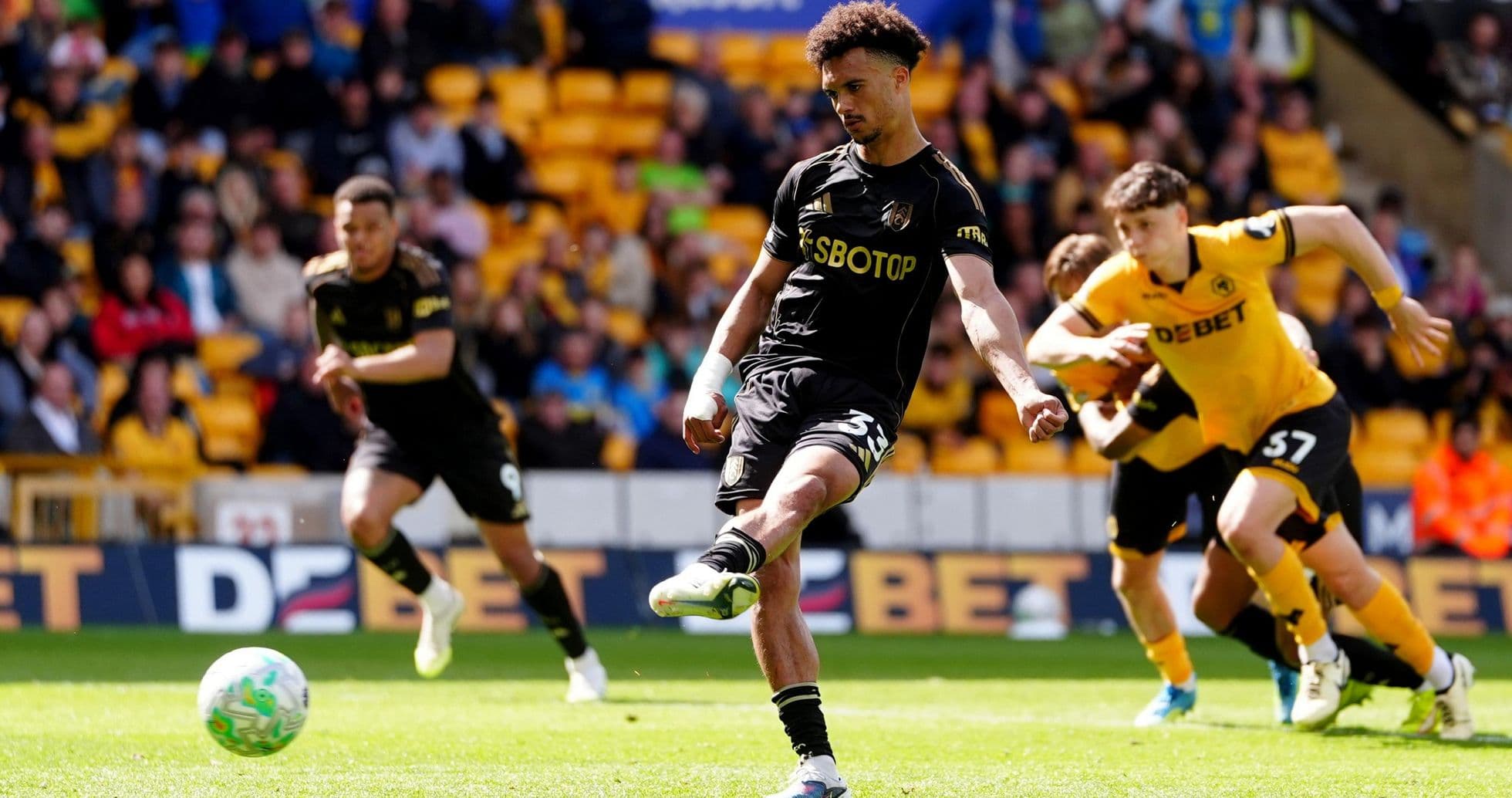
Tactical Analysis of Fulham vs Wolves: A 1-1 Draw at Molineux
The 1-1 draw at Molineux Stadium was a clear clash of game models: Wolves ceding territory and possession to protect space, Fulham imposing a structured, ball-dominant 4-2-3-1. Across 90 minutes, the tactical story was one of Wolves’ vertical directness against Fulham’s patient construction, with both sides’ approaches reflected almost perfectly in the statistical profile.
Wolves’ Tactics
Wolves’ 4-2-3-1 under Rob Edwards was built on compactness and fast transitions. With only 31% possession and 250 passes, they accepted long spells without the ball, instead prioritising a tight block and quick forward play once possession was regained. The double pivot of Joao Gomes and Andre sat close to the back four, screening the central lane and trying to limit service into Rodrigo Muniz’s feet and into the half-spaces where O. Bobb and E. Smith Rowe operated.
In attack, Wolves’ structure tilted towards the left. L. Krejci and M. Mane formed a key channel on that flank, with Hwang Hee-Chan drifting inside from the right to support A. Armstrong. The opening goal encapsulated the plan: a direct, early attack rather than a prolonged spell of circulation. Mane’s strike at 25' — assisted by Hwang Hee-Chan — came from inside the box, consistent with Wolves’ seven shots inside the area out of 11 total. They created 1.4 xG from relatively few attacks, underlining that when they did break, they did so with numbers and intent.
Defensive Approach
Defensively, the cost of this intensity was visible in the foul count. Wolves committed 20 fouls to Fulham’s 8, often breaking up play before Fulham could accelerate through the thirds. The late yellow card at 90+4' to Andre — explicitly for “Foul” — was a logical extension of that aggressive protection of central spaces. With just three shots on target conceded but 13 shots faced overall, the back four of D. M. Wolfe, L. Krejci, S. Bueno and Y. Mosquera spent long periods defending their own third, with J. Sa required for four goalkeeper saves. The goals prevented figure of -0.64 suggests Sa marginally underperformed the post-shot quality he faced, which aligns with Fulham’s penalty equaliser and several well-constructed chances.
Fulham’s Strategy
Fulham, in Marco Silva’s own 4-2-3-1, controlled the tempo. Their 69% possession and 580 passes (501 accurate, 86%) show a side comfortable recycling the ball and probing for openings. The Lukic–S. Berge double pivot provided the platform: one dropping to assist the centre-backs in build-up, the other stepping higher to connect with the line of three (O. Bobb, E. Smith Rowe, A. Iwobi). Full-backs Timothy Castagne and A. Robinson pushed on to create width, pinning Wolves’ wide midfielders back and helping generate six corner kicks.
Fulham’s 1.53 xG, with eight of 13 shots inside the box, reflects their ability to work the ball into high-value areas. The key tactical moment was just before half-time: a penalty confirmed by VAR at 45+1' after an intervention involving Timothy Castagne, followed by A. Robinson converting from the spot at 45'. That sequence highlighted Fulham’s pressure in the box and their capacity to turn territorial dominance into concrete chances.
Defensive Structure
Out of possession, Fulham’s shape was more controlled than Wolves’ — only 8 fouls and no cards — preferring to defend with structure rather than repeated duels. Their high pass completion allowed them to rest with the ball rather than engage in chaotic transitions. When Wolves did break, Fulham’s rest defence, anchored by I. Diop and C. Bassey, generally held the line well; Wolves managed only three shots on target, and B. Leno needed just two goalkeeper saves. The -0.64 goals prevented for Leno indicates he conceded roughly what the shot quality suggested, with no major overperformance.
Substitutions
Substitutions further underlined the tactical intentions. For Fulham, Kevin (IN) came on for S. Berge (OUT) at 46', a clear shift towards more attacking thrust from midfield after going level. Later, R. Jimenez (IN) for Rodrigo Muniz (OUT) and J. King (IN) for A. Iwobi (OUT) at 67' refreshed the front line to maintain pressing intensity and penalty-box presence. At 79', H. Wilson (IN) for E. Smith Rowe (OUT) and S. Chukwueze (IN) for O. Bobb (OUT) injected fresh wide threats, suggesting a late push to turn dominance into a winner.
Wolves’ changes were more about energy management and preserving their compact block. At 72', T. Arokodare (IN) replaced A. Armstrong (OUT), providing a more physical outlet to hold the ball and relieve pressure. At 79', J. Bellegarde (IN) for Hwang Hee-Chan (OUT) added fresh legs between the lines, while the double change on 85' — H. Bueno (IN) for D. M. Wolfe (OUT) and Pedro Lima (IN) for R. Gomes (OUT) — helped stabilise the defensive unit for the closing phase. None of these changes altered the basic 4-2-3-1 structure; they were like-for-like, reinforcing Wolves’ commitment to their initial game plan.
Statistical Overview
Statistically, the draw feels balanced when filtered through the tactical lens. Fulham’s superior possession, passing accuracy and shot volume justified their 1.53 xG and equaliser, but their inability to convert control into a second goal reflected Wolves’ disciplined low block. Wolves, with fewer passes (250, 173 accurate, 69%) and far more fouls, leaned into a high-risk, high-intensity defensive approach, yet still produced 1.4 xG and the more incisive transitions.
The final 1-1 scoreline at Molineux Stadium therefore reads as a fair synthesis: Fulham’s territorial and technical control offset by Wolves’ compactness, vertical threat, and willingness to suffer without the ball, with both goalkeepers performing roughly to the quality of chances they faced.