Tottenham's Struggles Exposed in 3-0 Defeat to Brentford
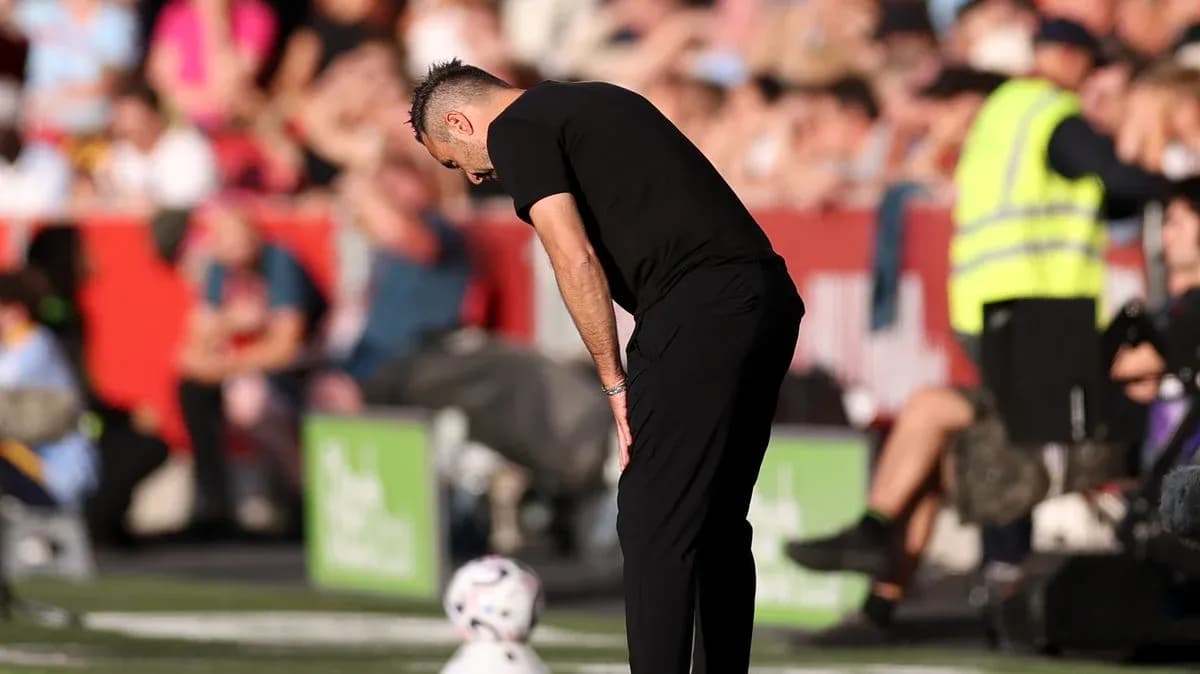
Tottenham’s new era under Roberto De Zerbi began with a jolt. A 3-0 defeat at Brentford, the kind that doesn’t just sting – it exposes.
From the first whistle at the Gtech Community Stadium, Spurs never truly got a grip. Brentford were sharper, stronger, more connected. Tottenham looked exactly what their head coach later called them: a project still in pieces.
A brutal opening day
The tone was set early. In the 12th minute, new Brentford signing Mamadou Sangare drifted into the Spurs box with far too much room. He had time to look up, slide the ball across, and find Keane Lewis-Potter in even more space. One calm side-foot finish, and Tottenham were already chasing.
The second goal was uglier. Richarlison failed to hold the ball up, Lucas Bergvall then lost it cheaply, and Brentford pounced. Mathias Jensen took aim, Antonin Kinsky could only palm his shot out, and Vitaly Janelt was first to the rebound to tap in. Spurs weren’t just being outplayed; they were being outfought.
Any hope of a reset at half-time evaporated almost immediately after the restart. Within four minutes of the second half, it was 3-0. Kinsky again made an initial save, this time from Sangare’s strike through a crowd, but the loose ball fell to Michael Kayode, who crashed it into the roof of the net. Tottenham’s opening day had turned into a full-scale collapse.
It could have been worse. Rodrigo Bentancur brought down Kevin Schade in the box and Brentford had the chance to make it four from the spot. Igor Thiago stepped up, beat Kinsky, but not the woodwork – his penalty smacked the left post and bounced away. A rare reprieve on a day short of positives.
‘We are not a team yet’
Facing the media afterwards, De Zerbi did not hide. He did not sugar-coat, either.
“For many reasons. I think we are not a team yet,” he said when asked why Spurs never managed to control the game. He spoke of fitness, of timing, of a squad still learning each other’s names in competitive fire.
He pointed to a disrupted pre-season, players arriving late after the World Cup, and a long trip to Australia that limited proper work. But he refused to lean on that as an excuse, describing it instead as “the normal situation when you are building a new project, a new process”.
He admitted he already knew they were behind schedule. “After the Hoffenheim game, I said we are not in the right point, we are late for the start of the Premier League,” he said. The performance at Brentford only underlined it.
What angered him most was not just the tactical disarray, but the basics. “We lost too many duels, we made too many mistakes in the timing when we wanted to push the pressure higher. We arrived second for the second ball, we didn't win one second ball, one duel, one tackle,” he said. Against a Brentford side built on aggression and detail, that is fatal.
Youth, risk and the long game
De Zerbi leaned heavily into youth. One player born in 2007, another in 2006. Mikey Moore, Mathys Tel, Archie Gray, Lucas Bergvall – the future of the club scattered across the pitch, learning the hard way.
Bergvall, in particular, stood at the centre of the second goal’s calamity. De Zerbi defended him. “I think he didn't play bad today, even if I substituted in the half-time,” he said. He insisted that in two years’ time, Bergvall would not lose that ball in that moment. This, he argued, is part of the steps needed to become better.
The Italian framed the selection as a conscious decision: build for the future or chase comfort now. “We need also Archie Gray, we need also Lucas Bergvall, or we work for today. And tomorrow, I don't know,” he said. For this project, he chose tomorrow – and took the hit today.
He stressed that the club’s direction remains intact. “I think we are working well as a club, as a project. We need the time, like the big teams have done in the last 10 years,” he said, insisting he would not change his idea after one ugly afternoon.
Soul, style – and a missing identity
De Zerbi has spoken repeatedly about two non‑negotiables for his teams: soul and style of play. Neither appeared in west London.
“To become a team, in my home, there are two big conditions. The soul and the style of play,” he said. “Today, we didn't show the soul, and we didn't show the quality of the play. With the ball and without the ball.”
Until those elements appear, he warned, Tottenham will suffer. He even suggested the defeat might serve as a necessary jolt. “Today, I think it's important for us, this defeat, because maybe we woke up stronger than we thought, maybe.”
The contrast with last season’s settled core was stark. De Zerbi listed the old defensive line – Pedro Porro, Kevin Danso, Micky van de Ven and Destiny Udogie – and compared it to the new one: Archie Gray, JP van Hecke, Marcos Senesi and Andy Robertson. Four changes at the back, two in midfield, a new structure everywhere you look.
Last season’s double pivot of Bentancur and João Palhinha became Bergvall and others. Bentancur, he said, had come back late in pre-season, and the staff had worked with Bergvall instead. From a long-term perspective, De Zerbi felt it was “right to play with Lucas Bergvall” at the start of this new project, even knowing he might suffer more than a 29-year-old Bentancur.
Archie Gray, set-pieces and the search for rhythm
Archie Gray’s role will be central to that rebuild. With Djed Spence gone, the teenager is expected to feature both at full-back and in midfield. De Zerbi backed him firmly despite a difficult day.
“Archie Gray can play as a full-back, as a midfielder. But I think he's much better than his performance today,” he said, before adding that the same applied to JP van Hecke, Sandro Tonali, Richarlison – “everyone”.
He refused to judge any of them on one performance. “We can't change our idea on Archie Gray for today, or for Richarlison or Mathys Tel,” he said.
Set-pieces, once a Tottenham strength, also came under scrutiny. With Cristian Romero and Palhinha gone, Spurs have lost two major aerial presences. De Zerbi, though, pointed straight at the opposition. “Brentford in set-pieces are maybe the best team in the Premier League. So it's normal to suffer,” he said, arguing that the bigger problem lay in open-play duels and second balls rather than dead-ball situations.
Time – and an early test of belief
So how long will this take? De Zerbi did not pretend it would be quick, but he also insisted Tottenham are “much better” than they showed.
“We need time, but I think we are much better than we showed today. So from Wednesday we can show our qualities, and we can show who we are,” he said, looking ahead to the midweek fixture and then Newcastle next weekend.
He warned that even if Spurs win those games, the deeper work will not be finished. “Even if we win Wednesday or next Saturday, we need time to become a team,” he said. That, in his view, demands analysis, understanding and individual improvement across the board. “Because we lose and we win together.”
For now, the table shows zero points and a bruising goal difference. The performance shows a side still searching for its shape, its voice, its leaders.
De Zerbi insists he believes in his players, his club and himself. The question now is whether this young, reshaped Tottenham can find that soul and style quickly enough to keep belief intact when the next test arrives.