US Soccer Triumphs Over Australia 2-0 in World Cup Showdown
Soccer was always going to win here. The arguments over what to call it could wait. On a bright, easy Friday in the Pacific north-west, the game itself took center stage, and the United States made sure the scoreboard did the talking.
A 2-0 victory over Australia in front of 66,925 fans – a full house roaring in red, white and blue – pushed the hosts into the knockout rounds and, depending on how Turkey v Paraguay plays out, might yet deliver top spot in Group D. The performance matched the occasion: tense, physical, and just open enough to keep a football-mad city on edge.
A stage built for stakes
This was never going to be a throwaway group game. Both nations carry the burden of being standard-bearers, forever selling the sport in countries where other games dominate the airwaves and playgrounds. Every World Cup for the US and Australia feels like a referendum on soccer’s place back home.
Seattle understood the assignment. Australia’s supporters, three loud pockets of yellow gathered mostly at the south end, sang and chanted all afternoon. They were outnumbered, not drowned out. But this was a US crowd, in one of the sport’s true American strongholds, and the stadium shook accordingly.
The flyover set the tone. Four military helicopters thundered overhead just as the final notes of the national anthem faded, a perfectly choreographed surge of noise and spectacle that turned up the temperature before a ball had been kicked.
No Pulisic, no problem
The buildup had been dominated by one question: Christian Pulisic or no Christian Pulisic?
The US star limped out at half-time of the World Cup opener with a calf issue and spent the week training apart from the group. Only shortly before kick-off did Mauricio Pochettino confirm what many feared – Pulisic wasn’t available. For a team that often leans on his creativity, it posed a real test of how they would break down a disciplined Australian backline.
Australia, meanwhile, arrived with a little extra edge. Stateside pundits had carelessly branded the Socceroos a “layup,” dismissing a side that had impressed in their first outing. Inside the US camp, the tone was very different. Players and staff talked up Australia’s quality at every turn, almost like a rehearsed line. Respect, yes. But also recognition that Group D leaves no room for arrogance.
Within 60 seconds, that respect looked well placed.
Alex Freeman’s loose pass invited trouble, and Mohamed Touré pounced, driving forward and firing low from a tight angle. Chris Richards held his ground, Matt Freese smothered the shot, and the US survived their early warning.
From there, the hosts settled. They began to control possession, probing both flanks, testing Australia’s shape rather than trying to blow it apart.
Balogun forces the breakthrough
The opener came from the kind of move that Pulisic might usually spearhead. Instead, it was Folarin Balogun doing the damage out wide.
Antonee Robinson fizzed a ball down the left channel, Balogun spun into space and simply beat Jacob Italiano for pace. His driven cross into the six-yard box was pure chaos – and pure misery for Burgess, who could only stab the ball into his own net.
For the second straight match, the US had an early lead via an own goal. Paraguay had folded when placed under that kind of pressure. Australia did not.
Within two minutes, they almost hit back. Touré, battling with his back to goal, laid the ball off as Mathew Leckie tried something audacious, whipping an outside-of-the-boot effort around Richards from the top of the box. It sailed high and wide, but the intent was there.
The physical edge that had been promised in the pre-match comments began to surface. Nishan Velupillay’s heavy challenge on Tyler Adams in front of the US bench fired up the home crowd. Jordan Bos went into the book for a hand to Weston McKennie’s face. Later, Alessandro Circati joined him after clipping Malik Tillman’s heel as the US midfielder burst toward the area. Australia were walking the line, but they were still in the fight.
Freeman’s unlikely moment
The game’s pivotal sequence arrived just before half-time, from a passage that summed up the US’s commitment to the scrap.
Tillman refused to let a ball run out near the Australian endline, wrestling with Velupillay and eventually earning a dangerous free-kick. Robinson rolled it to the top of the box, where Sergiño Dest stepped in and let fly. Harry Souttar hurled himself at the shot, the ball cannoned off him, and suddenly it was chaos again.
Freeman reacted first.
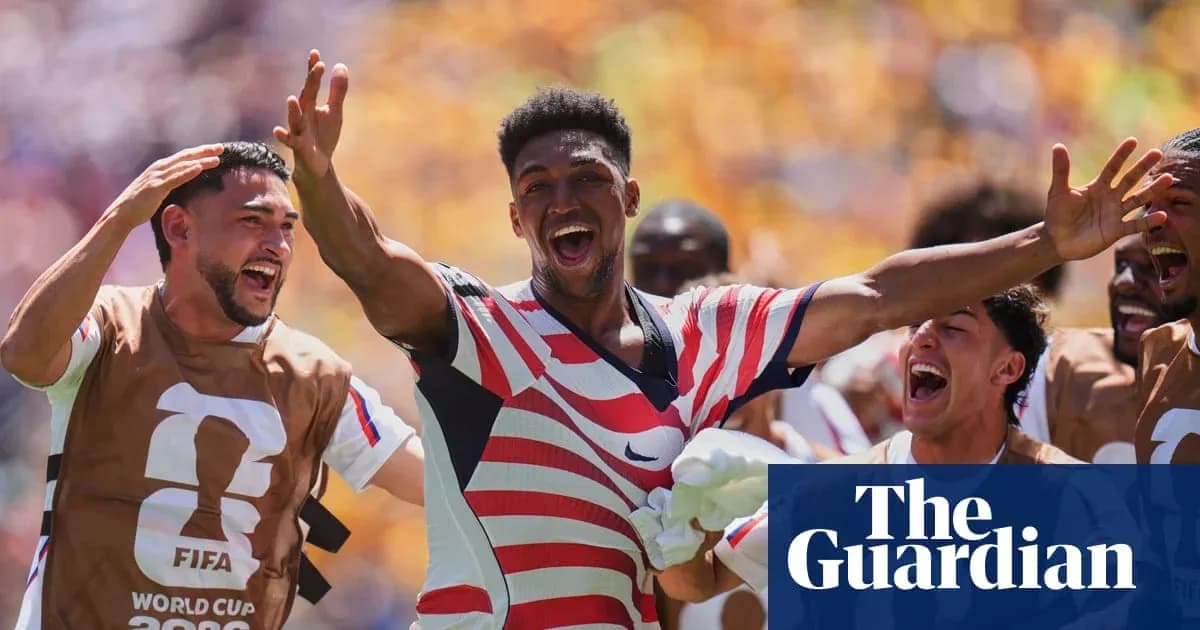
The defender, still shaking off the effects of a clash of heads minutes earlier with Paul Okon-Engstler, bundled the rebound over the line. The flag went up. The VAR check dragged on. The goal stood.
By the time the decision was confirmed, Freeman had already sprinted almost the length of the pitch, celebrating at the opposite end, engulfed by teammates streaming from the bench. A center-back, a bandaged head, a poacher’s finish – it was that kind of night.
At 2-0, with half-time looming, the US had control. Australia had a problem.
Popovic rolls the dice
Tony Popovic came out for the second half having seen enough. He tore into his bench and his tactics.
Jason Geria replaced Burgess. The previous match’s heroes, Nestory Irankunda and Connor Metcalfe, came on for Touré and Velupillay. On paper, it was a shift toward a more aggressive 4-3-3 in possession, snapping back into a five-man line without the ball.
The risks were obvious, and the US almost exploited them immediately.
Seven minutes after the restart, McKennie seized on a loose ball and threaded Balogun through, leaving only Souttar in chase. The forward drove at goal, shot, and saw his effort blocked, but the message was clear: Australia were now living dangerously.
They did, though, start to carve out chances of their own. Robinson picked up the US’s first yellow card on 56 minutes, forced into a tactical foul as Australia surged down his flank.
Just after the hour, Cristian Volpato entered for Leckie and almost made an instant impact. Irankunda tore down the right, cut the ball back, and Volpato, arriving in stride, lashed over from inside the box. Moments later, Metcalfe saw another effort smothered comfortably by Freese.
Popovic kept doubling down, sending on Jackson Irvine for Okon-Engstler to add more drive from midfield. Pochettino responded in the opposite direction, tightening the screws: Robinson, Dest and Ricardo Pepi made way for Sebastian Berhalter, Auston Trusty and Joe Scally, a clear tilt toward game management.
Hanging on, standing firm
The reshaped contest suited Australia. With fresh legs and more attacking intent, they began to pin the US back, forcing hurried clearances and ragged defensive headers.
Circati threatened, others went close, and the match started to fray. Tackles bit harder. Tempers shortened. The crowd, sensing the tension, roared “USA” in rolling waves as the minutes ticked away.
Yellow cards piled up late – Souttar, Balogun and Italiano all booked in the closing stages for incidents on and off the ball. The game never tipped into chaos, but it flirted with it.
Even the referee wasn’t spared. Felix Zwayer picked up an odd injury that briefly paused proceedings before he carried on to finish the match, another strange wrinkle in a night that had already seen its share of drama.
When the final whistle finally came, it was met with relief as much as celebration. Balogun, reading the moment, turned to the stands and windmilled his arms, inviting the crowd to turn the anxiety into a party. They obliged.
For one evening, at least, this corner of the Pacific north-west lived up to its unofficial title: Soccer City, USA. The hosts are through, the doubts over life without Pulisic eased, and Group D suddenly looks like a platform rather than a minefield. The question now is simple – how far can this team push it from here?