Africa's Champion Waits: The Controversial CAF Final Saga
Seventy-seven days after the final whistle, Africa is still waiting for a champion.
What should have been a showcase final has instead unravelled into one of the most contentious sagas in recent CAF history, a tangle of grievances that began long before a ball was kicked in Rabat.
A Final Tainted Before Kick-Off
According to Spanish newspaper AS, Senegal’s sense of injustice started the moment their delegation landed in Morocco.
The “Lions of Teranga” arrived expecting top-tier conditions and found the ground shifting under their feet. Initially booked into a luxury hotel in Tangier, they were abruptly moved to the Al-Rihab complex, a venue that did not even appear on CAF’s official list of approved accommodation.
Senegal protested. Officially. Loudly.
CAF responded with a compromise: the Amfitrit Hotel on the outskirts of Rabat. It was an upgrade on Al-Rihab, but it did not calm Senegalese anger. For them, the damage was done. They felt downgraded, sidelined, treated as an afterthought on the continent’s biggest stage.
The tension deepened when training arrangements were confirmed. Senegal were assigned the Mohammed VI Sports Complex, the same facility used by the Moroccan national team as their regular training base. On paper, a world-class venue. In reality, a political minefield.
From Dakar’s perspective, the principle of equal opportunity had been shredded. They feared their sessions could be monitored, their tactical plans exposed. Even the grass seemed to carry a question: who really holds the advantage here?
Security, Tickets, and Open Accusations
By the time the squad reached Rabat, frustration had hardened into suspicion.
Senegal complained of chaotic organisation on arrival, pointing to security issues and what they described as an “unfair distribution” of match tickets. Their supporters, they argued, were being squeezed out of a final that should have belonged to the whole continent.
Hours before kick-off, Senegal went public. They warned of “irregularities”, a loaded word on the eve of a showpiece match. The final had not started, yet the trust between the parties was already broken.
Then came the night at Moulay Abdallah Stadium.
Chaos Under the Floodlights
The match itself dissolved into a storm.
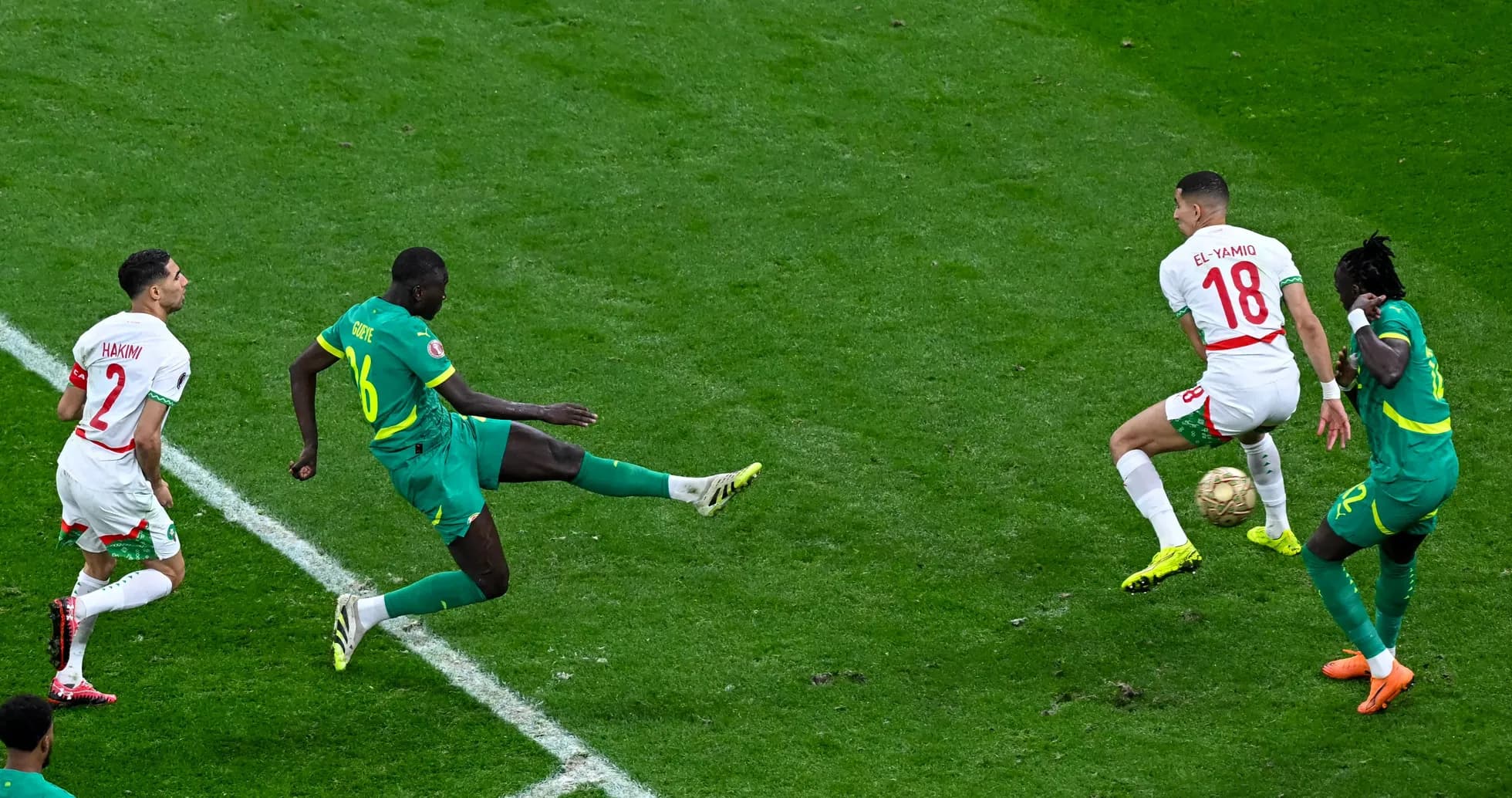
A controversial Senegalese goal was ruled out, igniting anger on the touchline and in the stands. Soon after, Morocco were awarded a penalty that triggered furious protests from the Senegalese camp. The sense of persecution, already simmering, boiled over.
The Senegal players made a drastic choice: they walked off. Not one or two, but the entire squad, leaving the pitch en masse in protest at what they called “blatant refereeing injustice”. It was a statement as much as a refusal, a team deciding it would no longer play under conditions it deemed rigged.
When play resumed, the drama only intensified. Ibrahim Diaz stepped up and tried a Panenka-style penalty, a bold, almost mocking gesture in such a volatile context. He missed.
Senegal held their nerve, regrouped, and struck in extra time. They kept a clean sheet and, on the grass, won the final.
On the scoreboard, in that moment, there was no doubt. On the continent, the arguments were just beginning.
A Title Won, Lost, and Frozen
Morocco saw the walk-off very differently.
For them, Senegal’s collective departure from the field constituted an official withdrawal. Under that interpretation, the outcome was simple: a 3-0 defeat for Senegal by forfeit. CAF initially backed that view, recording a 3-0 win for Morocco.
Senegal refused to accept it. They insisted they had settled the matter where it should be settled – on the pitch, in extra time, with the ball in the net and their goal untouched.
The case went to the Court of Arbitration for Sport (CAS). After appeal, CAS overturned CAF’s initial decision, blowing open a legal and political battle at the top of African football.
What should be a line in the record books remains a blank space.
Inside CAF: “Institutional Instructions” and Internal Shock
The dispute did not stop with ticketing rows or walk-offs. It cut into the heart of CAF’s credibility.
AS reported explosive details from a CAF Executive Committee meeting in Dar es Salaam on 13 February. During that meeting, the head of the Referees’ Committee, Olivier Safary, made an admission that sent shockwaves through the room.
Safary stated that the referee had received “institutional instructions” not to send off Senegalese players during the suspension of the match, so that the game could continue.
One sentence, enormous consequences.
The idea that a referee could be guided by anything other than the Laws of the Game – especially in a continental final – opened the door to accusations of interference in refereeing decisions at the highest level. Inside CAF, the revelation stirred controversy. Outside, it fed the narrative that the final had been managed, not merely officiated.
In a contest already poisoned by mistrust, this was gasoline on the fire.
A “Disastrous” Day in Court
The legal front has been no less fraught.
At a press conference in Paris on 26 March, lawyers representing the Senegalese Football Federation did not hold back in their assessment of the appeal hearing before CAS. They called it “disastrous”, claiming the judge appeared to have reached a conclusion before the arguments were even laid out.
Senegal then went further, challenging the composition of CAF’s own Appeals Committee. Their focus fell on lawyer Moez Nasri, who also serves as president of the Tunisian Football Federation.
For Senegal, his dual role represented a “clear conflict between his role as a judge and that of a party to the competition”. The complaint carried enough weight that even CAF President Patrice Motsepe, according to the reports, expressed surprise at Nasri’s presence on the committee.
When the president of the confederation questions who is sitting in judgment, the integrity of the entire process comes under the microscope.
A Continent Without a Champion
And so, the stand-off drags on.
Seventy-seven days after the final whistle, Africa has no official champion. Senegal insists it won where it matters most, under the stadium lights, in extra time, with a clean sheet and a trophy seemingly within reach. Morocco holds to the letter of the law as it interprets it, convinced that the walk-off turned the final into a 3-0 victory by default.
CAF stands in the middle, accused by both sides of “mismanagement” and a “lack of transparency”, its authority chipped away with every new revelation, every leaked detail, every unanswered question.
The trophy waits. The record books wait.
How long can a continent live with a final that produced a winner on the pitch, a loser on paper, and a title that officially belongs to no one?