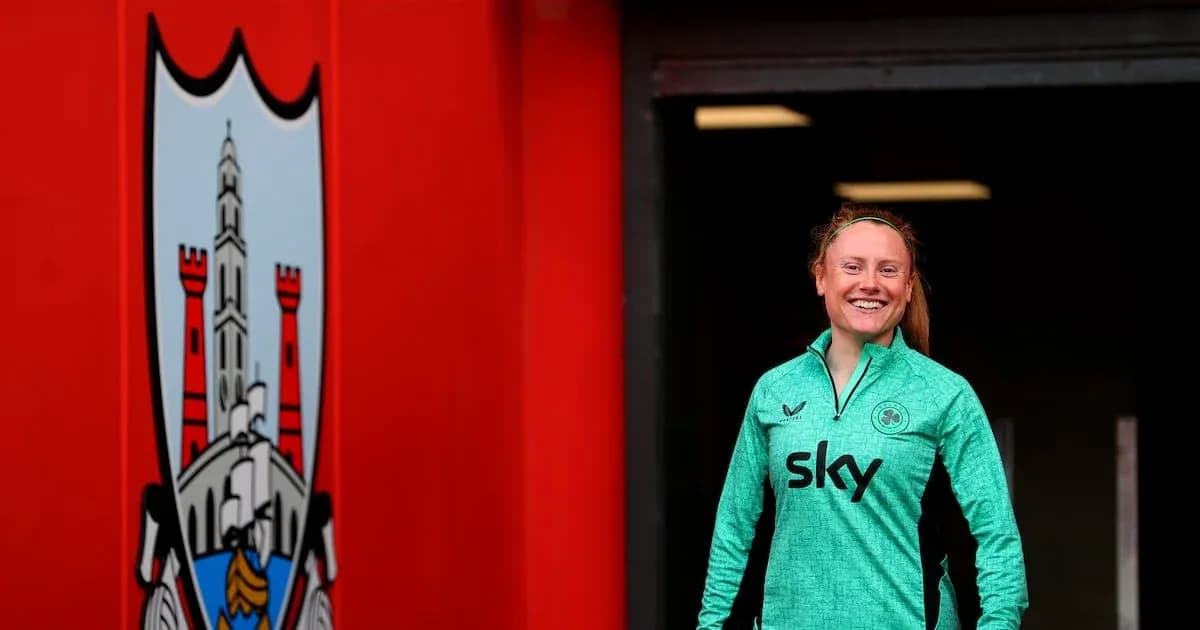
Amber Barrett: A Chance to Break the Super-Sub Spell
Amber Barrett has spent years living with a label. Super-sub. Impact player. The striker who appears when the game is stretched and the stakes are high.
It was inevitable once she wrote herself into Irish football history with that winner against Scotland at Hampden Park, the goal that dragged the Republic of Ireland to a first World Cup. The tag stuck. The starting place did not.
On Friday night in Páirc Uí Chaoimh, with Denise O’Sullivan and Emily Murphy suspended for the World Cup qualifier against the Netherlands, the door creaks open again. Carla Ward has to reshuffle. Barrett is right there, hand up.
A chance to break the “super-sub” spell
“The ‘super-sub’ label has kind of been hanging over my head for a long time now,” she said, and it’s hard to argue. Her last competitive start for Ireland came in May of last year, away to Turkey in the Nations League. Since then, she has watched the anthems from the bench, waiting, staying warm, staying patient.
Abbie Larkin looks the obvious replacement for Murphy, the teenager who has become a livewire option in attack. Saoirse Noonan, fresh from another prolific season with Celtic, is also hammering on the door.
Barrett, though, arrives into camp with something different: form from France and the feeling that her game has gone up a notch. After moving to RC Strasbourg in January, she hit five goals in six starts in the French Première Ligue. That kind of return travels well in a manager’s mind.
She knows the narrative that follows her. She also knows she cannot afford to be consumed by it.
“Sometimes I think I’m a wee bit unlucky not to get the nod,” she admitted. “But I’m also the type of person that if it’s not a starting position I get, I have to be ready to come on at any stage.
“It’s no good for anyone if I’m running around with a miserable face on me, because at the end of the day it’s not about me, it’s about everyone. When you carry yourself in that light, the opportunities come – and I never have any doubt that I’m ready to go when they do.”
That mindset has kept her relevant. Her passport has done the rest.
Have boots, will travel
While 21 of Ward’s 25-strong squad are based in England or Scotland, Barrett has taken the long way round Europe. From Peamount United to FC Köln, on to Turbine Potsdam, then Standard Liège and now Strasbourg, she has built a career on curiosity and a willingness to uproot.
She sounds almost evangelical about it.
“I don’t know what it is about being away from home and being in different countries, but I’ve just really loved that new-culture aspect and the different types of football I’ve played in Germany, Belgium and now France,” she said.
“And the football in each country is so diverse, it’s something that I feel has really, really helped shape my game in a positive way. Working with different coaches, different expectations, learning new languages, it’s something I’ve really enjoyed. And as much as I love playing football, life is too short to be stuck in one box all the time – so I’ve really enjoyed that aspect of it as well.”
She laughs about her schooldays, when languages were not exactly her strong suit. That changed the moment she left Ireland.
Now? “I speak French with a Donegal accent.”
It has been more than enough to connect with her Strasbourg teammates and help steer the club to seventh place in a 12-team league – a solid return for a side that only reached the French top flight two years ago.
France, and a higher bar
The move from Liège midway through the season was not simple. New city, new league, new dressing room. New standard.
“It’s been brilliant for me and definitely I think it has lifted my standards and put me at another level,” Barrett said. “It’s not easy moving halfway through the season, moving to a new country, leaving behind something you have known for the last 2½ years. I was very grateful to Liège for everything they did for me, but I think the time to move on was right.
“The quality of the players in the French league is much higher than what I was used to, so probably for the first couple of weeks I was at the adapting stage. But then I found my feet and as soon as the first goal went in, my confidence was up.”
That first goal changed everything. The runs became sharper, the touches cleaner, the belief louder. Five goals later, she arrives back into Ireland camp with hard evidence that she can thrive at a higher tempo.
Now comes the question that has hovered over her international career for years: is that enough to convince Ward that Barrett is more than a late-game weapon?
With O’Sullivan and Murphy out, Ireland need solutions, not stories. Barrett has spent four years living off one of the greatest Irish stories of all. Páirc Uí Chaoimh offers her a chance to write a new chapter – from the first whistle, not the last.