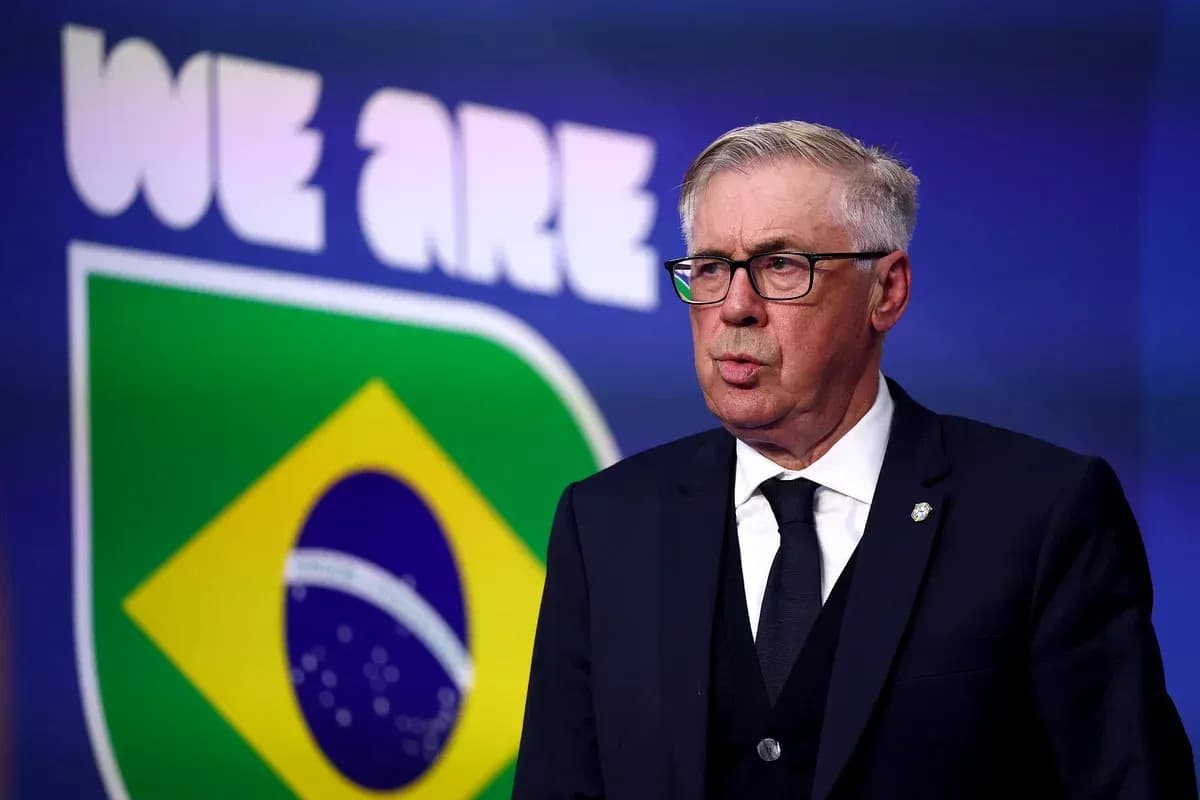
Carlo Ancelotti Prioritizes Brazil Over Italy's Azzurri
Carlo Ancelotti has never been short of suitors, but this time the answer was firm and simple: Brazil comes first.
Speaking to ESPN, the Brazil head coach addressed for the first time Italy’s recent attempt to lure him back to the Azzurri bench, an approach driven by former FIGC technical director Paolo Maldini. The response, Ancelotti stressed, had nothing to do with money or clauses.
“It’s not a contract issue; that’s not the reason,” he said. “It’s because I have a commitment to the CBF and to this country, because this country has welcomed me so warmly during this first year. I want to stay here.”
No hesitation. No ambiguity. A coach who has seen everything in the game made it clear that loyalty, not leverage, dictated his choice.
Ancelotti chooses Brazil over a romantic return
Ancelotti was only appointed Brazil head coach a year ago, then signed a contract extension that runs to 2030 before the start of the World Cup. For a 65-year-old with a medal collection that spans Europe’s elite, it is a long-term bet on one national project.
Italy came calling all the same.
Maldini, then Italy’s technical director, sounded out both Ancelotti and Pep Guardiola about taking over the Azzurri. It was an audacious plan: two of the defining coaches of the modern era, both with deep ties to Italian football, both capable of reshaping a national side in their own image.
The romantic storyline wrote itself with Ancelotti. He is a former Italy international, a Milan icon, and a man who shared a dressing room and a dugout with Maldini in one of the greatest club sides in history. Together at Milan, they lifted multiple trophies, including two UEFA Champions League titles. Few partnerships in football carry that kind of weight.
Yet when Maldini called, Ancelotti’s answer was a polite refusal.
“I thanked the Italian Federation, of course,” he explained, “but I want to stay here because I believe it’s right and fair to remain in a country that has welcomed me so warmly, at an institution that has given me the opportunity to work.”
The message was unmistakable: Brazil offered him trust and time, and he intends to honour that.
Chaos in Italy, clarity in Brazil
While Ancelotti spoke with clarity about his future, Italy’s bench became a carousel.
After failing to land either Ancelotti or Guardiola, Maldini turned to Andrea Pirlo, another former teammate and a World Cup winner. The idea seemed bold but logical: a young coach with a stellar playing career and a clear footballing identity.
Then politics and optics crashed into the plan.
FIGC President Giovanni Malagò refused to confirm Pirlo’s appointment, officially citing the former midfielder’s links with a Russian betting company. What looked like a done deal suddenly stalled, leaving Italy without a clear direction and Pirlo in limbo.
The fallout was swift. Maldini resigned from his role, stepping down alongside his advisor Leonardo. The man who had tried to bring Italy a marquee coach – and then a modern, stylish alternative – walked away from the project entirely.
Malagò moved quickly after that. Roberto Mancini was chosen as Italy’s new head coach, with Claudio Ranieri installed as technical director. Two experienced, pragmatic figures tasked with steadying a ship that had lurched from big ideas to boardroom turbulence in a matter of weeks.
A coach defined by loyalty
Against that backdrop, Ancelotti’s stance stands out even more. He had every reason to be tempted: a return to the national team of his homeland, the chance to lead Italy at a major tournament, the pull of history with Maldini. Instead, he anchored himself to Brazil.
The images tell their own story. Maldini, sharply dressed, watching from the stands at Empoli’s Stadio Carlo Castellani in 2022, still a central figure at AC Milan. Ancelotti on the touchline in Philadelphia in June 2026, Brazil tracksuit on, eyes fixed on a World Cup group game against Haiti. Two eras, two roles, one shared past – now firmly on different paths.
For Italy, the question is whether turning the page with Mancini and Ranieri can restore stability after a chaotic search for a head coach.
For Brazil, the equation is simpler. They have Carlo Ancelotti, tied down until 2030, publicly committed and emotionally invested.
The next World Cup cycle will show whether that loyalty becomes the foundation of something lasting – or the biggest gamble of his storied career.