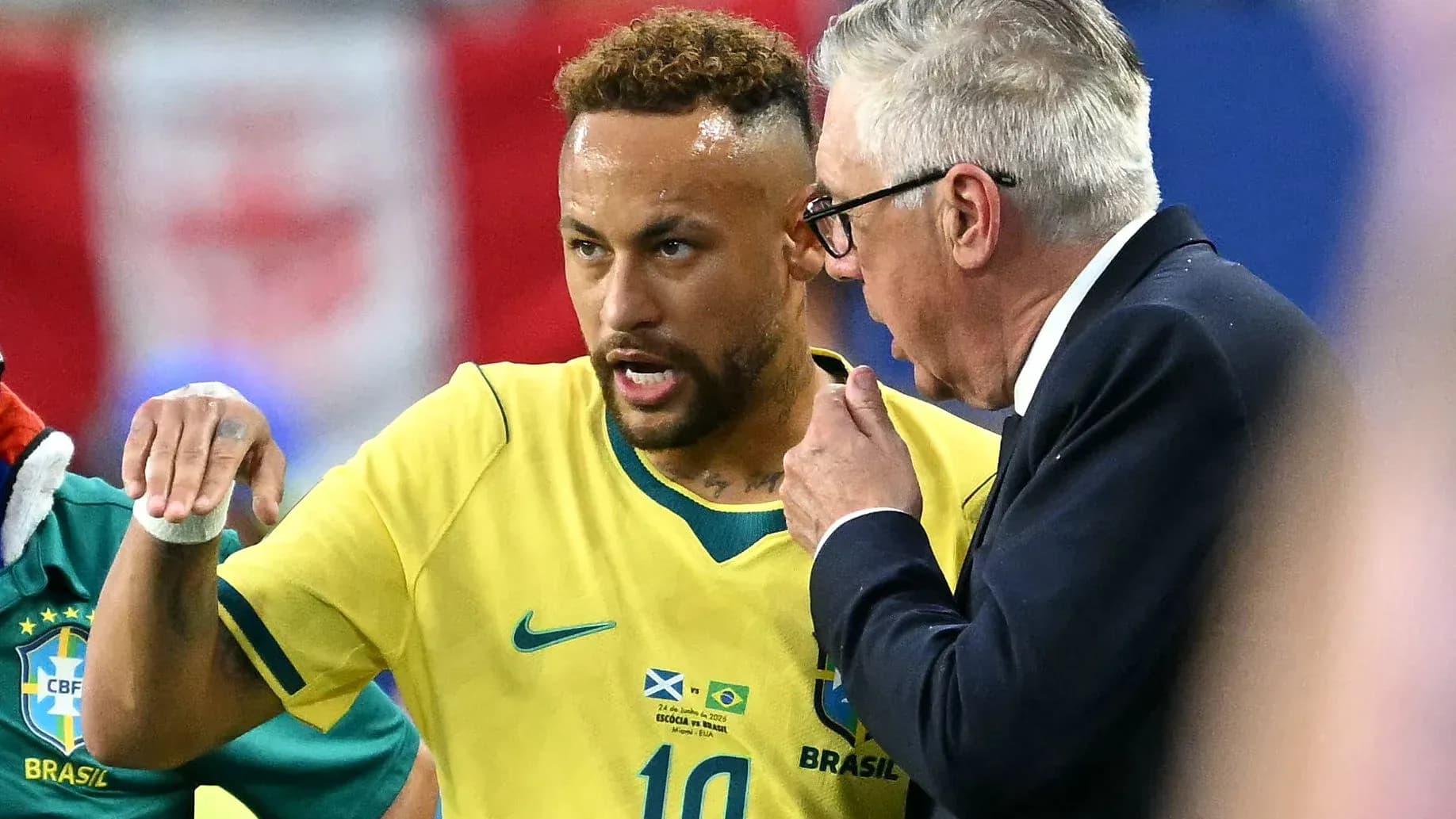
Ancelotti's Reflection on Neymar and Brazil's Transition
Carlo Ancelotti does not often show frustration in public. When he does, the target usually knows exactly why.
This time, it was Neymar.
The Italian coach, reflecting on Brazil’s campaign and the forward’s muted role in it, drew a clear line between admiration for the player and disappointment in his preparation. Neymar arrived short of sharpness, carrying a grade 2 calf strain that ruled him out of the opening group games against Morocco and Haiti. By the time he was fit enough to play, the tournament had already moved on without him.
“I think he didn’t contribute on a technical level as it was hoped he could, because he couldn’t,” Ancelotti told ESPN.
The words were sympathetic, but not soft. The coach immediately separated Neymar the player from Neymar the professional. “In terms of attitude, it was a very positive attitude. I have a lot of affection for him, I thanked him for his attitude, for his behavior, and I think it was the right decision to include him on the 26-man roster.”
So the mindset was right. The body was not.
That is where Ancelotti’s patience thinned. The calf strain was one thing; the build-up to the tournament was another. “The only thing that bothered me is that Neymar could have prepared himself better during that lead-up period,” he added. “He could have been ready for game one instead of game four. That was the only disappointing part.”
For a coach obsessed with detail and timing, those four games matter. In international football, you rarely get a second chance to play your way into form.
Now, with Brazil’s iconic No. 10 stepping away from the stage, Ancelotti is not just managing a transition. He is ripping up the old script. The plan is nothing less than a full program rebuild aimed squarely at the 2030 World Cup, a shift that signals the end of a decade-long dependency on the stars of the 2010s.
This is not just about Neymar. It is about an era.
“I think that players like Neymar, who already commented yesterday, and with all due respect to his decision. I believe that in history, one generation ends and another has to come, and it has to be better than the last one,” the former Real Madrid boss said.
That line is the crux of it. For years, Brazil leaned on familiar names, banking on their experience, their aura, their history in the yellow shirt. Ancelotti is now publicly acknowledging that the cycle is closing. The emotional ties remain; the sporting logic has changed.
And the clear-out will not stop with the No. 10.
When asked about the futures of Casemiro, Danilo, and Alex Sandro, Ancelotti did not hide behind platitudes or vague timelines. He spoke like a man already mapping out a different spine for his team.
“I think so. It is a period that is coming to an end,” he admitted. “Obviously, we have to thank all of them, and I have a lot of affection for all of them. But I think the idea that a player over 30 is done means that we have to think about the future.... Some of these players will be there, obviously. Marquinhos, for example. Alisson, we’ll see.”
The message is blunt: respect for what they gave, realism about what comes next.
Marquinhos is earmarked as a bridge between generations, a leader to carry the new group into the next cycle. Alisson’s place is less certain, a reminder that even established pillars are under review. No one is guaranteed anything, not anymore.
Brazil have been here before, standing at the edge of a generational handover, trying to balance nostalgia with necessity. This time, Ancelotti is making the cut himself. The affection is real. So is the ruthlessness.
The Neymar era is closing. The question now is whether the next wave can truly be, as Ancelotti demands, better than the last.