Arsenal Dominates Bayer Leverkusen in Champions League Clash
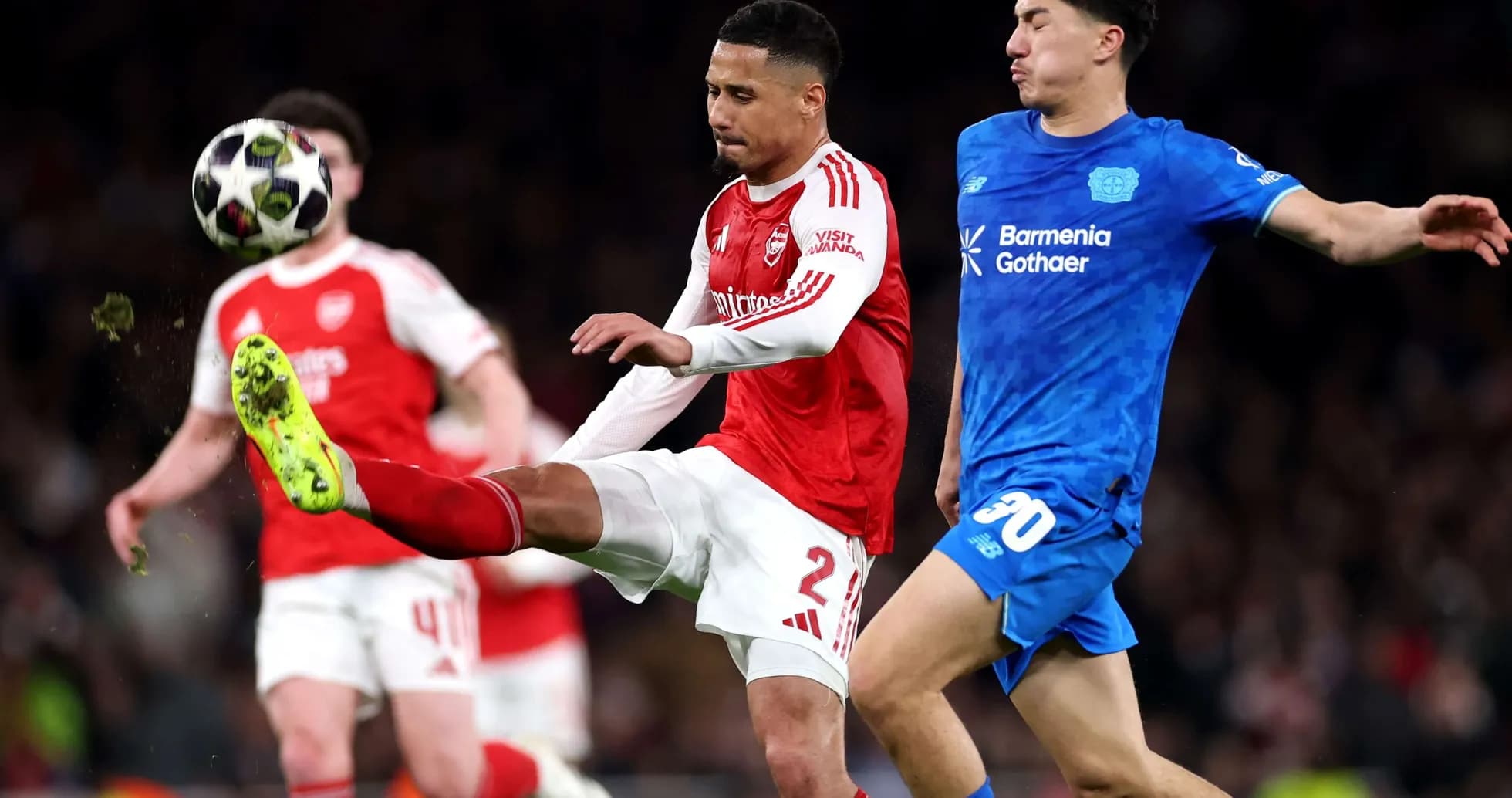
Emirates Stadium hosted this UEFA Champions League 1/8 final second leg between Arsenal and Bayer Leverkusen, with D. Makkelie in charge and kickoff at 20:00 UTC. Arsenal, ranked 1st in the competition standings with 24 points, won 2–0 in regular time, adding another clean sheet to a dominant European campaign. Bayer Leverkusen came in ranked 16th on 12 points and left London without scoring.
Squad framework and tactical shapes
Arsenal – 4-2-3-1 base
Arsenal lined up in a 4-2-3-1, consistent with one of their two main shapes overall this season (4-3-3 used 7 times, 4-2-3-1 used 3 times):
- Goalkeeper
- David Raya (1)
- Back four
- Right-back: Ben White (4)
- Right centre-back: William Saliba (2)
- Left centre-back: Gabriel Magalhães (6)
- Left-back: Piero Hincapié (5)
- Double pivot
- Declan Rice (41)
- Martín Zubimendi (36)
- Attacking midfield line
- Right: Bukayo Saka (7)
- Central: Eberechi Eze (10)
- Left: Leandro Trossard (19)
- Centre-forward
- Viktor Gyökeres (14)
Bench options gave Arsenal strong depth across all lines:
- Goalkeepers: Kepa Arrizabalaga (13), Khari Ranson (79)
- Defenders: Cristhian Mosquera (3), Myles Lewis-Skelly (49), Riccardo Calafiori (33)
- Midfielders: Christian Nørgaard (16), Max Dowman (56)
- Forwards: Gabriel Martinelli (11), Kai Havertz (29), Noni Madueke (20), Gabriel Jesus (9)
This structure matches Arsenal’s broader Champions League profile: 10 games overall this season, unbeaten (9 wins, 1 draw, 0 losses), with 26 goals scored and only 5 conceded. Their defensive line, anchored by Saliba and Gabriel with full-backs White and Hincapié, underpins an elite defensive record of 0.5 goals against per game overall this season.
The double pivot of Rice and Zubimendi provides both protection and progression, while the 3 behind Gyökeres (Saka–Eze–Trossard) are set up to overload half-spaces and wide channels.
Bayer Leverkusen – 3-4-2-1 structure
Bayer Leverkusen stayed loyal to their main European system: 3-4-2-1, used 11 times overall this season (with a one-off 5-3-2):
- Goalkeeper
- Janis Blaswich (28)
- Back three
- Right centre-back: Jarell Quansah (4)
- Central centre-back: Robert Andrich (8)
- Left centre-back: Edmond Tapsoba (12)
- Wing-backs / wide midfielders
- Right: Ernest Poku (19)
- Left: Alejandro Grimaldo (20)
- Central midfield
- Exequiel Palacios (25)
- Aleix García (24)
- Two attacking midfielders / second forwards
- Martin Terrier (11)
- Ibrahim Maza (30)
- Centre-forward
- Christian Kofane (35)
Bench options:
- Goalkeepers: Jonas Omlin (18), Niklas Lomb (36)
- Defenders: Tim Oermann (15), Axel Tape (16)
- Midfielders: Malik Tillman (10), Montrell Culbreath (42), Ezequiel Fernández (6), Jonas Hofmann (7)
- Forward: Patrik Schick (14)
The 3-4-2-1 is designed to create central overloads against a 4-2-3-1, but Leverkusen’s overall season numbers show a side that can be opened up: 16 goals for and 17 against in 12 Champions League games overall this season (1.3 scored vs 1.4 conceded per game). Their back three, with Andrich as a converted centre-back and also the competition’s top red-card recipient, is more functional than dominant.
Overall season profiles (competition-wide)
Arsenal – elite balance
Using team season statistics as the primary reference, Arsenal’s overall 2025 Champions League campaign before and including this tie looks like:
- Games overall this season: 10
- Wins: 9
- Draws: 1
- Losses: 0
- Goals overall this season:
- For: 26 (2.6 per game)
- Against: 5 (0.5 per game)
- Home vs away (overall this season):
- Home: 5 played, 5 wins, 14 scored, 3 conceded
- Away: 5 played, 4 wins, 1 draw, 12 scored, 2 conceded
- Clean sheets overall this season: 6
- Failed to score overall this season: 0
From the standings snapshot (8 games at that point), Arsenal were already on 24 points, with 23 goals for and 4 against, ranked 1st. The updated season stats confirm the trend: they have extended both their attacking and defensive output since that stage.
Discipline-wise overall this season:
- Yellow cards: spread across all phases, but heavily between 61–75 minutes (33.33% of their yellows).
- No red cards recorded in the competition.
Arsenal also have a flawless penalty record overall this season: 2 penalties taken, 2 scored, 0 missed – correctly described as 2 successful penalties with 100.00% conversion and no misses.
Bayer Leverkusen – competitive but porous
Leverkusen’s overall Champions League season profile:
- Games overall this season: 12
- Wins: 4
- Draws: 5
- Losses: 3
- Goals overall this season:
- For: 16 (1.3 per game)
- Against: 17 (1.4 per game)
- Home vs away (overall this season):
- Home: 6 played, 1 win, 4 draws, 1 loss, 9 scored, 11 conceded
- Away: 6 played, 3 wins, 1 draw, 2 losses, 7 scored, 6 conceded
- Clean sheets overall this season: 5
- Failed to score overall this season: 3
From the standings at 8 games, they had 13 for and 14 against; the season stats show they have since added both goals scored and conceded, reinforcing the picture of a team that trades chances.
Discipline overall this season:
- Yellow cards: most concentrated between 46–60 minutes (38.89% of yellows).
- Red cards: 1 red in the 31–45 minute window – this is Robert Andrich, who tops the red-card chart in the competition with 1 red and 1 yellow.
They have 1 penalty overall this season, which they converted (1 successful penalty, 0 missed).
Key absences and “Battle 3 – The Void”
Several important players were unavailable, reshaping both squads.
Arsenal absentees
- M. Merino – Missing Fixture (Leg Injury)
- M. Odegaard – Missing Fixture (Knee Injury)
- J. Timber – Missing Fixture (Injury)
The data does not provide specific season outputs for Merino or Odegaard, but structurally:
- Odegaard’s absence removes a high-volume creative midfielder. Eberechi Eze stepped into the central attacking midfield slot, with Arsenal relying more on the wide creativity of Saka and Trossard and the all-round forward play of Gyökeres and the bench options (Havertz, Martinelli, Jesus).
- Merino’s absence meant Zubimendi and Rice formed the double pivot. Given Zubimendi’s overall season numbers (see below), Arsenal actually retained a strong control-and-protect profile in midfield.
- Timber’s absence limited rotation in the back line, but with Saliba, Gabriel, White and Hincapié starting, the core defensive strength remained intact.
Battle 3 – The Void (Arsenal): Odegaard’s usual creative output (not numerically detailed here) is effectively replaced by Eze’s dribbling and between-the-lines threat, while Zubimendi, a top yellow-card holder, anchors the midfield. The replacement dynamic is less about raw output and more about stylistic shift: more direct ball-carrying and wide combinations, fewer classic No.10 patterns.
Bayer Leverkusen absentees
- Arthur – Missing Fixture (Ankle Injury)
- L. Bade – Missing Fixture (Muscle Injury)
- E. Ben Seghir – Missing Fixture (Ankle Injury)
- M. Flekken – Missing Fixture (Knee Injury)
- Lucas – Missing Fixture (Calf Injury)
- N. Tella – Missing Fixture (Inactive)
- I. Traore – Missing Fixture (Inactive)
Again, without individual season stat lines for these players, the main impact is structural:
- Defensive and goalkeeping depth is hit (Flekken, Bade, Arthur, Lucas), forcing Leverkusen to lean on Blaswich in goal and a back three with Andrich, Quansah and Tapsoba.
- Wide and attacking rotation is reduced (Tella, Ben Seghir, Traore), which increases the burden on Grimaldo, Terrier and Maza to create and on Kofane and Schick to finish.
Battle 3 – The Void (Leverkusen): With several defenders and a first-choice goalkeeper missing, Leverkusen’s replacement backbone (Blaswich behind a back three including Andrich) is statistically less convincing than Arsenal’s replacement structure. This is reflected in their 17 goals conceded overall this season, compared to Arsenal’s 5.
Individual matchups
Battle 1 – Top scorer vs opponent defensive record
The competition’s top scorer in this dataset is:
- Gabriel Martinelli (Arsenal) – 6 goals, 1 assist in the Champions League
- 9 appearances, 5 starts, 493 minutes
- 15 shots (7 on target)
- 14 key passes, 81% pass accuracy
- 31 dribbles attempted, 16 successful
- 1 yellow card
He started on the bench in this match but remains Arsenal’s main scoring reference overall this season in Europe.
Versus Bayer Leverkusen’s defensive record overall this season:
- Goals against overall this season: 17 in 12 games (1.4 per game)
- Biggest defeat: 2–7 at home
- Away goals against: 6 in 6 games (1.0 per game)
This sets up a clear statistical edge for Arsenal’s attacking unit:
- Martinelli’s 6 goals overall this season in the competition come against a defence that concedes more than once per game on average.
- Even when Martinelli does not start, Arsenal’s attacking depth (Gyökeres, Saka, Trossard, Eze, plus Havertz, Jesus, Madueke from the bench) stretches a back three that has already shipped 17 overall this season.
On the other side, Leverkusen do not present a top-scorer candidate in the provided data, underlining Arsenal’s superiority in individual goal threat.
Battle 2 – Playmaker vs Enforcer
With no top-assists table available, we use the provided individual data:
Playmaker – Martín Zubimendi (Arsenal)
- 8 appearances, all starts, 681 minutes
- 457 passes, 13 key passes, 86% accuracy
- 8 tackles, 4 blocks, 7 interceptions
- 70 duels, 33 won
- 4 yellow cards overall this season in the Champions League
- 2 assists, 0 goals
Zubimendi is both a deep playmaker and a midfield controller, combining high passing volume and accuracy with ball-winning and positional discipline. He is also Arsenal’s top yellow-card holder in the competition, which speaks to his role in breaking up play.
Enforcer – Robert Andrich (Bayer Leverkusen)
- 9 appearances, all starts, 744 minutes
- 495 passes, 1 key pass, 88% accuracy
- 5 shots, 2 on target, 1 goal
- 2 tackles, 3 blocks, 11 interceptions
- 32 duels, 16 won
- Cards overall this season: 1 yellow, 1 red
Andrich leads the red-card chart in the competition and has been redeployed as a central defender in this 3-4-2-1. His numbers suggest a solid passer with good interception reading, but relatively low tackle volume and duel count for someone in such a critical defensive role.
Head-to-head dynamic:
- Zubimendi’s 13 key passes and 2 assists overall this season show that he can break lines from deep and connect Arsenal’s structure.
- Andrich’s 1 key pass and 1 goal point to a more limited creative role, with his main impact in distribution and positioning.
- Discipline-wise, Zubimendi carries more yellow cards (4) but no reds, while Andrich has already been sent off once. In a high-stakes 1/8 final, Arsenal’s deep playmaker looks more reliable in maintaining numbers on the pitch.
If we broaden Battle 2 to team-level control:
- Arsenal’s possession and pass accuracy are not numerically given, but their 9 wins and 1 draw, plus 26–5 goal difference overall this season, strongly imply territorial and technical dominance.
- Leverkusen’s 4 wins, 5 draws, 3 losses and negative goal difference (16–17) show a side that struggles to consistently control games at this level.
Disciplinary balance
To maintain balance when discussing cards:
- Arsenal overall this season:
- Yellow cards: spread across the match, with a notable spike between 61–75 minutes (7 yellows, 33.33%).
- Red cards: none recorded in the competition.
- Bayer Leverkusen overall this season:
- Yellow cards: 18 overall (sum of the ranges), with the heaviest concentration between 46–60 minutes (7 yellows, 38.89%).
- Red cards: 1, in the 31–45 minute window – attributed to Robert Andrich, the competition’s top red-card holder.
This underlines that while Arsenal can be aggressive in the final third of games, Leverkusen are more prone to serious disciplinary incidents, especially through Andrich.
Squad depth and substitution vectors
The raw data does not list minute-by-minute substitutions for this specific fixture, so we cannot detail exact substitution vectors. However, any substitution in this competition must be interpreted according to the mandated logic:
- When a substitution event lists an assist player and a player, the assist is the entering player and the player is the one leaving.
- Descriptively, this must always be phrased as: “[Entering Player] came on for [Leaving Player].”
In this match, Arsenal’s bench strength (Kepa, Mosquera, Calafiori, Nørgaard, Dowman, Lewis-Skelly, Madueke, Martinelli, Havertz, Jesus, Ranson) gives them multiple like-for-like and system-shift options:
- Wide rotation: Martinelli and Madueke for Saka or Trossard.
- Central-forward rotation: Havertz or Jesus for Gyökeres.
- Midfield reinforcement: Nørgaard for Rice or Zubimendi.
- Defensive consolidation: Mosquera or Calafiori to lock down a lead.
Leverkusen’s bench (Omlin, Lomb, Oermann, Tape, Fernández, Hofmann, Tillman, Culbreath, Schick) is more limited in high-end quality, particularly in defence, although Schick provides a genuine penalty-box reference if they need to chase a game.
Defensive comparison
Using the “defensive logic” rule (lower goals conceded = better defence):
- Arsenal overall this season: 5 goals conceded in 10 games (0.5 per game), 6 clean sheets.
- Bayer Leverkusen overall this season: 17 goals conceded in 12 games (1.4 per game), 5 clean sheets.
Arsenal’s back four plus Raya clearly form the superior defensive unit. Their biggest concession overall this season in a single game is 2 goals, while Leverkusen have a 2–7 home defeat in their record, showing a much lower defensive floor.
Match context: scoreline and phases
- The score at half-time: Arsenal 1–0 Bayer Leverkusen.
- Full-time score: Arsenal 2–0 Bayer Leverkusen.
- Fixture status: Finished in regular time (FT), 90 minutes played.
- No extra-time or penalties were required.
We do not infer who scored first or at what minute beyond knowing that the game state at the break was 1–0 and ended 2–0.
Verdict – Statistical edge and squad outlook
Taking team season statistics as the primary truth:
- Arsenal arrive and leave this 1/8 final as the most complete side in the competition: unbeaten overall this season (9 wins, 1 draw), 26 goals for, only 5 against, 6 clean sheets, and a deep, flexible squad even without Merino, Odegaard and Timber.
- Bayer Leverkusen, while competitive and tactically coherent in a 3-4-2-1, carry a negative goal difference overall this season (16–17), a significantly weaker defensive record, and more volatile discipline, highlighted by Robert Andrich’s red card record.
Battle 1 favours Arsenal’s attack and their top scorer Gabriel Martinelli against a defence that concedes 1.4 per game overall this season. Battle 2 tilts towards Arsenal’s midfield control through Martín Zubimendi and Declan Rice against a Leverkusen spine anchored by Andrich, whose red-card history is a liability. Battle 3 (The Void) shows Arsenal coping better with key absences than Leverkusen, thanks to superior depth and a more robust defensive framework.
Statistically and structurally, Arsenal hold a clear edge in squad quality, balance and reliability, which is reflected in the 2–0 scoreline at Emirates Stadium and their continued progression in the UEFA Champions League.