Arsenal Dominates Coventry in Premier League Opener
Under the lights of the Emirates Stadium, Arsenal opened their 2026 Premier League campaign with a statement: a 3-0 home win over newly promoted Coventry that felt as controlled as it was clinical. Following this result, Arsenal sit 2nd with 3 points and a goal difference of +3 (3 goals scored, 0 conceded), while Coventry find themselves 19th, also with a goal difference of -3 (0 scored, 3 conceded) after their first outing on their travels at this level.
I. The Big Picture – Arsenal’s refined machine vs Coventry’s reality check
Mikel Arteta’s choice of a 4-2-3-1 looked familiar in structure but refreshingly new in personnel. David Raya anchored the side behind a back four of Ben White, C. Mosquera, Gabriel and Riccardo Calafiori. Declan Rice and M. Lewis-Skelly formed the double pivot, with Bukayo Saka, Martin Ødegaard and Christos Tzolis supporting Kai Havertz as the lone forward.
Across from them, Frank Lampard’s Coventry arrived in a 4-1-4-1 designed to compress central spaces. C. Rushworth started in goal, protected by a back line of M. van Ewijk, B. Thomas, A. Amenda and J. Dasilva. M. Grimes screened the defence, with L. Tchaouna, Caleb Marfo Yirenkyi, F. Onyeka and B. Thomas-Asante behind striker E. Simms.
The pattern of the game mirrored the early-season numbers. At home, Arsenal have played 1 match, winning it 3-0 and averaging 3.0 goals scored and 0.0 conceded. Coventry, by contrast, have played 1 match away, losing it 3-0, with an away average of 0.0 goals scored and 3.0 conceded. The symmetry of those figures was brutally evident on the pitch.
II. Tactical Voids – Absences and the discipline battle
Both managers had to navigate notable absences. Arsenal were without Bruno Guimaraes (thigh injury), W. Saliba (back injury) and J. Timber (ankle injury), forcing Arteta to lean into Mosquera and Calafiori as part of a retooled back line. Coventry, meanwhile, missed L. Woolfenden and H. Wright, limiting Lampard’s options for defensive reshuffles and attacking variation.
Despite Arsenal’s dominance, the disciplinary story was relatively controlled. Across the season so far, Arsenal’s only yellow card has come in the 31-45 minute window, representing 100.00% of their cautions, while Coventry’s single yellow has arrived between 16-30 minutes, also 100.00% of their total. On the individual level, Gabriel has already been booked once, his combative edge both a weapon and a warning sign, while Yirenkyi’s yellow – coupled with 2 fouls committed in 62 minutes – underlined Coventry’s struggle to contain Arsenal’s rotations without overstepping the line.
Crucially, neither side has seen a red card, and with both teams yet to take a penalty this campaign, there is no spot-kick narrative to cloud the tactical picture.
III. Key Matchups – Hunter vs Shield, and the engine room duel
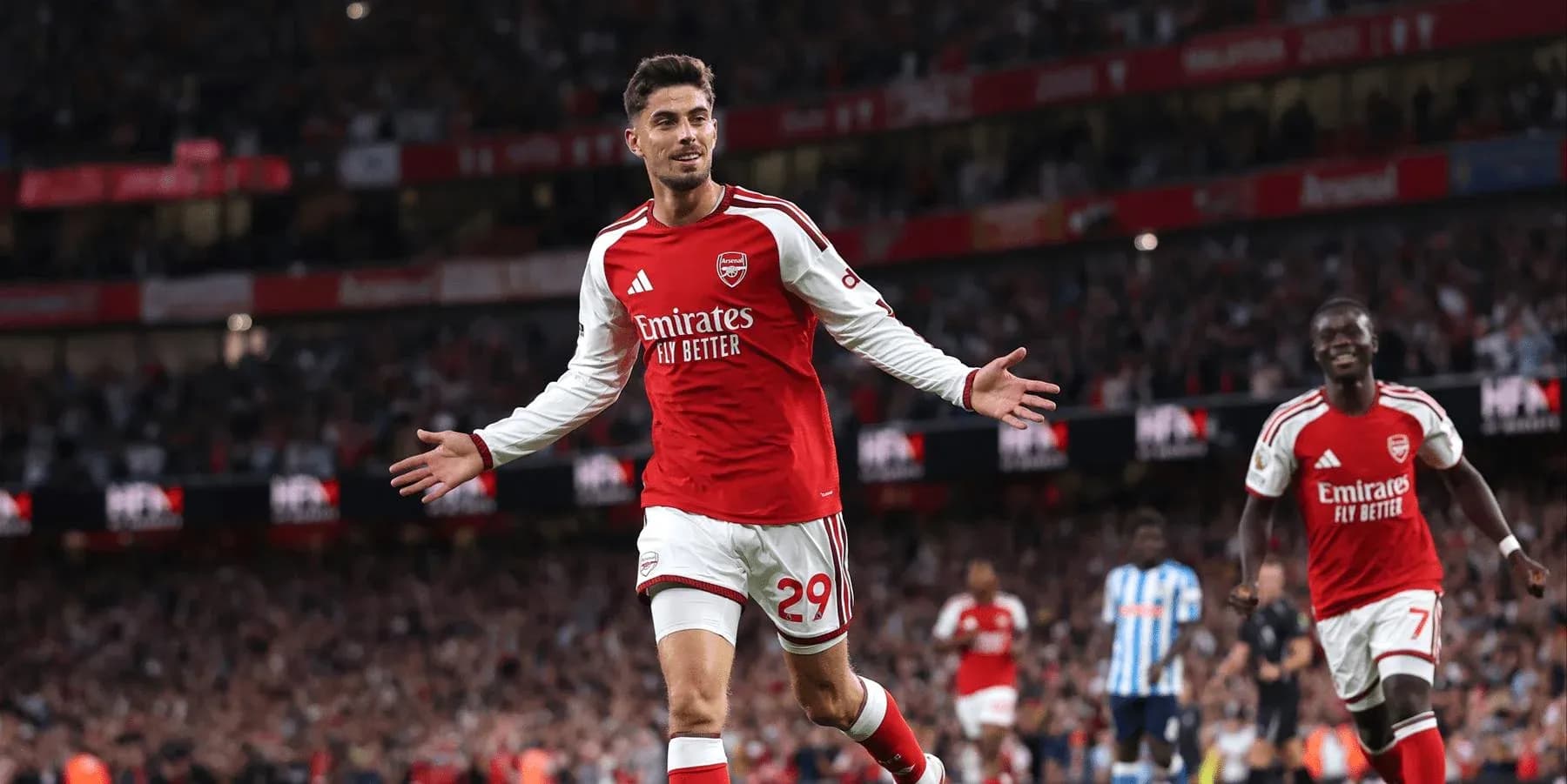
The “Hunter vs Shield” storyline belonged to Arsenal’s front four against Coventry’s defensive block. Saka, Ødegaard and Havertz all scored once in total this season, each with 1 shot and 1 on target, a ruthless conversion that underlined the quality of their chances rather than sheer volume.
Saka’s numbers – 1 goal, 34 passes at 88% accuracy, 2 key passes and 1 successful dribble – tell of a wide creator-finisher hybrid. His duels (5 contested, 3 won) and a foul drawn show how he repeatedly pinned back J. Dasilva and forced Yirenkyi into awkward decisions. Against an away defence that has already conceded 3.0 goals on average and allowed 33.33% of those in the first 15 minutes and another 33.33% between 16-30, Saka’s early thrusts were perfectly timed with Coventry’s vulnerability in the opening half hour.
Havertz, leading the line, offered a different kind of threat. His 1 goal, 25 passes at 80% accuracy, 1 key pass and 10 duels (5 won) paint the picture of a centre-forward who acted as a wall and a blade: holding play, linking with Ødegaard and Tzolis, then attacking the box with purpose. Coventry’s centre-backs B. Thomas and A. Amenda were repeatedly dragged into uncomfortable zones, and with Coventry conceding another 33.33% of their goals between 46-60 minutes, Havertz’s persistent presence after the interval ensured there was no second-half respite.
In the “engine room”, Ødegaard vs Coventry’s central trio was the decisive mismatch. The Norwegian delivered 1 goal, 56 passes at 92% accuracy and 3 key passes, alongside 3 tackles and 4 duels won from 6. He not only dictated tempo but also pressed intelligently, suffocating Coventry’s attempts to build through M. Grimes and Yirenkyi. Coventry’s midfield numbers underline the imbalance: Yirenkyi completed just 13 passes at 76% accuracy, with no key passes and only 1 duel won from 3. He also committed 2 fouls, one of which brought his yellow card, emblematic of a unit chasing shadows rather than controlling zones.
Behind them, Arsenal’s “shield” of Rice and Lewis-Skelly quietly ensured the platform. With Arsenal yet to concede a goal in total, and having kept 1 clean sheet at home, their defensive structure looked robust even without Saliba and Timber. Calafiori, already on the top assists chart with 1 assist and 24 passes at 83% accuracy, showed why Arteta trusts him as a progressive outlet from left-back, while White matched him on the opposite flank with 78 passes at 94% accuracy and 2 key passes, plus 1 tackle and 1 interception.
IV. Statistical Prognosis – Arsenal’s ceiling vs Coventry’s adjustment curve
Following this result, Arsenal’s seasonal profile is stark: 1 match in total, 1 win, 3 goals scored, 0 conceded, 1 clean sheet and no failures to score. Their goals have been evenly spread across 0-15, 16-30 and 46-60 minutes, each window accounting for 33.33% of their total. That distribution suggests a side capable of starting fast, sustaining pressure before the break and reasserting control after half-time.
Coventry’s numbers, in total, are the mirror image: 1 match, 1 defeat, 0 goals scored, 3 conceded, no clean sheets and 1 failure to score. All 3 goals conceded have come in the same time bands where Arsenal are most dangerous – 0-15, 16-30 and 46-60, each again at 33.33%. The “critical intersection” is therefore brutally clear: Coventry’s defensive frailty in those windows aligns exactly with Arsenal’s offensive peaks.
There is no xG data in this snapshot, but the pattern of chance quality is implied by efficiency. Arsenal’s key attackers – Saka, Ødegaard, Havertz – each scored with their only shot on target, while the full-backs and Calafiori’s assist numbers highlight a side that creates high-value opportunities rather than speculative efforts. Defensively, an average of 0.0 goals conceded at home and in total, plus under 0.5 conceded in every goals-against threshold so far, points to a unit that is not simply riding variance but structurally sound.
For Coventry, the prognosis is more sobering. Their away average of 0.0 goals scored and 3.0 conceded, combined with a failure to score in total, indicates that Lampard must quickly re-balance his 4-1-4-1. The midfield shield around Grimes and Yirenkyi needs reinforcing, and the front line must find a way to turn sporadic transitions into genuine threat, or the pattern of chasing games against superior technical sides will repeat.
As an opening chapter, this fixture reads like a manifesto for Arsenal’s season: a controlled, multi-channel attack built on a secure base, even amid injuries, and a squad where defenders like Calafiori and White are as central to chance creation as the headline forwards. For Coventry, it is a blunt introduction to the Premier League’s margins – and a clear statistical map of where they must harden if they are to climb from 19th and escape the relegation narrative that already shadows them.