Tottenham's Tactical Evolution Shines in 2–0 Victory Over Crystal Palace
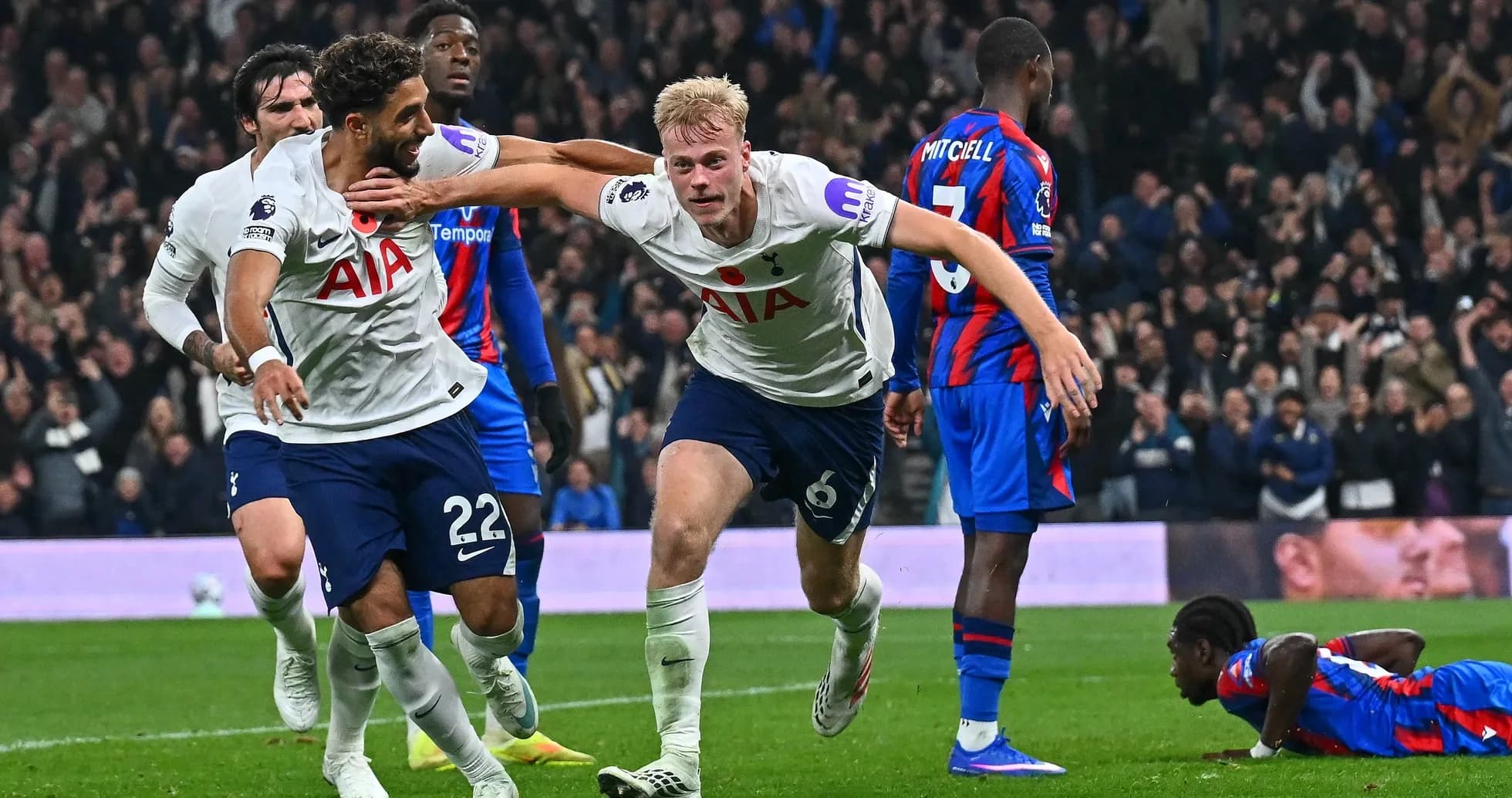
Under the lights at Tottenham Hotspur Stadium, a 2–0 home win over Crystal Palace closed the book on Round 9 of the Premier League season and quietly redefined the narrative around both squads. Tottenham, now 8th with 12 points, have a goal difference of 0 after scoring 10 and conceding 10 overall. Crystal Palace remain deep in trouble: 18th with 7 points, their overall goal difference is -12, with 9 scored and 21 conceded.
I. The Big Picture – Two Projects at Different Speeds
This was billed as a clash between a Tottenham side trying to knit together a new attacking core and a Palace team still searching for defensive stability. Heading into this game, Tottenham’s season profile was one of balance without brilliance: 3 wins, 3 draws, 3 defeats from 9, with 10 goals scored and 10 conceded overall. At home they had been slightly more incisive, with 7 goals for and 6 against across 5 matches, averaging 1.4 goals for and 1.2 against at Tottenham Hotspur Stadium.
Palace arrived with a much starker identity: chaotic and porous. Across their 9 league fixtures before this one, they had scored 9 and conceded 21 overall, an average of 1.0 goals for and 2.3 against per game. On their travels, the numbers were even more alarming: 3 goals for and 11 against in 5 away matches, an average of 0.6 scored and 2.2 conceded away from home.
Within that context, Tottenham’s 4-2-3-1 under R. De Zerbi and Palace’s committed 3-4-2-1 under P. Sage felt like opposite answers to the same question: how do you control the middle of the pitch?
II. Tactical Voids – Absences Shape the Chessboard
Tottenham’s squad sheet was defined as much by who was missing as by who started. T. Adarabioyo (calf), R. Bentancur (suspended after a red card), L. Bergvall (knee), M. Mudryk (ankle), W. Odobert (knee), X. Simons (knee), and another unnamed muscle injury all stripped depth from De Zerbi’s options. The absence of Bentancur, who has already seen red once this season, removed a destructive presence from midfield and perhaps nudged De Zerbi towards a cleaner, more possession-oriented double pivot of S. Tonali and Mateus Fernandes.
For Palace, P. Sage was without J. Larsen (ankle), C. Riad (knee), I. Sarr (groin), Q. Timber (hamstring), and T. Tomiyasu (calf). The loss of defensive and wide options forced Sage to lean heavily on A. Disasi and C. Richards in the back three, with Óscar Mingueza and T. Mitchell tasked with enormous workloads as wing-backs.
Discipline has also been a recurring storyline. Tottenham’s season card profile shows yellow cards spread across the match, with notable peaks at 0–15 minutes and 61–75 minutes (both 23.08%), and a solitary red card in the 76–90 range. Palace, by contrast, have lived on the edge: their yellow cards spike between 46–60 and 61–75 minutes (both 23.08%), and they have already seen reds in the 0–15 and 31–45 ranges. A. Disasi and J. Mateta each carry a red card in their league record, underlining how quickly Palace’s structure can unravel if they lose emotional control.
III. Key Matchups – Hunter vs Shield, Engine Room vs Enforcer
De Zerbi’s 4-2-3-1 is built around a fluid attacking band. M. Kudus, Omar Marmoush, M. Tel, and D. Solanke formed a front four that constantly rotated positions. Kudus, one of the league’s top assist providers with 3 in 8 appearances, is the creative hinge: 194 passes at 89% accuracy, 9 key passes, and a remarkable 36 dribbles attempted with 21 completed. His ability to receive between the lines and drive at the Palace back three was always going to be central.
Opposite him, A. Disasi is Palace’s defensive shield and also one of the league’s leading red-card recipients. Across 5 appearances he has produced 9 tackles, 3 successful blocks, and 12 interceptions, underlining his reading of the game. But his red card this season reflects the fine line he walks when exposed. With Palace conceding heavily between 46–60 minutes (33.33% of their goals against), the period just after half-time was primed for Kudus to test Disasi’s discipline and timing.
Further ahead, D. Solanke’s role as the lone forward in the 4-2-3-1 was less about sheer goalscoring numbers and more about occupying the Palace back three to create lanes for Marmoush and Tel. Against a side that had already shipped 11 away goals heading into this fixture, his movement across the front line was the pressure point that could drag Disasi and J. Canvot into uncomfortable wide areas.
In the “engine room”, the duel between S. Tonali and D. Kamada offered a more subtle storyline. Tonali, anchoring alongside Mateus Fernandes, was tasked with dictating tempo and protecting a back four of A. Gray, J. van Hecke, M. van de Ven, and A. Robertson. Kamada, meanwhile, has quietly become Palace’s creative metronome: 309 passes at 83% accuracy, 8 key passes, 3 assists, and 17 tackles. His dual role as playmaker and presser is central to any Palace resurgence.
Yet Palace’s attacking structure has been betrayed by their defensive timing. They score 33.33% of their goals between 31–45 minutes and another 22.22% between 46–60, but they concede a huge 33.33% of their goals between 46–60 minutes. That overlap – an attacking push coupled with defensive collapse just after the restart – is the critical intersection De Zerbi targeted with his high-tempo transitions.
Yeremy Pino, another Palace focal point, adds edge and risk on the flank. With 3 yellow cards in 9 appearances, 11 tackles, 1 successful block, and 4 interceptions, he presses aggressively but can be drawn into fouls. Up against an overlapping A. Robertson and the inside drifts of Tel or Marmoush, his discipline was always under scrutiny.
IV. Statistical Prognosis – Why 2–0 Felt Inevitable
Following this result, the numbers tell a story of trajectories diverging. Tottenham’s overall goal difference remains at 0 (10 scored, 10 conceded), but the clean sheet reinforces a growing defensive solidity that already included 4 clean sheets overall heading into the game (2 at home, 2 away). Their profile of 4 matches in which they failed to score overall is being slowly overwritten by a more coherent attacking structure, especially at home where they average 1.4 goals.
Palace’s defensive crisis, by contrast, deepens. With 21 goals conceded overall before this match, their patterns of vulnerability were stark: an early fragility (19.05% of goals conceded in the opening 15 minutes) and that brutal 46–60 window where they ship a third of their goals. Against a Tottenham side comfortable in a 4-2-3-1 – a shape they had already used 8 times this season – those windows were always likely to be exploited.
Both sides have yet to take a penalty this season, so there was never the illusion of set-piece efficiency masking open-play issues. This was about structure, timing, and control.
In the end, Tottenham’s layered attack, anchored by the creativity of Kudus and the balance of Tonali and Mateus Fernandes, proved too organised for a Palace side whose 3-4-2-1 still leaks in predictable phases. A 2–0 scoreline felt less like a surprise and more like the logical outcome of two tactical identities meeting at very different stages of their evolution.