Arsenal's Tactical Statement in 2–0 Victory Over Everton
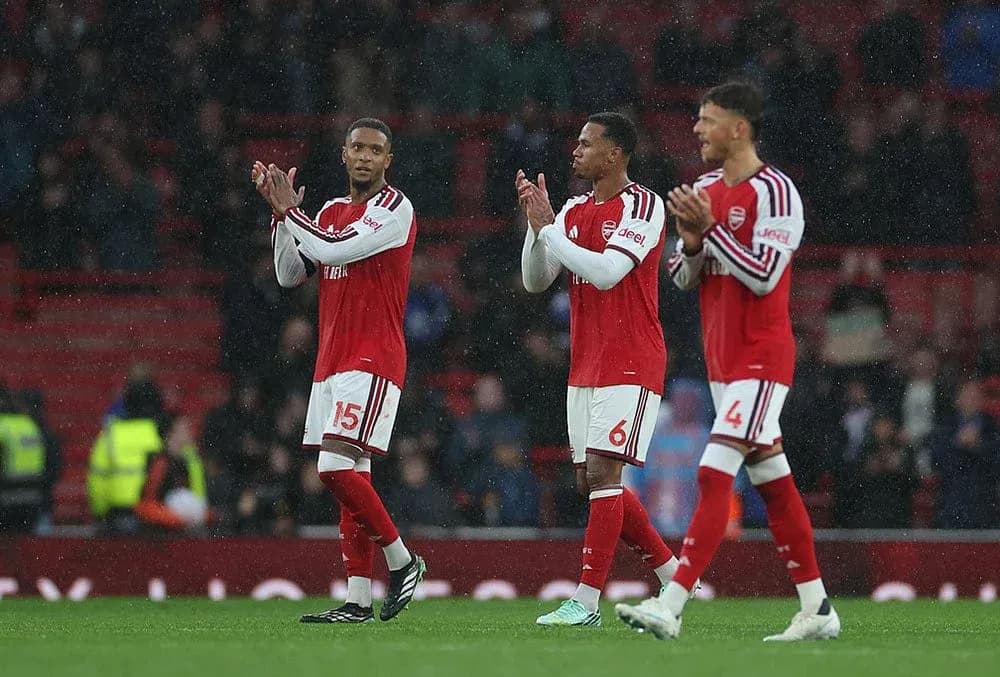
Under a grey London sky at Emirates Stadium, Arsenal’s 2–0 win over Everton felt less like a routine home victory and more like a tactical statement from a side shaping an early title challenge. This was Round 8 of the Premier League season, and heading into this game Arsenal sat 2nd with 21 points from 8 matches, their goal difference a clean +8 from 13 scored and 5 conceded overall. Everton arrived 11th, with 10 points, their own goal difference a narrow -1 from 8 scored and 9 conceded overall. It was a meeting between one of the division’s most balanced machines and a stubborn mid-table outfit still working out its identity.
Mikel Arteta doubled down on his season’s blueprint: a 4‑2‑3‑1 that has become Arsenal’s default, used in all 8 league games. David Raya anchored a back four of B. White, E. Konsa, Gabriel Magalhães and the youthful M. Lewis‑Skelly. In front of them, D. Rice and Mikel Merino formed a double pivot designed to suffocate transitions and accelerate Arsenal’s own. The line of three – N. Madueke, M. Ødegaard and E. Eze – floated behind V. Gyökeres, a centre‑forward tasked with stretching Everton’s back line vertically as much as finishing moves.
This structure has been ruthlessly effective at Emirates Stadium. At home this season Arsenal have played 4, won 4, scoring 9 and conceding just 2. That is 2.3 goals for and 0.5 against on average at home, a profile of a side that both dominates territory and limits chaos. Their scoring pattern is telling: across the campaign, 35.71% of their goals arrive between 46–60 minutes and 21.43% between 61–75. Arsenal are built to squeeze opponents after the interval, when their passing rhythm and pressing traps are fully calibrated.
Everton's Setup
Everton, under D. Moyes, mirrored the 4‑2‑3‑1 on paper but not in personality. J. Pickford started behind a back four of M. Röhl, J. Tarkowski, J. O'Brien and V. Mykolenko. H. Armstrong and J. Garner were paired as the double pivot, with B. Johnson, K. Dewsbury‑Hall and Tyrique George supporting lone forward T. Barry, Everton’s leading scorer this season with 3 league goals from 20 shots, 12 of them on target. Barry’s profile is central to Everton’s attacking plan: a tall, mobile target who can contest duels (118 overall, 56 won) and offer a direct out‑ball under pressure.
But Everton’s season numbers painted a more fragile picture than their shape suggested. On their travels they had played 4, drawn 3 and lost 1, scoring 3 and conceding 5 – an away average of 0.8 goals for and 1.3 against. Their defensive vulnerability is concentrated in the very window where Arsenal are at their most ruthless: 33.33% of Everton’s goals conceded come between 46–60 minutes, with another 22.22% in both the 61–75 and 76–90 ranges. In other words, more than three‑quarters of Everton’s concessions arrive after half‑time – exactly where Arsenal’s attacking curve peaks.
Tactical Absences
The absences only sharpened the tactical edges. Arsenal were without B. Saka, W. Saliba and C. Tzolis, all listed as missing this fixture through injury. Losing Saka stripped Arteta of his most direct right‑sided threat and a player with 3 league goals already, including a perfect penalty record this season (1 scored from 1, no misses). Saliba’s absence forced a re‑draw of the defensive hierarchy, with Konsa stepping into the right‑centre role. Yet the system absorbed the losses. White’s presence – 3 assists already in the league, with 7 key passes and strong duel numbers – gave Arsenal a playmaking full‑back, while Rice, one of the league’s leading assist providers with 4, orchestrated from deep.
Rice’s season is the tactical spine of this Arsenal side. With 574 completed passes at 91% accuracy and 15 key passes, he is both metronome and creator. His defensive line – 10 tackles, 4 blocked shots, 8 interceptions – underpins a goals‑against profile that sees Arsenal concede on average just 0.6 goals per game overall. Their defensive wobble, such as it is, comes before the break: 40% of their conceded goals arrive between 31–45 minutes and another 40% between 46–60. But once they settle, they rarely let go.
Disciplinary Risks
Against that, Everton’s “engine room” of Garner and Armstrong arrived with a reputation for steel but also for disciplinary risk. Garner’s 3 yellow cards this season, combined with 18 tackles and 8 fouls committed, mark him as a combative presence. Armstrong mirrors that edge with 3 yellows of his own, 15 tackles and 10 fouls committed. Everton as a team tend to collect their cautions late: 25.00% of their yellows come in the 76–90 period and 18.75% between 61–75, a pattern that dovetails with Arsenal’s late surges and increases the likelihood of tired legs making poor decisions under pressure.
Creative Advantages
Further forward, the “Hunter vs Shield” duel centred on T. Barry against Arsenal’s reshaped back line and Raya. Barry’s 3 goals from 8 appearances, supported by 6 key passes and 6 successful dribbles, made him Everton’s primary threat. Yet he was up against a unit that had already kept 5 clean sheets overall this season and had failed to score in only 1 match. At home Arsenal had conceded just 2 in 4, and their defensive minute distribution suggested that if they survived the early exchanges, control would be theirs.
In creative zones, Arsenal’s advantage was pronounced. Beyond Rice and White, R. Calafiori – though on the bench here – has 2 assists and 1 goal in the league, highlighting the depth of progression from the back. Ødegaard and Eze, while not individually profiled in the wider league stats, slotted into a structure designed to overload half‑spaces and feed Gyökeres. The Swede’s role was as much about occupying Tarkowski and O'Brien as it was about finishing; by pinning Everton’s centre‑backs, he created lanes for late runs from midfield.
Everton's Statistical Profile
Everton’s broader statistical arc suggested a side that stays in games but struggles to tilt them. They average 1.0 goal for and 1.1 against overall, with 37.50% of their scoring coming in the 76–90 window – a late‑game surge that often rescues points rather than secures dominance. Away, they had kept 1 clean sheet in 4, and failed to score twice, underlining their reliance on Barry’s moments rather than sustained territorial control.
Overlaying the season’s xG‑adjacent indicators – goal averages, clean sheets, timing patterns – the prognosis before a ball was kicked pointed firmly towards Arsenal. A team scoring 2.3 per game at home and conceding 0.5, whose main attacking storm hits exactly when Everton’s defensive structure historically loosens, will almost always be favoured. Everton’s resilience, their cluster of late goals and their physical midfield hinted at a contest rather than a procession, but the structural balance, depth of creative outlets and defensive solidity all leaned red and white.
In the end, the 2–0 scoreline reflected that underlying geometry. Arsenal’s system, even without Saka and Saliba, proved too cohesive; Everton’s honest industry could not mask the gaps that their season data had already sketched in advance.