AS Roma vs Cagliari: Tactical Showdown in Serie A
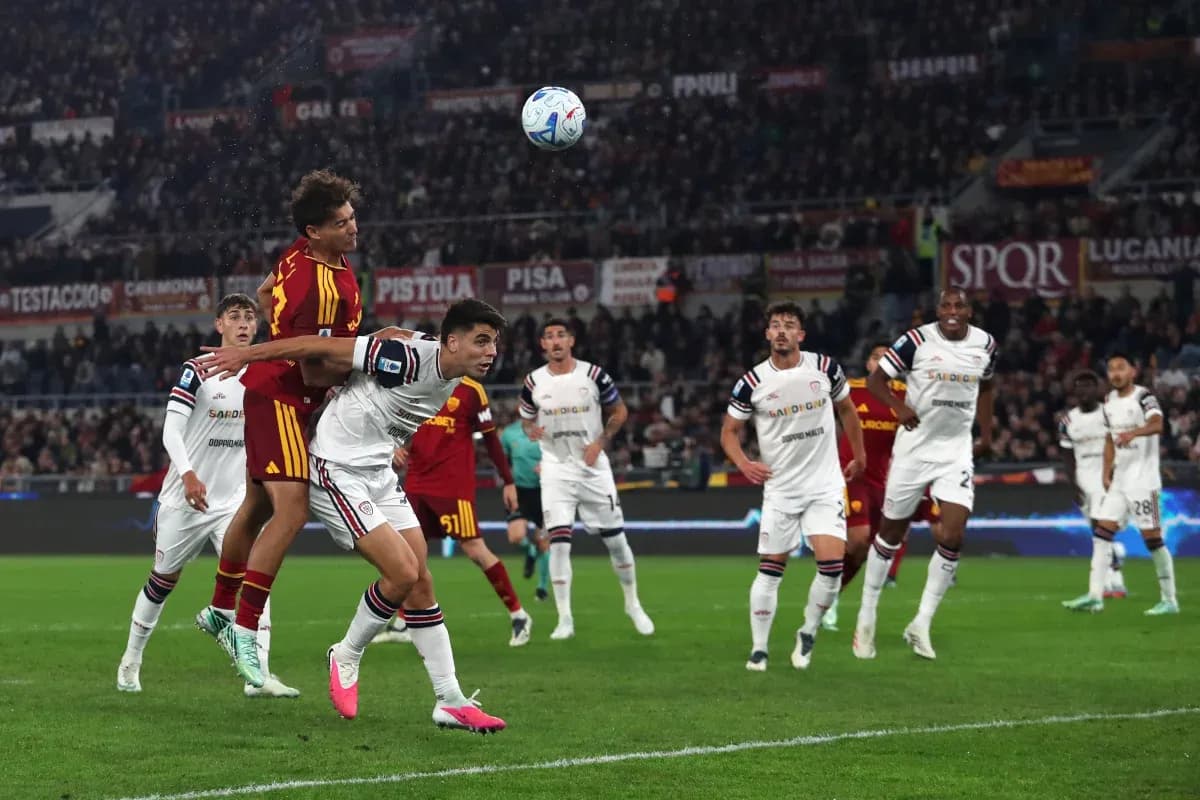
Under the Stadio Olimpico lights on a cool Rome night, AS Roma and Cagliari delivered a game that felt like a tactical thesis as much as a 4–2 spectacle. In a Serie A season where margins at the top are fine, this Regular Season - 9 fixture showcased why Roma sit 3rd on 21 points and remain unbeaten after 9 matches, and why Cagliari’s volatility keeps them marooned in 10th despite flashes of real quality.
I. The Big Picture – Roma’s ruthless structure vs Cagliari’s fragile edge
Heading into this game, Roma’s seasonal profile was clear: a side built on control and late surges. Overall they had scored 23 goals and conceded 8, a goal difference of +15, with a total scoring average of 2.6 and just 0.9 conceded. At home they had been even more assertive, averaging 2.8 goals for and 1.0 against across 5 matches, with 4 wins and 1 draw.
The minute-by-minute distribution painted Roma as a team that grows into games. Overall, 30.43% of their goals had arrived between 76–90 minutes, their single most explosive window. Yet they were no slow starters either: 13.04% of their goals came in each of the 0–15 and 46–60 ranges, and 17.39% in both 16–30 and 61–75. It is a side that can hurt you early, but systematically finishes you late.
Cagliari, by contrast, arrived as a team walking a tightrope. Overall they had 8 goals for and 13 against, a goal difference of -5. On their travels they were dangerous going forward, with 6 goals and an away scoring average of 1.2, but porous at the back, conceding 9 away for an average of 1.8. Their late-game defensive profile was particularly alarming: 38.46% of their goals conceded had come between 76–90 minutes.
It set up a stark statistical collision: Roma’s late-game surge versus Cagliari’s late-game collapse.
II. Tactical Voids – Creativity lost, responsibility redistributed
Roma’s squad sheet for this fixture was marked by notable absences. Paulo Dybala, one of Serie A’s leading creators with 4 assists and a 7.88 rating from 6 appearances, missed out through a calf injury. Lorenzo Pellegrini was also unavailable with a thigh problem, while M. Bah, M. Kone and goalkeeper M. Svilar were sidelined as well. For a team whose attacking geometry often flows through Dybala’s between-the-lines work, this forced Gian Piero Gasperini to lean into a more collective, system-first approach.
Cagliari had their own gaps: M. Felici and R. Idrissi were both ruled out with knee injuries, while H. Winks’ back problem removed a potential controller from midfield. For a side already conceding 1.4 goals per game overall, losing a stabilising presence in the middle only increased the burden on the remaining engine room.
Disciplinary trends also shaped the tone. Roma, despite their attacking flair, had shown an edge: Donyell Malen, their leading scorer with 7 goals, already carried both a yellow and a red this season, while Matías Soulé had 2 yellows to his name. Cagliari’s Alessandro Deiola, meanwhile, entered as one of the league’s most card-prone players with 4 yellows and a reputation for combative interventions.
III. Key Matchups – Hunters and shields
Gasperini’s Roma lined up in a 3-5-2, with P. Gollini behind a back three of G. Mancini, E. Ndicka and K. Koulierakis. The wing corridors belonged to N. Molina and E. Lulli, with B. Cristante, M. de Roon and N. Pisilli forming a dense central triangle. Up front, Soulé and S. Castro were tasked with stretching Cagliari’s back line and exploiting the half-spaces usually occupied by Dybala.
The key offensive weapon in Roma’s wider squad remains Malen. Across the campaign, his 7 goals, 1 assist, 24 shots (12 on target) and 22 dribbles attempted (14 successful) define him as a direct, high-volume threat. Even starting from the bench here, his profile shadows the way Roma build: vertical, incisive, and ruthless in transition. Soulé complements that with a more elastic interpretation of the forward role: 3 goals, 1 assist, 19 shots, and 29 dribbles attempted with 20 successful, plus 15 key passes. He is both creator and finisher, a constant problem between lines.
Cagliari’s 3-5-1-1 under F. Pisacane tried to mirror Roma’s structure. E. Caprile was shielded by Zé Pedro, Y. Mina and J. Rodríguez. The wing lanes were manned by Y. Sugawara and A. Obert, while the central trio of M. Adopo, A. Romano and Deiola had to both screen and spring forward. Ahead of them, A. Fadera supported M’Bala Nzola.
The “Hunter vs Shield” duel lived in Roma’s attack against Cagliari’s late-game defence. Roma’s overall 76–90 surge (30.43% of their goals) ran directly into Cagliari’s most fragile period, where they conceded 38.46% of their goals. Every Roma wave in the final quarter of an hour carried the weight of those numbers.
In the “Engine Room” battle, Cristante and de Roon’s disciplined positioning and passing had to outthink Deiola and Romano. Cristante’s role as tempo-setter allowed Roma to compress the pitch, while de Roon’s reading of danger cut off Cagliari’s attempts to counter through Fadera and Nzola. Deiola, who had already committed 7 fouls this season and picked up multiple yellows, walked a fine line between necessary aggression and costly indiscipline.
IV. Statistical Prognosis – Why a high-scoring Roma win made sense
The 4–2 final scoreline at the Olimpico felt like a narrative written in the data. Roma, who had seen 8 of their 9 league games finish with over 0.5 and over 1.5 team goals, are structurally built for multi-goal performances. Their home scoring average of 2.8 and overall attacking spread across all phases of the game made a multi-goal outing highly probable.
Cagliari’s profile pointed toward a chaotic contest. On their travels they averaged 1.2 goals for but 1.8 against, and overall they had gone over 0.5 goals conceded in 6 of 9 matches and over 1.5 conceded in 3. Their late-game collapse zone (76–90) aligned perfectly with Roma’s finishing power.
Add in Roma’s defensive record – just 8 goals conceded overall at an average of 0.9 – and the expectation tilted towards a Roma win with Cagliari still capable of landing blows, especially in their own strong 16–30 window where 37.50% of their goals had been scored.
In tactical terms, Roma’s 3-5-2 gave them superior occupation of central spaces, wing overloads through Molina and Lulli, and multiple lanes of attack even without Dybala and Pellegrini. Cagliari’s 3-5-1-1, while structurally sound on paper, simply could not withstand the cumulative pressure, particularly as the game stretched and Roma’s patterns repeated.
In the end, the 4–2 scoreline was less a surprise and more a crystallisation of who these teams are right now: Roma, a relentless, late-surge machine with depth in attack and control in midfield; Cagliari, brave and occasionally incisive, but too open and too brittle when the lights burn brightest in the final quarter of an hour.