Atalanta vs Frosinone: A Thrilling 4-4 Draw in Serie A
New Balance Arena had barely caught its breath when the final whistle went: Atalanta 4–4 Frosinone, a wild eight-goal draw that distilled everything both sides have been this Serie A season – exhilarating, fragile, and tactically open to punishment.
I. The Big Picture – Two Identities Colliding
This was Round 8 of the Serie A regular season, and the table framed the narrative neatly. Atalanta came in 11th with 10 points, their overall goal difference at -1, the product of 14 goals scored and 15 conceded in total. At home, though, they had been far more convincing: 3 wins, 1 draw, 1 defeat, with 11 goals for and 8 against, averaging 2.2 goals scored and 1.6 conceded at New Balance Arena.
Frosinone arrived as one of the early-season surprises. Sixth in the table with 14 points and a total goal difference of +4 (17 for, 13 against overall), they had married attacking ambition with just enough resilience. On their travels they had been competitive rather than dominant: 1 win, 2 draws, 1 loss away, with 8 goals scored and 8 conceded, an away average of 2.0 goals for and 2.0 against.
Put those numbers together and you get exactly what unfolded: two teams whose offensive output outpaced their defensive control. Atalanta’s total scoring average of 1.8 goals per game and total concession rate of 1.9 met a Frosinone side averaging 2.1 goals scored and 1.6 conceded in total. The 4–4 scoreline felt less like chaos and more like arithmetic made flesh.
Both coaches mirrored each other structurally, sending their sides out in a 4-2-3-1. Maurizio Sarri leaned into Atalanta’s technical midfield and fluid front four, while Massimiliano Alvini trusted a young but fearless Frosinone spine that has already unsettled bigger reputations this season.
II. Tactical Voids – Absences and Discipline
If the match felt stretched, the team sheets explained part of it. Atalanta were stripped of almost an entire alternative back line and midfield shield. I. Hien (muscle injury), S. Kolasinac (thigh injury), O. Kossounou (thigh injury), G. Scalvini (thigh injury), K. Sulemana (knee injury) and F. Kessie (calf injury) were all ruled out, along with G. Raspadori (thigh injury). That is a huge chunk of defensive experience and physical presence removed from Sarri’s toolbox.
In their absence, T. Kristensen and R. Obric anchored the central defence, flanked by R. Bellanova and D. Zappacosta. In front of them, G. Gaetano and Ederson formed the double pivot. On paper it offered passing range and verticality; in practice it also meant less pure destroyer presence, more space between the lines, and greater responsibility on timing the press.
The disciplinary backdrop had already been warning Atalanta. Across the season, 42.86% of their yellow cards have arrived between minutes 61–75, and 28.57% between 76–90, a clear late-game surge of bookings that speaks to fatigue and reactive defending. Red cards have also been an issue: G. Gaetano and E. Elmas each have one this campaign, underlining the fine line Sarri’s aggressive midfield walks.
Frosinone’s absentee list was lighter but not irrelevant. F. Grillitsch, out with a thigh injury, removed a potential extra layer of control in the middle. Yet Alvini could still field his preferred 4-2-3-1, with G. Calo and P. Masini as the double pivot and a lively band of three – F. Ghedjemis, R. Schmid, and G. Kvernadze – behind the prolific A. Raimondo.
Discipline-wise, Frosinone are busier than reckless. Their yellow cards are spread relatively evenly across the 0–75 minute ranges, with a small spike (18.75%) in both the 16–30 and 46–60 windows, and a late flicker between 91–105 (18.75%). But crucially, they have not seen a red card in the league so far, even with combative profiles like G. Bracaglia (4 yellows) and Raimondo (3 yellows) playing big minutes.
III. Key Matchups – Hunter vs Shield, and the Engine Room
The headline duel was always going to be in the penalty areas. For Frosinone, A. Raimondo came into this fixture as Serie A’s top scorer with 7 goals in 8 appearances, averaging just under a goal a game. He had taken 22 shots in total, 10 on target, and thrives on early service and quick combinations around the box.
Across from him, Atalanta’s defensive unit had already conceded 15 goals in 8 matches in total, including 7 on their travels and 8 at home. At New Balance Arena they had kept only 1 clean sheet in 5 home games. Raimondo against Kristensen and Obric was always going to be a test of positioning versus penalty-box instinct, and the four goals Atalanta shipped underline how often Frosinone managed to reach their striker and attacking midfielders in dangerous zones.
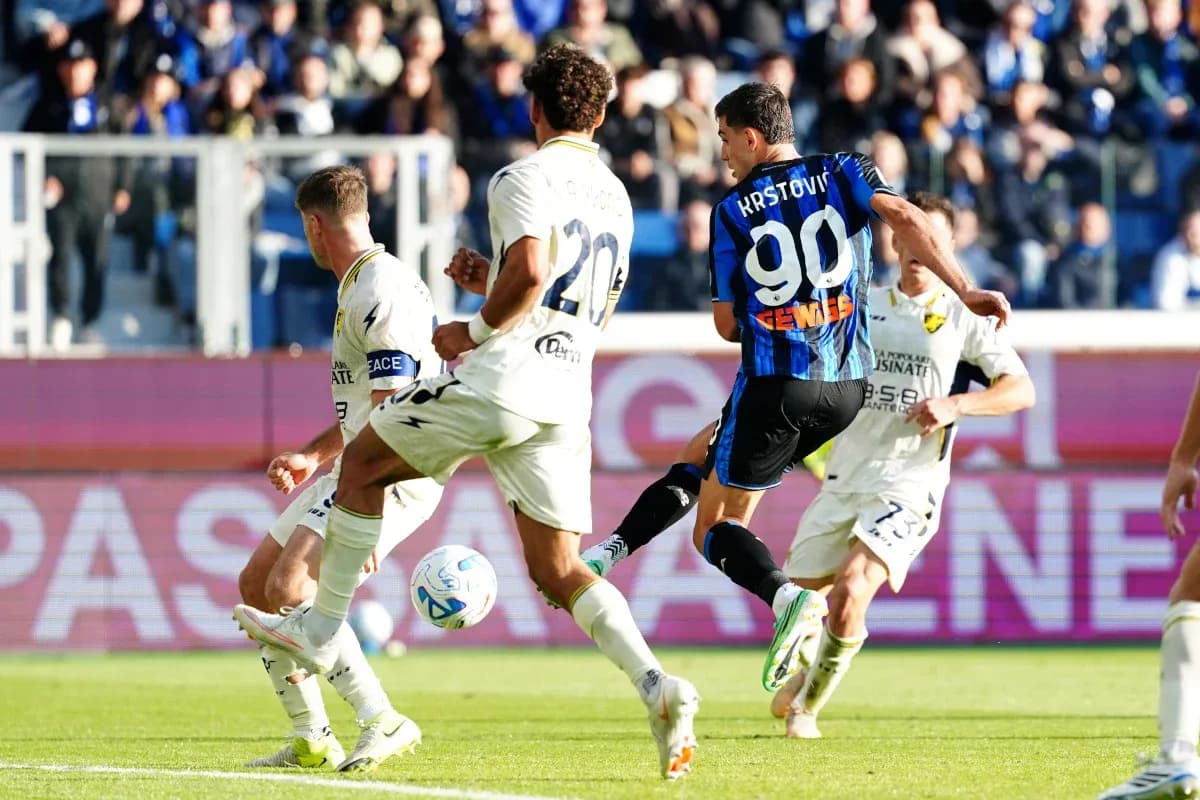
At the other end, the “Hunter” role fell to N. Krstovic. With 6 goals and 2 assists in 8 appearances, plus 20 shots (10 on target), he has been Atalanta’s most ruthless presence. His 7.38 average rating and ability to both finish and link play made him the natural reference point of Sarri’s 4-2-3-1.
Frosinone’s overall defensive record – 13 conceded in 8 games in total, 8 of those away – suggested vulnerability against a forward of his profile. Their away concession average of 2.0 per game was almost a direct invitation to Krstovic and the creative triangle behind him.
Behind the forwards, the “Engine Room” battle was rich with nuance. For Atalanta, Gaetano and Ederson had to blend progression with protection. Gaetano, despite his red card earlier in the season, brings secure passing (228 completed passes with 88% accuracy) and ball-winning (8 tackles, 8 interceptions), making him the fulcrum in front of the back four. Ederson, more dynamic, provides the vertical thrust that allows C. De Ketelaere, E. Elmas and J. Rowe to occupy advanced pockets.
Frosinone’s response came through G. Calo and P. Masini, with Calo in particular acting as the metronome and shield. He has already produced 3 goals and 1 assist this season, with 420 passes at 81% accuracy and 30 key passes – elite numbers for a deep midfielder. Add 9 blocks and 3 interceptions, and you see why he is as much “Shield” as playmaker.
Ahead of him, Kvernadze and Schmid offered different but complementary threats. Kvernadze, with 3 goals and 1 assist plus 37 dribble attempts (21 successful), constantly attacked full-backs 1v1, while Schmid, with 2 goals and 3 assists and 13 key passes, drifted between lines to feed Raimondo. On this day, their movement repeatedly pulled Atalanta’s full-backs out of shape, exposing the centre-backs.
IV. Statistical Prognosis – What This 4–4 Tells Us
Following this result, the statistical picture of both squads hardens rather than shifts.
Atalanta’s attacking ceiling is clear. At home they continue to average 2.2 goals scored, and with Krstovic, De Ketelaere’s 16 key passes and 2 assists, plus the creative depth of Elmas and Rowe, they will generate chances against almost anyone. Their penalty record – 1 taken, 1 scored, with no misses – shows composure from the spot when they get there.
But the defensive fragility is now a defining trait. Conceding 15 goals in 8 matches in total, with an overall concession average of 1.9 per game, is relegation-zone defending wrapped in European-aspirant attacking play. Injuries at the back explain some of it; the late-card pattern and the aggressive midfield line explain the rest.
Frosinone, by contrast, look like a side whose numbers support their league position. Seventeen goals scored in 8 games in total, at 2.1 per match, with Raimondo at 7 and a supporting cast of Kvernadze, Calo, Schmid and Ghedjemis all contributing goals or assists, is the profile of a genuine attacking unit, not a one-man show. Their total concession rate of 1.6 per game is not elite, but away from home they accept risk to maintain their offensive identity.
From an xG-style lens, even without explicit expected goals data, the volume and spread of attacking talent on both sides, combined with their concession averages, point towards more high-scoring encounters to come. Atalanta’s path forward demands either the return of injured defenders or a recalibration of Sarri’s risk tolerance in midfield. Frosinone can lean into their current model, but must watch the disciplinary load on Bracaglia and Raimondo to avoid suspensions that could destabilize their balance.
In the end, this 4–4 was not an anomaly; it was a crystallization. Atalanta are a side whose attacking fluency is undermined by structural and personnel gaps at the back. Frosinone are a fearless, upwardly mobile unit whose offensive metrics justify their place near the top six. The numbers say both will continue to entertain – and that clean sheets will remain rare currency when either of them take the field.