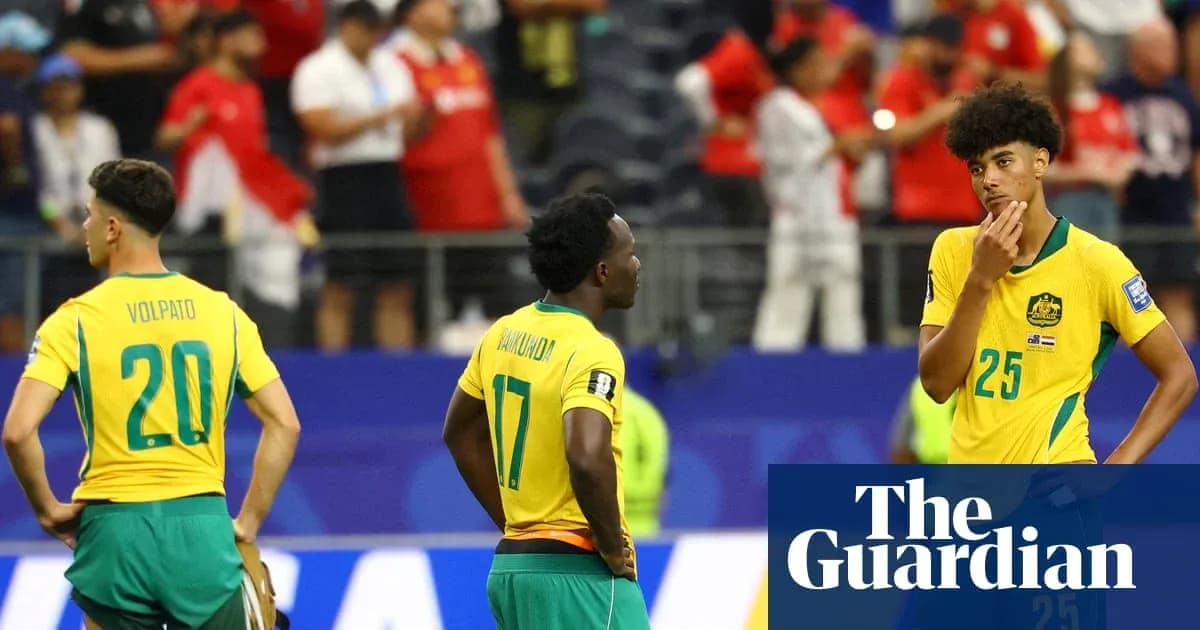
Australia's World Cup Heartbreak: Lucas Herrington's Penalty Miss
Lucas Herrington never should have been the face of this. Not this night, not this way.
At 18, he walked into history as the youngest starter the Socceroos have ever fielded at a World Cup. By the end, he walked into something crueller: the moment that will follow him for the rest of his career.
His run-up was calm enough. The technique looked right. But his side-footed penalty climbed too high, thudding off the crossbar and back into a silence that swallowed the Australian end. Herrington turned away from the frame that had betrayed him, one arm reaching up into his mop of curls as if to steady himself.
Awer Mabil went straight to him. No celebration, no remonstration, just a sprint to the teenager who knew instantly what he had done and what it meant. When Egypt finished the shootout a few kicks later, Herrington bent over, trying to fold himself into the turf and out of the moment. Jackson Irvine arrived quickly, then Nestory Irakunda – a foot shorter, but standing tall enough to wrap him in an embrace.
They are meant to be the future of Australian football. On this night, they were stuck in its most painful present.
Penalties and a door slammed shut
Australia will now wait at least another four years for that elusive first World Cup knockout win. The nagging thought will not be easily shaken: they may not see a better opening than this for a long time.
Herrington’s miss was not the first wound of the shootout. Harry Souttar, who had emptied himself over 120 minutes, stepped up to take Australia’s opening penalty. He looked shattered, legs heavy, face drawn. His effort sailed over the bar, handing Egypt the advantage from the outset.
Tony Popovic played his late wildcard, summoning captain Maty Ryan in the final moments of extra time for the shootout. It changed nothing. Egypt converted all four of their spot kicks, ruthless and unflinching, and ended the contest early.
A long, bleak night in Arlington
Three hours into their World Cup without a goal and trailing 1-0, the Socceroos went into half-time with morale already low. It dipped even further when Jordy Bos, after a challenge, tried to put weight through his left knee and discovered he could barely walk. He left the field, another blow to a side already struggling to create.
The first half had been reduced to a tactical arm wrestle. Both teams pressed, both teams evaded, and the game drifted into a pattern of risk-averse chess. Australia carved out only flickers of threat: a Cristian Volpato effort that skimmed the crossbar, a charging Bos run into the box that promised more than it delivered.
Then came the punch to the ribs.
Down their right, Australia yielded ground too easily as their press broke down. On the edge of the area, Irvine was caught out by Ziko and conceded a foul. Emam Ashour took the free-kick, his initial effort blocked by Irvine, but the danger didn’t clear. The ball came back in, the Australian line switched off, and Egypt’s No 8 slipped unmarked to the back post to nod home.
One lapse. One finish. A reminder of Egypt’s cutting edge and a deficit that instantly felt heavy.
A response at last
The second half began in chaos. With Bos off, Kai Trewin came on for his World Cup debut at right-back. Within 10 seconds his direct opponent had nearly scored, a wild start that threatened to end Australian hopes before they could reorganise.
They steadied. Slowly, then with more conviction. And for the first time this tournament, Australia scored from behind.
Officially, the equaliser went down as a Mohamed Hany own goal. It hardly did justice to Aiden O’Neill’s delivery. From the left side of the box, he shaped a gorgeous, looping ball into the danger area, the kind of cross that forces panic. Hany got the final touch, but it was O’Neill’s vision that dragged Australia back into the tie.
The setting was grand, even if the football rarely matched it. The roofed arena in Arlington, ringed by 24,000 parking spaces, is a cathedral of American sport now opening its doors to the world game. This match will not have converted many sceptics. Stoppages broke the flow, rhythm evaporated, and by the 100-minute mark the two sides had combined for just four shots on target.
For those in green and gold, and those draped in red, it did not matter. The tension wound tighter with every minute the score stayed at 1-1. Crosses rained in. Defenders threw themselves at everything. Patrick Beach punched and clawed at high balls, while Egypt’s back line, not blessed with height, found a way to survive the aerial assault.
Salah’s late surge
For much of the night, Mo Salah existed on the fringes of the contest, a looming threat rather than an active one. Then, as normal time ebbed away, he came to life.
He swept in a wicked cross for Ramy Rabia, who looked certain to score until Beach flung up a hand and clawed the ball over the bar. Minutes later, Salah had a shot of his own. Then he slipped a final pass that produced another Egyptian chance, one Souttar blocked with a desperate lunge, the ball otherwise destined for the corner.
If there were doubts about Salah’s fitness, that spell answered them. At the coin toss for extra time, he shared a grin with Souttar – two men who had just emptied themselves and knew there was still more to give.
Even he faltered, though. Early in extra time, a ricochet popped up for Salah on the bounce. He leaned back, went for power, and sent it over the bar.
From there, the pattern was set. Egypt pushed. Australia resisted. The Pharaohs laid siege to the Australian box, but could not find a way through. Both sides stood on the edge of history, each chasing a first knockout victory at a World Cup. Neither could land the decisive blow in open play.
The shootout offered only one of them that chance.
Egypt took it. Australia, once again, are left with the wait, the what-ifs, and a teenager staring at a crossbar he will never forget.