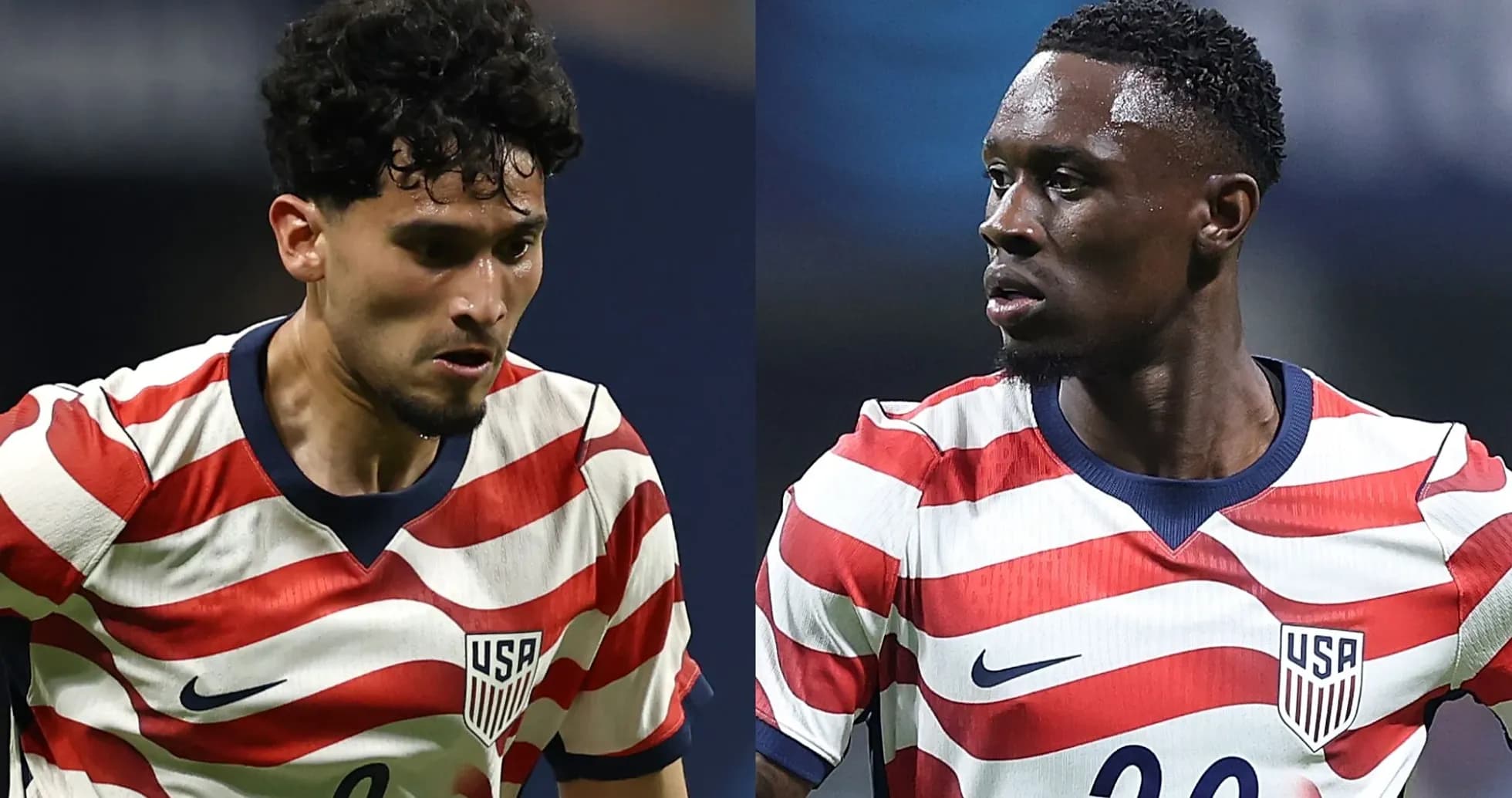
Balogun and Pepi: Rising Stars Ahead of the World Cup
Folarin Balogun and Ricardo Pepi are arriving at the same destination from very different roads. One came through Arsenal’s academy and a €40 million move to Monaco. The other fought his way from Augsburg to PSV, often from the bench. Both, though, are now staring at the same horizon: a home World Cup and the lure of the Premier League.
Balogun: From Arsenal fringe to Monaco spearhead
Born in New York but forged in north London, Balogun never truly broke through at Arsenal. Ten competitive appearances, two Europa League goals, and a sense that the pathway was blocked.
So he went to Reims and exploded.
Twenty-two goals in Ligue 1 changed everything. Monaco paid big money in 2023, and this season he delivered his most complete campaign yet, hitting 19 goals across all competitions and looking every inch a top-level No. 9.
That body of work has turned him into something else in the eyes of European recruiters: not a prospect, but a proven scorer in a major league.
Brad Friedel sees it the same way.
The former USMNT goalkeeper, speaking to GOAL in association with MrQ, believes Balogun is already built for the sharp end of English football.
“With Balogun, I think Balogun could play at one of the big boys and deal with the perception and reality situation, because I think he would be deemed more of a seasoned player,” he said, stressing that the difference is about experience, not raw talent.
In other words, if a Manchester United or an Arsenal came calling now, Friedel wouldn’t flinch.
Pepi: The impact striker ready for a step up
Pepi’s route has been less glamorous, more stop-start, but no less impressive in its own way.
He arrived in Europe with Augsburg in January 2022, a young striker thrown into the grind of the Bundesliga. The goals didn’t flow there, but the education did. The real breakthrough came with PSV.
This season, he matched Balogun’s 19-goal haul across all competitions, helping PSV to yet another Eredivisie title. He did it without always starting, often asked to change games late, to live on scraps and still deliver.
Friedel is convinced that profile fits the Premier League too, with one important caveat.
“Both of them could play in England for sure, depending on the size of the club,” he said. “I think someone like Pepi would need to be one of the mid to lower teams. Something like Brentford, Bournemouth, Fulham.”
Not because of quality, but because of timing and pressure.
“I think if he moved to a Manchester United or Arsenal, it would be too much for him, too quick,” Friedel added.
That’s not a slight. It’s a roadmap.
A club like Fulham makes particular sense to him. Pepi has already been linked there, and Friedel sees echoes of Raul Jiménez in the American’s game: strong in the box, good in the air, a penalty-area striker who thrives on service.
“I think that would actually be a seamless transition,” he said, reaching back to Fulham’s American lineage. “It’s almost like how Fulham had Brian McBride going and Clint Dempsey coming in… so it’s very similar like that, the comparison of Pepi and Jimenez.”
Brentford, Bournemouth, Fulham: clubs that demand, but don’t devour. Clubs where a young forward can make mistakes, learn fast, and still be trusted.
Friedel’s bottom line is clear: “I wouldn’t be surprised at all to see Balogun or Pepi in England next season, and I think they could both be successful in the Premier League.”
Pochettino’s call: Balogun first, Pepi as the hammer off the bench
Before any transfer tug-of-war begins, there’s the small matter of a World Cup on home soil.
Balogun and Pepi are not just chasing club moves; they’re fighting for the same shirt, the same starting role, in a tournament that will define a generation of U.S. players.
Asked who he would pick if he were in Mauricio Pochettino’s technical area, Friedel didn’t hesitate.
“Balogun would be my pick,” he said. The reasoning is tactical as much as technical.
“If you look historically at Pochettino’s teams, he usually likes to have players who play very vertically and who are really dynamic, and that’s more of what Balogun is.”
Pochettino’s best sides at Southampton, Tottenham and beyond have been built on forwards who stretch the pitch, run behind, press relentlessly. Balogun fits that blueprint.
Pepi, though, is no understudy in Friedel’s eyes. He’s the change of angle, the different problem.
“And then to have the option of Pepi, who again will work really hard, but is very good in the box, good in the air, to come off the bench.”
In a World Cup played in summer heat across the United States, that rotation won’t be a luxury. It will be a necessity.
Friedel can already see it: minutes shared, roles tweaked, plans adjusted game by game.
“I could also see a little bit of a rotation in the group phase, because it’s also going to be very hot over here. And the players have just come off, those two especially, a long season. So you could see Mauricio maybe wanting to take a different tactical approach against Paraguay and Australia.”
Different opponents, different weapons. Balogun’s vertical threat one night, Pepi’s penalty-box presence the next.
A warning called Turkiye
The real edge to Friedel’s analysis comes when he looks at the group.
The U.S. will want the job done early. The last thing they need is a must-win finale against a side that can keep the ball and punish nerves.
“Hopefully, they have points in the bag by the time they play Turkiye,” he said. “Because if they’re not careful by the time they get to Turkiye, and they have to win that match, Turkiye is a very talented possession-based team.”
That is where the choice between Balogun and Pepi, and how Pochettino uses them, could define more than just a single tournament.
Two American strikers, two rising European careers, one shared stage at a home World Cup. The Premier League can wait. The real audition starts in 2026.