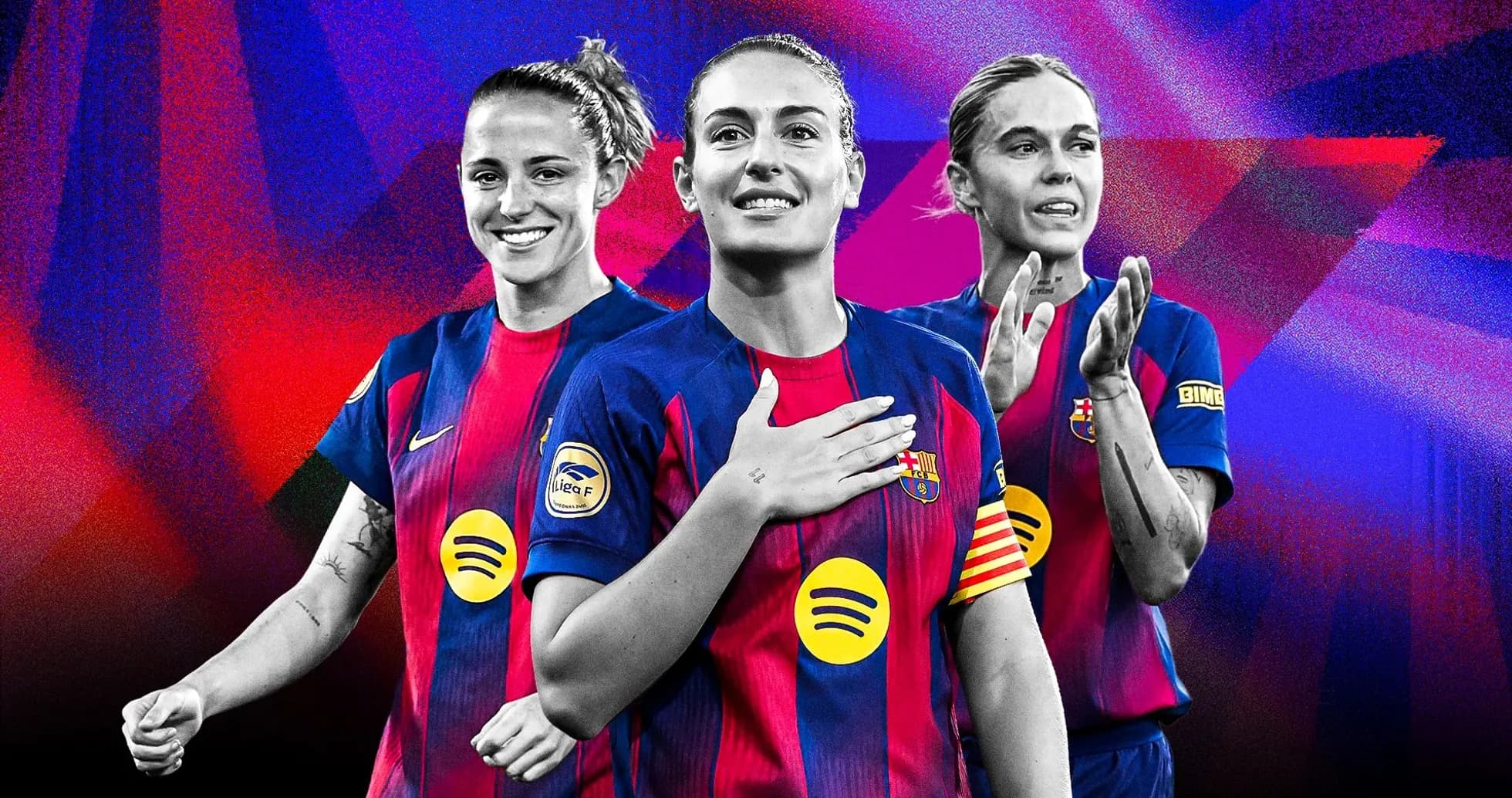
Barcelona Faces Major Departures: Putellas, León, and Batlle Leave
Barcelona know how to celebrate European titles. They also know how to say goodbye.
This summer, they must do both at once.
Alexia Putellas, Mapi León and Ona Batlle are not just three departures. They are the spine of an era. Putellas, the captain and cultural reference point. León, arguably the best centre-back in the women’s game. Batlle, an elite full-back at the peak of her powers. Between them, they leave gaps in quality, personality and experience that no club can simply brush aside.
Yet if any institution is built to absorb that kind of shock, it is Barça.
Icons out, questions in
On the pitch, the loss is brutal. Putellas has been so influential this season that a third Ballon d'Or feels like a realistic next chapter to her story. León has anchored the back line with a calm authority and a passing range that starts half of Barça’s attacks. Batlle’s energy and precision down the flank has been central to a team that suffocates opponents from every angle.
Those are three world-class players leaving a European champion in one swoop.
Off the pitch, the damage might be even more complex. Putellas is not just the captain; she is the standard. The one others look at in the dressing room when the noise outside grows. The one young players orbit around.
Esmee Brugts summed it up neatly when she spoke recently about the 32-year-old’s influence. Putellas, she said, is the main example of how experienced players should lead, someone who calms her down on the pitch and gives her the confidence to play her own game. Strip that out of a squad and you’re not just losing a midfielder. You’re losing a compass.
La Masia and the market
Barcelona’s answer, traditionally, has come from two places: La Masia and smart recruitment.
La Masia remains a production line unlike anything else in the women’s club game. This season forced that factory into overdrive. Jonatan Giráldez’s successor Marc Romero turned inward, promoting teenagers Clara Serrajordi and Aicha Camara into regular first-team roles. Martine Fenger, Carla Julia and Adriana Ranera all tasted senior football. Sydney Schertenleib, Brugts herself, Vicky López and Kika Nazareth had to shoulder more weight than their ages suggest they should.
They didn’t do it alone. Putellas, as captain, stood at the centre of that process. She set the tone, offered the words, took the pressure. Remove her and the dynamic changes overnight.
So the question becomes: who carries that mantle now? Patri Guijarro, Aitana Bonmatí and Irene Paredes are obvious candidates. They are serial winners, big personalities, players whose voices already carry. But leadership is not something you assign; it is something you grow into. This coming season will reveal who actually steps forward when the dressing room door closes.
Then there is the transfer market.
Twelve months ago, Barcelona’s hands were tied. The men’s team’s financial problems bled across the club, with La Liga’s Financial Fair Play regulations squeezing the women’s side as well. That restricted what they could do, who they could chase, how bold they could be.
The landscape looks different now. Hansi Flick’s team has just sanctioned a £69 million ($93m) move for Anthony Gordon. That kind of fee suggests the purse strings at Camp Nou are loosening. If the men can spend, the women should feel some of that freedom too.
But freedom to spend is not the same as spending well. Replacing a world-class right-back, a world-class centre-back and a world-class midfielder in one window is a puzzle even for the best sporting departments. Get one piece wrong and the balance of a team that has dominated Europe can shift quickly.
Spain watching closely
This is not just a Barcelona story. It is a Spain story.
León is expected to join London City Lionesses, who finished sixth in their first Women’s Super League season. Putellas may follow her to the English capital. Batlle is set for Arsenal, the side that beat Barça in the 2024-25 Champions League final.
Batlle’s move looks the most straightforward on paper. She goes from being a nailed-on starter in a Barça team fighting on four fronts to a nailed-on starter in an Arsenal side contesting three, with new League Cup rules excluding Champions League clubs. The WSL is stronger than Liga F, but the reduction in competitions should roughly balance the physical load. Different colours, similar demands.
León’s situation is very different. London City Lionesses will not be in the Champions League. The calendar will be lighter, the midweeks less punishing. If Putellas joins her, the same applies. They will swap the relentless, high-stakes rhythm of Barça for a schedule with fewer games but a higher baseline of domestic competition.
Because while the Champions League lights won’t shine on them every few weeks, the WSL offers a weekly grind against Arsenal, Chelsea, Manchester City, Manchester United and more. The intensity will still be there. It will just be spread differently.
From Spain’s point of view, that might be ideal. Two of their most important players, both in their 30s, could arrive at the 2027 Women’s World Cup with fewer miles in their legs but without dropping their competitive level. Less wear and tear, same sharpness. For a national team trying to defend a world title, that is a tantalising prospect.
La Masia’s fingerprints on La Roja
The other side of this equation is what happens at Barça when stars leave. If the club turns again to La Masia to fill the gaps, Spain stands to benefit.
Serrajordi is the clearest example. The teenager has grown more assured with every appearance since her senior international debut in October. She is already in the Spain squad for Friday’s clash with England. If she, and others like her, take on bigger roles at club level in the wake of these departures, La Roja’s depth will swell.
The pipeline is already obvious. Of the current Spain squad, 11 players are Barça players. Jana Fernández and Lucía Corrales also came through the club’s system before being sold last summer when the financial reality demanded painful decisions. The education those players receive in Catalunya is elite, and the national team is cashing in.
So while Barça wrestle with how to replace icons, Spain might quietly be winning.
No collapse in sight
There will be anxiety in Barcelona. You do not lose Putellas, León and Batlle and shrug. But this is a club that has weathered exits before. Mariona Caldentey, Lucy Bronze, Keira Walsh and Sandra Paños all moved on before or during the 2024-25 season. The response was emphatic: trophies, performances, questions answered.
This remains a world-class squad, underpinned by an academy that keeps delivering and a core group that knows only how to compete for titles. The road ahead will not be smooth; there will be awkward afternoons, defensive recalibrations, moments when the absence of that familiar No. 11 in midfield feels particularly stark.
Yet nothing about Barcelona suggests a sudden collapse.
What it does suggest is a summer of hard decisions, bold recruitment and accelerated promotions. A summer that could subtly reshape Spain’s champions and, by extension, the world champions they feed.
For Barça, the task is to reinvent without losing their edge. For Spain, the question is more intriguing: when the 2027 World Cup kicks off, will this turbulent window be remembered as the moment that actually made them stronger?