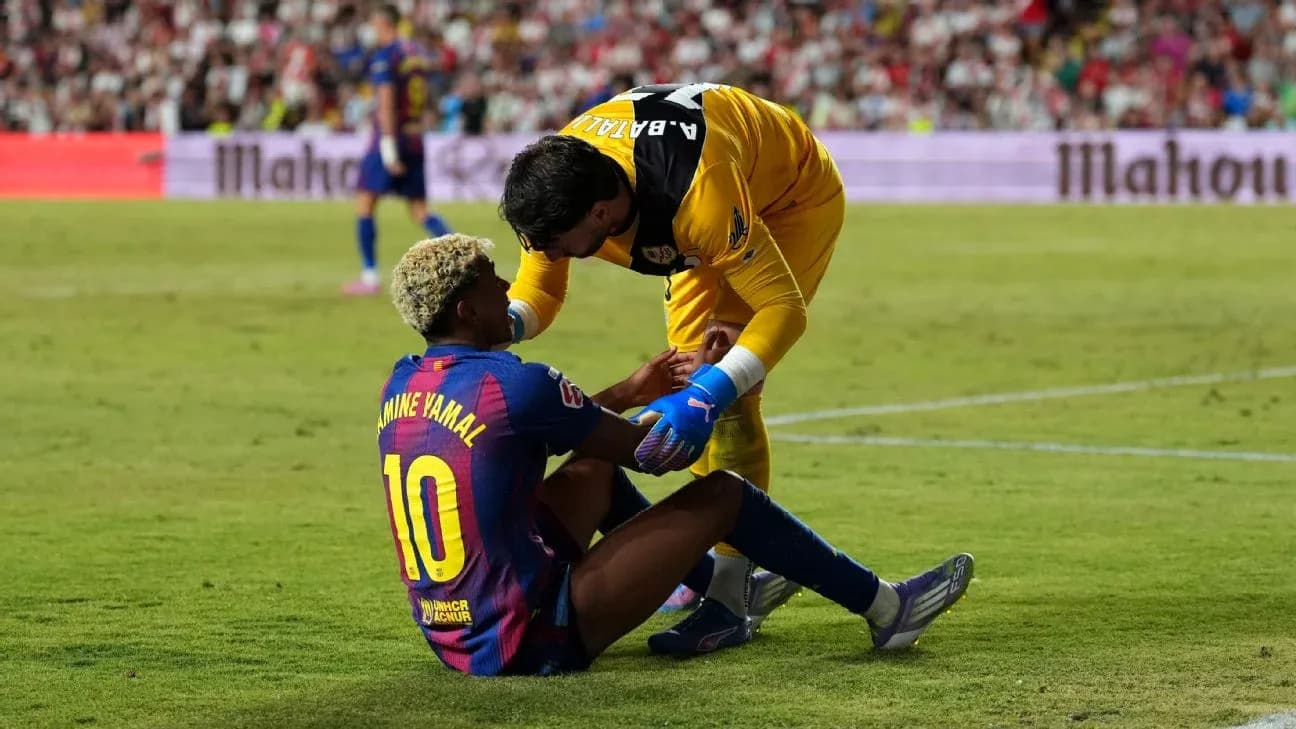
Barcelona's Dominance Confirmed in 1-0 Victory Over Rayo Vallecano
Camp Nou has seen a lot of statement wins this season, but Barcelona’s 1-0 victory over Rayo Vallecano in Round 29 felt like a controlled confirmation of hierarchy as much as a spectacle. The league leaders, flawless at home so far, tightened their grip on La Liga’s summit with a performance that mirrored their statistical DNA: heavy possession, layered attacking structure, and a defence that quietly strangles games.
Coming into this fixture, the standings already framed a clash of opposites. Barcelona sat No. 1 with 73 points from 29 matches, a +50 goal difference, and a perfect 15 wins from 15 at Camp Nou. They have been a 3.1-goals-per-home-game machine, scoring 47 and conceding only 8 in their own stadium. Rayo Vallecano, 14th with 32 points and a -7 differential, arrived with a modest away record: 3 wins, 3 draws, 9 defeats, and just 12 goals scored on their travels against 24 conceded.
The 1-0 scoreline, already baked into those league totals, fits the season-long pattern. Barcelona’s campaign average of 2.7 goals for and 1.0 against per match narrows slightly here, but the structural dominance remains: 24 wins in 29, only 4 defeats, and not a single home draw or loss. Rayo’s overall return of 28 goals in 29 games – just 1.0 per match – underlines how thin their margin for error is when visiting the division’s most ruthless home side.
Both coaches leaned into familiarity with matching 4-2-3-1 shapes. Hansi Flick’s version is now the league’s reference model, used 19 times in 29 rounds, and this lineup was very much his current blueprint: J. Garcia in goal behind a back four of J. Cancelo, P. Cubarsi, R. Araujo and G. Martin; M. Bernal and Pedri as the double pivot; Lamine Yamal, Fermín and Raphinha supporting R. Lewandowski. Inigo Perez mirrored the structure: A. Batalla in goal, A. Ratiu, F. Lejeune, P. Ciss and P. Chavarria across the back, with P. Diaz and O. Valentin holding, C. Martin, G. Gumbau and F. Perez behind Isi Palazon.
If Barcelona’s XI looked like a statement of continuity, the absences revealed the tactical void Flick has had to navigate. A. Balde, A. Christensen and J. Kounde were all out with injuries, stripping him of three first-choice defenders. F. de Jong’s hamstring problem removed the side’s most press-resistant midfielder. That forced the continued elevation of P. Cubarsi and G. Martin, and increased responsibility on M. Bernal as the single true holding profile. The fact Barcelona have still produced 8 home clean sheets so far speaks to how effectively those replacements have been integrated.
Rayo’s own missing pieces were more about depth and discipline. I. Akhomach and D. Mendez were unavailable through injury, but the more telling absence was N. Mendy, suspended after a red card. His profile – a defender with 16 blocked opponent attempts and strong duel numbers – would have been invaluable against a side that averages 3+ goals at home. Without him, Perez leaned on F. Lejeune and P. Ciss to absorb pressure, with Ciss bringing the aggression of a player who has already seen 2 reds and 5 yellows this season.
Discipline was always likely to be a sub-plot. Barcelona’s yellow-card timing skews heavily towards the second half: 23.91% of their bookings arrive between 46-60 minutes, another 23.91% from 76-90, with a further 17.39% in added time (91-105). Rayo’s caution profile is more back-loaded still, peaking between 61-75 minutes (20.00%) and then holding high from 46-60 and 76-90 (both 17.50%), while their reds cluster late: 25.00% in both the 61-75 and 76-90 windows and 37.50% in 91-105. In a match where Barcelona routinely turn the screw after the interval, that tendency towards late, high-stress cards was always going to be dangerous for the visitors.
Within that framework, the key narrative matchups told the story. “The Hunter vs. The Shield” was Lamine Yamal and the Barcelona frontline against a Rayo defence that, away from home, concedes 1.6 goals per game. Lamine arrived as one of La Liga’s most devastating dual threats: 14 goals, 9 assists, and among the highest-ranked players in the league (ratingPosition 3). His 220 dribble attempts with 119 successes, 63 key passes and 47 fouls drawn make him the player most likely to dismantle a mid-table block over 90 minutes. Rayo’s response hinged on F. Lejeune’s positioning and P. Ciss’s ability to step out and disrupt without overstepping the disciplinary line he has flirted with all season.
In the “Engine Room Duel”, Pedri and Fermín dictated Barcelona’s tempo against P. Diaz and O. Valentin. Pedri, ranked among the league’s top creators (ratingPosition 6 in assists), has 48 key passes and 90% pass accuracy, while also contributing 37 tackles and 19 interceptions. He is not just the metronome; he is the first line of counter-press. Fermín, with 8 assists and 32 successful dribbles from midfield, offers the vertical thrust. Opposite them, P. Diaz and Valentin were tasked with neutralizing that axis while still providing an outlet for transitions – a tall order against a side that has failed to score in exactly zero home matches so far.
Depth tilted the scales further. Flick’s bench is stacked with game-changers: Ferran Torres (12 league goals), Dani Olmo (7 goals, 6 assists), M. Rashford (6 assists), and R. Bardghji as another direct wide threat. Any of them could come on for a tiring starter and maintain or even raise the attacking tempo. By contrast, Rayo’s most explosive reserve option is Jorge de Frutos, their leading scorer with 10 goals and 1 assist, but he started this one on the bench. S. Camello and Alemao offer energy and movement, yet none carry the same individual gravity as Barcelona’s substitutes.
The statistical prognosis before and after the fact points in the same direction. Barcelona’s flawless home record, 3.1 goals scored and just 0.5 conceded per home game, and 12 clean sheets overall set a platform that Rayo’s anaemic away attack – 0.8 goals per match, 8 away blanks to date – struggled to meaningfully threaten. With Lamine Yamal operating as the league’s No. 1 assist provider and among its top scorers, and with Pedri and Fermín orchestrating behind him, the decisive factor was always likely to be whether Rayo could survive the second-half pressure without a lapse or a card-induced crack.
They could not. The 1-0 final at Camp Nou fits the underlying numbers: Barcelona dictating and eventually exploiting, Rayo largely neutralized. For Flick’s side, it is another step in a season that, statistically and tactically, they continue to control on their own terms.