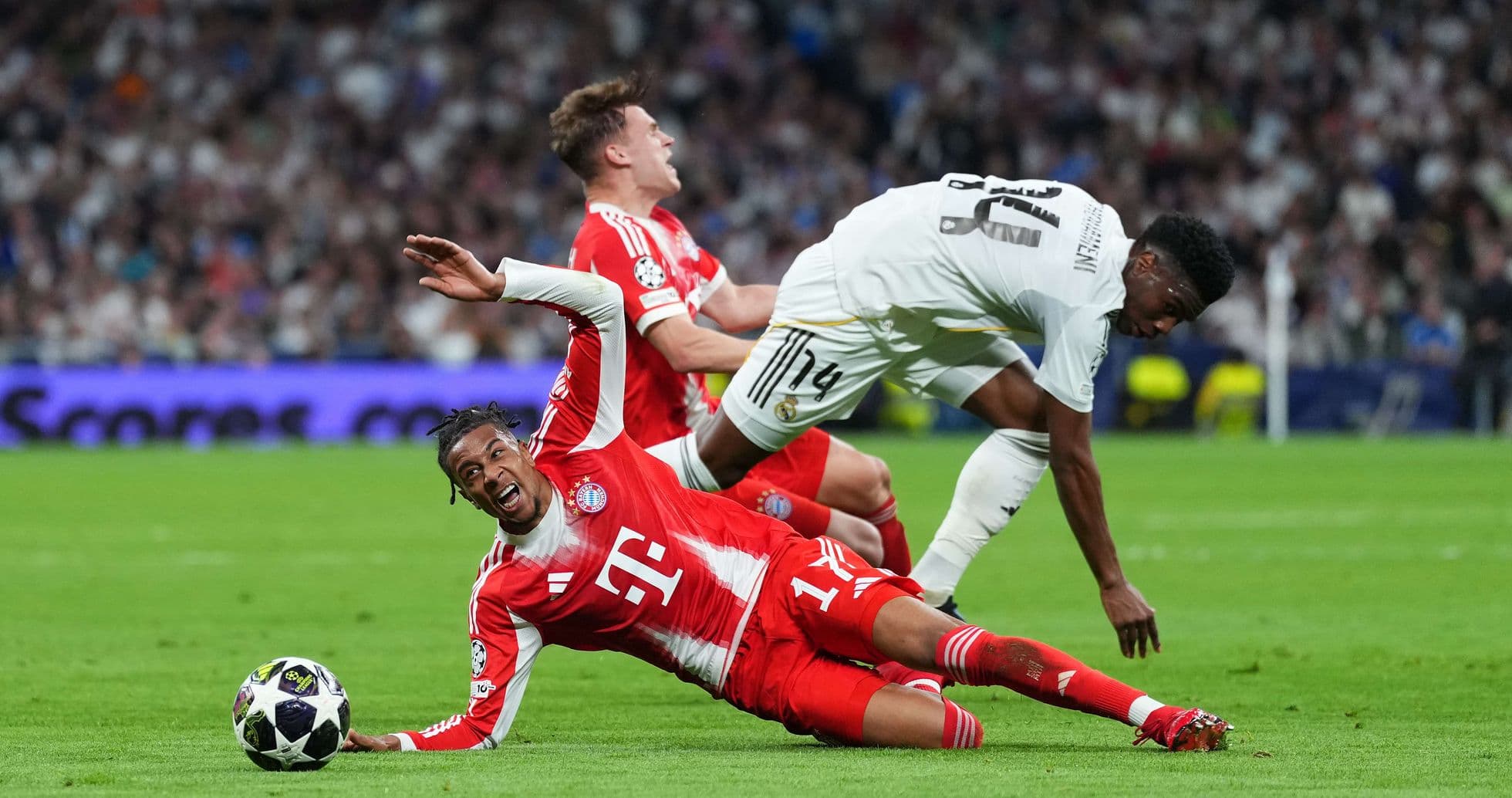
Bayern München Triumphs 2–1 Over Real Madrid in Champions League Quarter-Final
At the Bernabéu, Bayern München claimed a 2–1 away win over Real Madrid in the UEFA Champions League 2025 quarter-final, first leg, in a match defined by Bayern’s vertical efficiency and control of key moments. Despite near-parity in total shots (20–20) and a narrow possession split (52% Bayern, 48% Real Madrid), the German side translated their 2.92 xG into two decisive goals from Luis Díaz and Harry Kane. Real Madrid, in a 4-4-2, generated 2.2 xG and nine shots on target but were repeatedly denied by Manuel Neuer’s nine saves. Bayern’s compact 4-2-3-1 and superior blocking (6 vs 3 blocked shots) blunted Madrid’s late surge.
Scoring Sequence & Disciplinary Log
The game’s rhythm was shaped early by a tactical booking. At 37', Aurélien Tchouaméni received a yellow card for a foul, signalling Real Madrid’s need to break up Bayern’s counter-attacking transitions through the middle.
Bayern struck first. On 41', Luis Díaz opened the scoring for the visitors, finishing a move assisted by Serge Gnabry. The goal reflected Bayern’s plan: quick progression into the half-spaces, with Gnabry and Díaz attacking the channels behind Real Madrid’s full-backs. Bayern led 1–0 at the break.
Immediately after half-time, Bayern doubled their advantage. At 46', Harry Kane made it 2–0, assisted by Michael Olise. The timing, straight after the restart, underlined Bayern’s intent to press Madrid’s initial build-up and exploit any disorganisation between the lines.
Real Madrid responded after a triple substitution phase. At 74', Kylian Mbappé pulled one back, finishing from a Trent Alexander-Arnold assist to make it 2–1 and tilt the final quarter of the game towards sustained Madrid pressure.
Discipline was a major subplot. Beyond Tchouaméni’s 37' yellow, Bayern accumulated four bookings: Jonathan Tah for a foul at 70', Luis Díaz for a foul at 77', Manuel Neuer for time wasting at 82', and Jamal Musiala for a foul at 86'. These cards reflected Bayern’s increasingly reactive, game-management approach as Madrid’s pressure intensified. No VAR interventions were recorded in the event log, so all goals stood without additional review narratives.
Tactical Breakdown & Personnel
Real Madrid set up in a 4-4-2: Andriy Lunin in goal; a back four of Álvaro Carreras, Dean Huijsen, Antonio Rüdiger, and Trent Alexander-Arnold; a midfield line of Arda Güler, Aurélien Tchouaméni, Thiago Pitarch, and Federico Valverde; with Vinicius Júnior and Kylian Mbappé as the front two. This structure aimed to stretch Bayern laterally with wide midfielders while keeping two constant threats on the last line.
Bayern’s 4-2-3-1 had Manuel Neuer in goal; a back four of Konrad Laimer, Jonathan Tah, Dayot Upamecano, and Josip Stanišić; a double pivot of Joshua Kimmich and Aleksandar Pavlović; an attacking three of Luis Díaz (left), Serge Gnabry (central), Michael Olise (right) behind Harry Kane. The double pivot was crucial in controlling the central corridor and screening passes into Mbappé’s feet.
Bayern’s out-of-possession shape was compact, with Kimmich and Pavlović protecting the half-spaces and the back four holding a relatively high line. This allowed them to maintain 52% possession and connect short through Kimmich (part of a 493-pass total at 89% accuracy). Their six blocked shots, compared to Real Madrid’s three, show how effectively they closed shooting lanes at the edge of the box, especially against Valverde and Güler.
Real Madrid’s main route was right-sided overloads. Alexander-Arnold frequently advanced from right-back to form a three-man triangle with Valverde and Mbappé. The goal at 74' crystallised this pattern: Alexander-Arnold (shirt 12) advanced high, delivered quality service, and Mbappé (shirt 10) attacked the space between centre-back and full-back to finish.
Carlo Ancelotti’s in-game adjustments were clear in the substitutions. At 62', Éder Militão (IN) came on for Dean Huijsen (OUT), likely to add recovery pace and more aggressive front-foot defending. Simultaneously, Jude Bellingham (IN) came on for Thiago Pitarch (OUT), shifting Madrid towards a more vertical, box-arriving midfield profile. At 71', Brahim Díaz (IN) replaced Arda Güler (OUT), injecting dribbling and inside movements from wide to overload central zones. These changes corresponded with Madrid’s most dominant spell, culminating in their goal and a series of chances that pushed Neuer to his nine-save tally.
On the Bayern side, Thomas Tuchel’s substitutions were about protecting the lead and refreshing wide energy. At 69', Alphonso Davies (IN) came on for Konrad Laimer (OUT), adding pace on the left to deal with Vinicius and offer an out-ball on counters. In the same minute, Jamal Musiala (IN) replaced Serge Gnabry (OUT), giving Bayern more ball-carrying ability to relieve pressure. Late, at 90+3', Leon Goretzka (IN) came on for Aleksandar Pavlović (OUT), adding aerial presence and physicality in central midfield, while Tom Bischof (IN) replaced Luis Díaz (OUT) to help manage the final moments.
Goalkeeper reality was decisive. Andriy Lunin made 5 saves, with Real Madrid’s team-level “goals prevented” at 1, indicating he kept the tie alive despite Bayern’s 2.92 xG and 13 shots inside the box. However, Neuer’s 9 saves and Bayern’s own 1 goal prevented were even more critical, especially in the final 30 minutes when Madrid’s 12 shots inside the box and sustained pressure threatened an equaliser. The difference in save volume (9 vs 5) underlines Neuer’s superior workload and impact, not a symmetry.
The Statistical Verdict
Statistically, Bayern edged the tactical battle. They matched Real Madrid’s 20 total shots but with higher shot quality (2.92 xG vs 2.2) and more presence in dangerous zones (13 vs 12 shots inside the box). Their 52% possession and higher passing accuracy (89% vs 85%) show a slight but meaningful advantage in ball control and circulation, particularly through Kimmich and Pavlović.
Defensively, Bayern’s 6 blocked shots to Madrid’s 3 reflected a more compact, sacrificial block in front of Neuer, which, combined with his 9 saves, underpinned their ability to absorb Madrid’s late onslaught. Fouls were balanced at 12–12, but the card distribution (1 yellow for Real Madrid, 4 for Bayern) illustrates how Bayern increasingly resorted to tactical fouling and time management once ahead.
Overall, the numbers validate the narrative: Bayern were more efficient in both boxes, Real Madrid’s adjustments narrowed but did not close the gap, and the 2–1 away win sets Bayern up with a narrow yet deserved advantage heading into the second leg.