Boavista: The Rise and Fall of a Portuguese Football Giant
Boavista are gone. Not relegated. Not “rebuilding.” Extinguished.
A court order issued on 16 July 2026 told the Porto club to cease all activities by 31 July and hand over its premises, drawing a brutal line under more than a century of history. Years of financial chaos, unpaid debts and failed restructuring attempts finally caught up with a club that once dared to break Portuguese football’s glass ceiling.
For Celtic supporters, the news lands with a jolt of memory as much as sadness. Boavista were never just another European opponent. They were part of the story.
From Hoops and Numbers to a New Name in Europe
Celtic first met Boavista in the 1975 Cup Winners’ Cup. Back then, the Portuguese side were a curiosity rather than a heavyweight, a rising name from Porto rather than one of the big Lisbon giants.
The first leg in Porto finished 0-0. Tight, cagey, forgettable to neutrals, but it set the stage.
Two weeks later, Celtic Park supplied the colour. Under the lights on 5 November 1975, Celtic won 3-1, with Kenny Dalglish, Shuggie Edvaldsson and Dixie Deans on the scoresheet. The goals told only half the story.
That night was also a quiet landmark for the club: the first time those famous green-and-white hoops carried squad numbers on their backs. A small detail, but a symbol of the game modernising, even as the old stadium roared with something timeless.
Boavista left Glasgow beaten on aggregate, 3-1, but not forgotten.
The Night Larsson Broke Them
For most Celtic fans, though, the word “Boavista” doesn’t conjure 1975. It drags you straight back to spring 2003 and the white‑knuckle run to Seville.
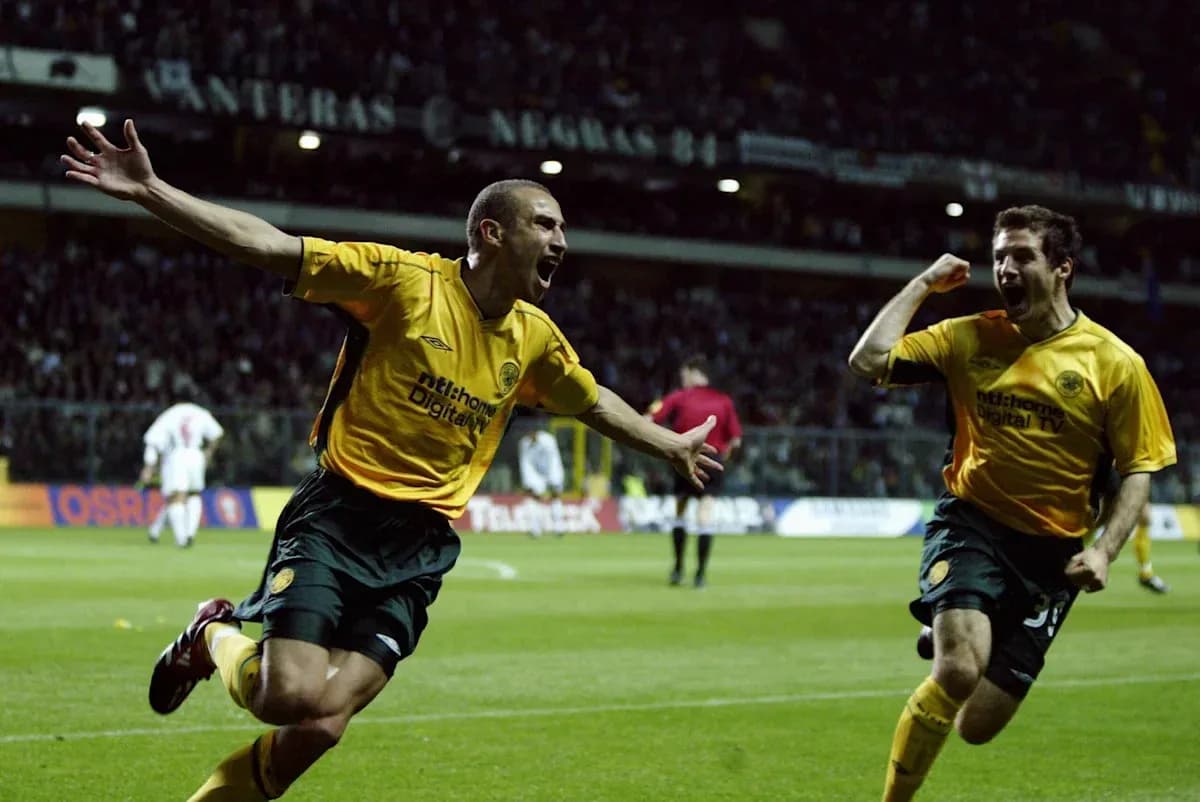
The UEFA Cup semi-final first leg at Celtic Park finished 1-1. Henrik Larsson scored the equaliser that night, a familiar figure in a competition he seemed determined to bend to his will. Boavista were disciplined, awkward, and utterly unafraid of the atmosphere. They left Glasgow with an away goal and a sense that they could finish the job back in Porto.
The return leg at the Bessa Stadium on 24 April 2003 was not a classic in the purist’s sense. It was a grind, a test of nerve as much as talent. Boavista dug in, spoiled, frustrated. Every minute that ticked by without a Celtic goal tightened the knot in the stomach.
Then Larsson struck.
One moment, tension. The next, eruption. His winner sealed a 1-0 victory on the night and a 2-1 aggregate triumph, sending Celtic to a historic European final against Boavista’s city rivals, Porto. Martin O’Neill’s embrace of Larsson at full-time remains one of those enduring images: relief, joy, and the sense that something special had just been secured.
The final in Seville is a different story, one that still stings. But Celtic do not reach that stage without Boavista standing in the way – and Larsson pushing them aside.
The Club That Broke the Cartel
Boavista were never meant to crash the party in Portugal. Founded in 1903, they grew in the shadow of Benfica, Porto and Sporting Lisbon, the “big three” who traditionally divided the honours between them.
Yet in 2001, Boavista did the unthinkable. They won the Primeira Liga, becoming the first – and still the only – club outside that trio to be crowned champions of Portugal. Nine major honours in total, but that title stands alone, a black-and-white interruption in a landscape of red, blue and green.
They were awkward opponents, a club that made the elite uncomfortable. That was their identity. That was their pride.
A Slow Unravelling
The fall did not come in one dramatic collapse. It dragged on, season after season, as financial problems mounted and the football side tried to survive amid the wreckage.
Boavista were hit with a ban on signing players for five transfer windows, a punishment that crippled any chance of rebuilding properly. When the shackles briefly came off, the response was desperate rather than measured: nine players signed in a single day in February 2025. It looked like a club scrambling to plug holes in a sinking ship.
On the pitch, the slide continued. In the 2024/25 season, Boavista finished bottom and were relegated after a 4-1 defeat away to Arouca on the final day. Around 2,000 travelling fans watched the collapse and some invaded the pitch in anger and disbelief. It felt like a breaking point.
The Portuguese league authority then barred Boavista from playing in Liga Portugal 2. Relegated side Oliveirense, suddenly, had a reprieve. Boavista did not.
Attempts to reposition the club followed. Registration for the third-tier and fourth-tier Campeonato de Portugal was refused in 2025. A change of company structure saw Boavista’s name attached to a side entering the Liga Pro, the new elite competition of the Porto Football Association, while the club itself fielded a team in the fourth division of the district leagues.
It was messy. Fragmented. A once-unified institution split between legal entities and footballing realities.
The club-run team started failing to show for fixtures, racking up defeats by default. By the end of October, that side withdrew from competition altogether. Each step felt smaller, more desperate, more removed from the club that once stared down Celtic in a European semi-final.
The Final Whistle
The end, when it came, was legal rather than sporting.
On 16 July 2026, a court ordered Boavista to cease all activities by 31 July and surrender its premises. Years of unpaid obligations to creditors, years of attempted debt restructuring, had finally met an immovable object in the legal system. The club’s insolvency was no longer a looming threat. It was a fact.
In simple terms, Boavista failed to pay what they owed. The punishment is total: extinction, at least in their current form.
In modern football, of course, nothing ever truly disappears. Names re-emerge with a “FC” or a “1911” or a “United” bolted on. Supporters’ groups rally, form phoenix clubs, cling to colours and crests and songs. There are already murmurings about a rebirth, perhaps under a banner like “The Boavista FC.”
But that would be something new, however familiar the stripes. The Boavista who stopped Celtic in Porto in 1975, who pushed them to the brink in 2003, who tore down Portugal’s established order in 2001 – that club has been ordered to switch off the lights.
For Celtic fans, Boavista will always be part of a cherished chapter: the grind to Seville, the roar after Larsson’s goal, the feeling that Europe once again belonged to the club in green and white hoops.
Now the name that once stood in the way of that dream has been reduced to a cautionary tale about money, mismanagement and the fragile life of even the proudest clubs.
In an era where balance sheets dictate survival as much as league tables, how many more Boavistas are waiting for their own final whistle?