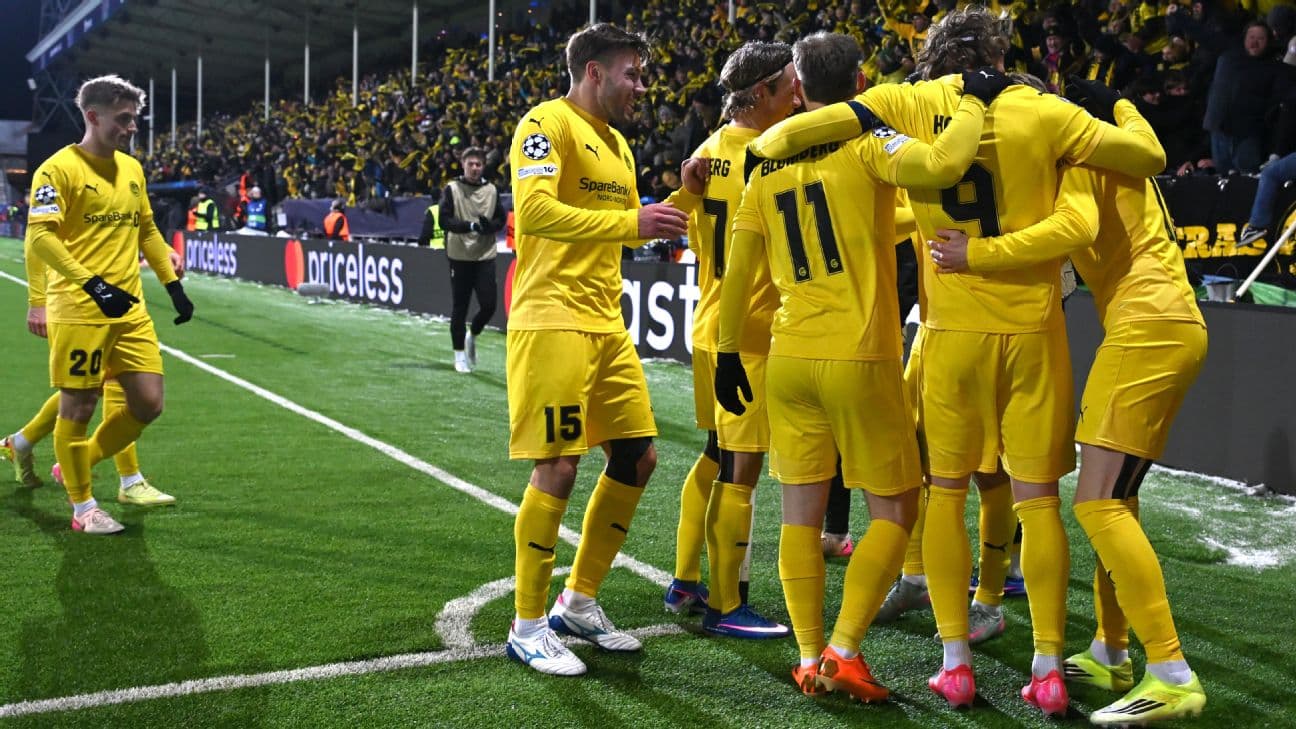
Bodo/Glimt Outplays Inter in Champions League Clash
Inter had more of the ball but not the better plan. With 58% possession and 607 total passes at 87% accuracy, the Italians controlled circulation, especially through their 3-5-2 midfield. Yet Bodo/Glimt, with only 42% possession and 452 passes at 81% accuracy, controlled the key spaces. Their 4-3-3 compacted central areas and invited Inter into the final third, then sprang forward with direct, vertical attacks. The Norwegian side accepted playing without the ball, focusing on efficiency and tempo changes rather than long settled spells. The 3-1 scoreline reflects a game where territorial and ball dominance did not translate into control of decisive moments.
Offensive Efficiency
The shot profile underlines the contrasting game plans. Inter produced 15 total shots to Bodo/Glimt’s 8, including 13 attempts from inside the box, suggesting sustained occupation of the attacking third. However, only 4 of those 15 were on target, a sign of wastefulness and difficulty in creating clear, balanced shooting situations despite a higher xG of 1.56. Their 3 corner kicks matched Bodo/Glimt’s 3, indicating that territorial advantage did not snowball into overwhelming set-piece pressure.
Bodo/Glimt were far more selective and clinical. Of their 8 total shots, 6 were on target and 7 came from inside the box, a very high accuracy and shot quality ratio. With an xG of just 1.19, turning that into 3 goals highlights ruthless efficiency and well-timed attacks rather than constant volume. The 4-3-3 structure allowed wide forwards and advanced midfielders to attack spaces behind Inter’s wing-backs, using quick combinations rather than long possession chains. Their limited but high-quality shot volume shows a game plan built on few but clear chances, exploiting Inter’s stretched shape in transition.
Defensive Discipline & Intensity
Out of possession, Bodo/Glimt balanced aggression with control. They committed 12 fouls to Inter’s 6, reflecting a deliberate readiness to break up rhythm and halt Inter’s positional attacks before they became dangerous. Yet only 1 yellow card suggests these interventions were controlled rather than reckless. Defensively, they allowed 15 shots but limited Inter to just 4 on target, helped by 1 blocked shot and compact central defending.
Inter, despite chasing the game, remained relatively clean with only 6 fouls and 1 yellow card, but that lower foul count also hints at insufficient tactical fouling to stop transitions. Both goalkeepers made 3 saves, indicating that Bodo/Glimt’s defensive block forced Inter into lower-quality finishing, while Inter’s back line and Sommer could not match that control inside their own box.
Bodo/Glimt’s compact 4-3-3, disruptive 12-foul defensive work, and ruthless conversion of 6 shots on target from just 8 attempts trumped Inter’s 58% possession, 15-shot volume, and higher xG. Efficiency, not domination of the ball, decided this Champions League tie.