Borussia Dortmund’s Season Review: Players’ Performances Analyzed
The numbers tell one story. The tone of this season tells another. Borussia Dortmund stumbled through a campaign in which a handful of players carried the load, others flickered, and too many never really arrived. Strip it down, and you see a squad split between reliability, raw promise and expensive frustration.
Kobel: The Last Line, Almost Always the Best One
If there was one constant in yellow and black, it stood between the posts. Gregor Kobel played more minutes than anyone, 4,260 of them, across 47 competitive matches. He conceded 57 goals, yet the raw figure hides how often he bailed his team out. Eighteen clean sheets, countless spectacular saves, and a penalty shoot-out masterclass in Frankfurt – the Swiss keeper didn’t just protect results, he manufactured them.
His season wasn’t spotless. One needless pass against Freiburg led to Jobe Bellingham’s red card and stood out precisely because Kobel’s decision-making is usually so sharp. A rare blot on an otherwise elite campaign. Rating: 2.
Defence: One Rock, One Question Mark, One That Got Away
Nico Schlotterbeck returned from injury in September looking like he had never been away. Then the rhythm broke. His form oscillated, and with it his reliability. Directly involved in several goals conceded, the centre-back never quite shook off the uncertainty around his future. Five goals at the other end – a personal best in 37 matches and 3,290 minutes – underline his value on set pieces, but he is capable of far more defensively. Rating: 3.
Alongside him, Waldemar Anton quietly became the pillar Dortmund had been searching for. The former Stuttgart defender clocked 3,927 minutes in 44 matches and turned them into a catalogue of rugged, assured performances. He tackled with conviction, read danger early and attacked every duel. It was Anton, not Schlotterbeck, who emerged as the defensive linchpin. Rating: 2.
Then there was the cameo that left a mark: Aaron Anselmino. Loaned from Chelsea and short of rhythm, he impressed immediately, only to be halted by injury. When he returned, he looked anything but rusty – aggressive in the tackle, calm on the ball, mature beyond his 20 years. Ten matches, 585 minutes, one goal, one assist, and a sense that Dortmund had unearthed something. Then Chelsea triggered the buy-back clause in winter and took him home. Rating: 2.5.
At the other end of the experience scale, young Italian defender Reggiani was thrown in because of injuries and held his nerve. Nine games, 603 minutes, one goal. As the right-sided player in a back three, he often played it safe and leaned heavily on Anton’s guidance, but “decent” is not faint praise for a defender learning on the job at this level. Rating: 3.5.
Not every prospect stayed on track. Another 20-year-old defender stepped in early, impressed in a cup tie in Essen, then imploded five days later with a late penalty concession and red card on his Bundesliga debut. Six appearances, 311 minutes, no goals, no assists, and then a drop to the U23s. A harsh lesson, and one that comes without a rating.
On the left, Ramy Bensebaini quietly pieced together a strong season. Once settled, the Algerian combined technical quality with a sharper defensive edge. His role in the build-up was clean, his end product notable: seven goals and three assists in 32 matches, making him the most prolific player behind the attacking quartet of Guirassy, Brandt, Beier and Adeyemi. Rating: 2.5.
The right side told a different story. One full-back, last season’s “problem child”, started by backing up his words with improved performances. He cut out many of the glaring errors and showed full commitment going forward, but defensive duels remained a weakness. Six goal contributions (three goals, three assists) across 27 games and 1,501 minutes were respectable, yet not enough to hold off the charge of Julian Ryerson after the winter break. The result: a long spell on the bench and a €25 million fee that still looks steep. Rating: 4.5.
Jobe Bellingham, stepping up from England’s second tier, felt the jump. Early on, he played within himself, safe on the ball and shaky in defence. Gradually, he grew. By the end of the season he had started 29 of the 45 games he played, logged 2,665 minutes and delivered four assists, though no goals. Not a breakout year, but a foundation. Rating: 3.5.
Midfield: From Nmecha’s Control to Sabitzer’s Vanishing Act
In midfield, Felix Nmecha finally produced the season Dortmund had been waiting for. Across 42 appearances and 3,137 minutes, he often dictated the tempo, used his strength on the ball to break lines and showed the vision to accelerate play. He did drift at times, yet his absence through injury underlined his importance. Five goals and three assists were the numbers behind a genuine step up. Rating: 2.
Next to him, the story was far less convincing. Emre Can’s campaign never really started. Injured for months, the captain returned, saw his form swing wildly and then had to shut down his season early with a cruciate ligament tear. Sixteen games, 980 minutes, three goals – and a year that will be remembered mostly for what he couldn’t do rather than what he did. Rating: 3.5.
Marcel Sabitzer, with his experience and pedigree, should have been a stabilising force. Instead, his season became a study in disappearance. After a shaky pre-season, the Austrian briefly looked like he had found his rhythm, then faded again. In 34 appearances and 2,347 minutes, he scored once and assisted four times, but too often drifted out of games, unable to put his stamp on them. Rating: 4.5.
Salih Özcan’s year barely registered on the pitch. Left out of the Champions League squad, denied a summer move by injury and then promised more time by Niko Kovac after the winter break, he ended up with just 74 minutes across 12 appearances. No goals, no assists, no rating – and now no contract, as he leaves on a free.
Wings and Creativity: Numbers, But Not Always Influence
On paper, the Norwegian wide man’s season was remarkable. No goals, yet 18 assists in 42 games and 3,067 minutes, with 15 of those in the Bundesliga. Only Michael Olise and Luiz Diaz provided more in the league. His work rate and fighting spirit never dipped; he ran, pressed and created. In Europe, though, his technical ceiling showed. The top level punished his limitations. Rating: 2.5.
Julian Brandt, in his seventh season at the club, again delivered output without ever fully seizing the stage. Eleven goals and four assists in 41 games, only Guirassy scoring more. Fifteen goal contributions from just 24 starts is an excellent return. Yet the familiar frustration remained: the consistency you expect from a player of his talent still wasn’t there, and a few displays fell well below his standard. Dortmund, who chose not to extend his contract, must now replace both his numbers and his flashes of inspiration. Rating: 2.5.
On the opposite end of the spectrum stood Carney Chukwuemeka. The fee was high, the return modest. Across 38 matches he logged only 1,225 minutes, averaging just 32 per appearance and starting ten times. In mid-April at Hoffenheim he completed 90 minutes in a professional game for the first time. Three goals, two assists – flashes of the talent nobody doubts. The problem remains fitness and stamina. Until he builds a body that can handle the workload, his impact will stay sporadic. Rating: 4.5.
The veteran playmaker who ranked second among outfielders with 15 assists in the 2024/25 campaign never got going this time. Restricted mostly to a substitute role, he started only eight of his 16 appearances, clocked 732 minutes and managed two assists. When chances came, he didn’t convince. By winter, frustration had boiled over into a return to former club Brighton. Rating: 4.5.
Attack: Goals, Droughts and a Late-Blooming Star
Up front, the picture was complex. Serhou Guirassy still finished with 22 goals and six assists in 46 matches, contributing to 28 goals overall. That’s half the story. The other half is the epic drought: one goal in 13 Bundesliga games. His body language sagged, his frustration spilled over. A penalty dispute in Turin, a refusal to shake Kovac’s hand, visible irritation on the pitch – the leading scorer also became a lightning rod. Rating: 2.5.
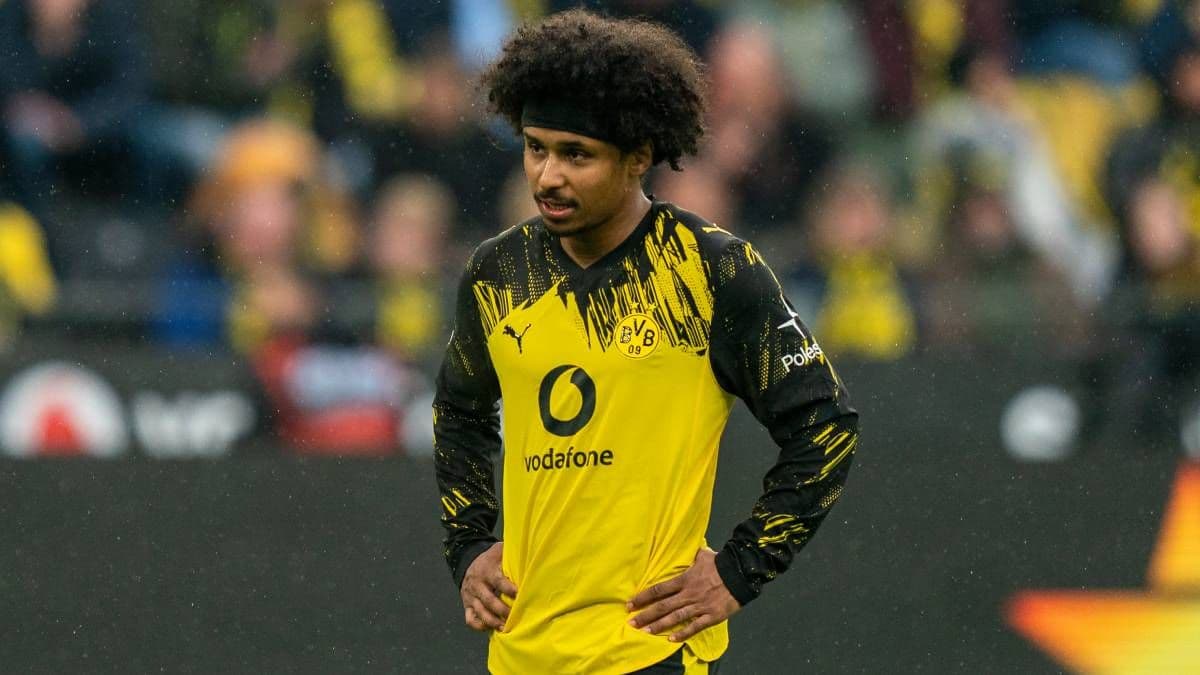
Kareem Adeyemi’s season split in two. Before the turn of the year, he was electric, involved in nine goals and finally looking like the player Dortmund thought they had signed. Then 2026 arrived, and the lights dimmed. Only six starts, a month out injured, and a steep drop in form. He still ended with ten goals and six assists in 39 games and 1,836 minutes, joint third-top scorer with Beier, but given his ability and the expectations heading into the World Cup, his second-half slump – layered over earlier disciplinary issues on and off the pitch – was a major disappointment. Rating: 4.
Max Beier, by contrast, became Dortmund’s revelation of the run-in. Six goals and seven assists in the second half of the season, ten goals and ten assists overall from 44 matches and 2,736 minutes. He rarely played where he truly wants to – either in a two-man strike partnership or as a central, deeper striker – yet still imposed himself. Used increasingly as a left midfielder, he remained a constant threat. On this form, a World Cup call-up with the DFB looks likely. The challenge is simple: keep this level. Rating: 2.5.
Behind them, the new striker spent much of the year trying to catch up. Arriving injured, he often had to settle for short cameos. When he started, the energy was there, the end product was not. Three goals and seven assists in 39 games and 1,181 minutes hint at a useful squad player, but a forward at Dortmund needs sharper numbers. Next season will be his real audition. Rating: 3.5.
And then there is the future. Inacio, only 18, has already turned heads. Kovac’s verdict – “sees things that others don't see even at 30” – matches the eye test. Across seven appearances and 383 minutes, the Italian showed why. He drifted into pockets between the lines, worked hard off the ball and constantly appeared in dangerous spaces. One goal on the board, and the feeling that with a little more precision he could already have had three or four. No rating yet, but the promise is obvious.
The Relentless Engine
Amid all the fluctuation, one player ran and ran: the Swedish midfielder who quietly logged the third-most minutes in the squad. Forty-five matches, 3,462 minutes, four goals, two assists. In the first half of the season, he barely missed a game, covering huge distances and showing tactical discipline. Going forward, though, he often lacked presence. The calendar year 2026 became a mixed bag for him, a reminder that work rate alone is not enough at this level. Rating: 4.
The Footnotes – and the Question
At the fringes, a cluster of names never made it onto the pitch. Alexander Meyer, Patrick Drewes, Silas Ostrzinski, Yannik Lührs, Danylo Krevsun, Elias Benkara, Julien Duranville, Giovanni Reyna and Mussa Kaba all spent time in matchday squads without playing a minute. Cole Campbell, Almugera Kabar and Mathis Albert tasted only seconds of top-flight football.
This is the snapshot of a squad caught between eras: a world-class goalkeeper, a new defensive leader, a handful of emerging stars – and too many players either stuck in neutral or drifting out of the picture. The talent is there. The question, as another season looms and a World Cup hangs over several key figures, is whether Dortmund can turn these scattered individual stories into a coherent, ruthless team – or whether another year of “almost” is already on the way.