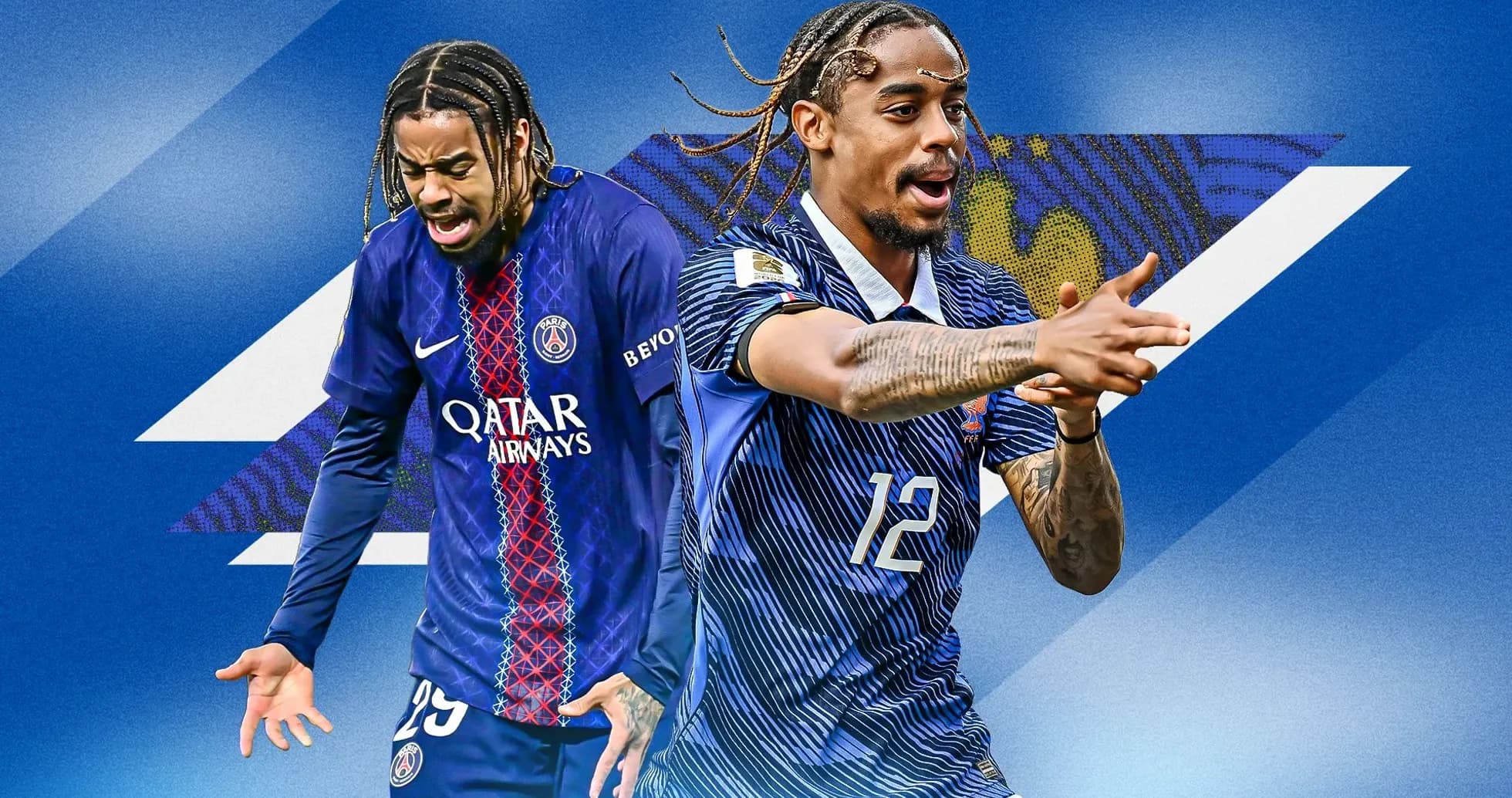
Bradley Barcola's Uncertain Future at PSG: A Transfer Dilemma
Bradley Barcola was supposed to be past this stage by now.
Three years on from swapping Lyon for the Parisian spotlight, the 23-year-old should have been a fixture on the Parc des Princes teamsheet, a cornerstone of PSG’s post‑Mbappé era. Instead, he finds himself trapped in a strange limbo: too good to ignore, never quite trusted enough to build around.
A star who never fully arrived
On paper, Barcola has done more than enough. His first season in Paris brought 14 goal contributions and the sense of a winger growing into the shirt. Then came the summer of 2024. Mbappé left, the left flank looked open, and the path seemed clear.
PSG slammed that door almost as quickly as they opened it.
Desire Doue arrived to add competition. By January 2025, Khvicha Kvaratskhelia swept in as the headline act. Barcola responded in the only way top players know how: he produced. His 2024‑25 campaign was outrageous – 21 goals and 21 assists – the kind of numbers that usually make a player undroppable.
Yet when the season reached its sharpest edges, he was often watching. The Champions League final against Inter? Not trusted from the start. In the biggest games, he rarely saw out 90 minutes. The message from Luis Enrique was subtle but unmistakable: useful, yes. Essential, no.
The following season, the numbers dipped hard. Thirteen goals, seven assists in 2025‑26, and the pattern hardened. Enrique regularly rotated in Ligue 1 to keep his stars fresh for Europe, but Barcola found himself on the wrong side of that hierarchy. No starts in the Champions League quarter-finals, semi-finals or final of another triumphant campaign. Unused in marquee league fixtures against Lyon and Monaco.
He wasn’t just being rotated. He was being edged towards the margins.
France: impact without security
The same story is playing out in national colours.
For a player of his profile and talent, the left wing for France should have been a natural home. Instead, his international career has been stop‑start, and this World Cup has underlined the uncertainty.
Didier Deschamps left him out of the starting XI for the opener against Senegal. Barcola came on, scored within two minutes, and decided the match. That cameo forced a start against Iraq on matchday two. He couldn’t seize it. Back to the bench for Norway.
Again, he changed the game from the fringes. Introduced with 25 minutes left, he whipped in a perfect cross for Doue’s late header. Deschamps rewarded him with another start in the last‑32 tie against Sweden, and Barcola delivered, smashing home a fine second‑half finish as Michael Olise ran the show.
Finally, a run? Not quite. He kept his place against Paraguay in the round of 16, but disappeared in a scrappy 1-0 win. Now, on the eve of a quarter-final with Morocco, his spot is under threat again.
He is making decisive contributions. He is still fighting for trust.
PSG’s stance shifts – and the market stirs
All of this unfolds against a tense backdrop in Paris. Barcola’s contract runs until 2028, but negotiations over an extension have stalled. The player wants clarity on his role; PSG cannot offer the guarantees he craves.
Earlier in the summer, the club’s position sounded ironclad. Barcola was “not for sale”, and their internal valuation sat well above the £116 million Manchester City paid Nottingham Forest for Elliot Anderson, according to The Athletic. He was framed as part of the core.
That tone has changed.
On his YouTube channel this week, transfer specialist Fabrizio Romano cut through the old narrative. “Until last week, Barcola was untouchable; now I see him linked to several clubs. The reality is that Barcola is not untouchable. Barcola has serious possibilities to leave Paris in the summer transfer window.”
Something has shifted in Paris. The reason is no mystery.
Diomande, the new obsession
PSG have locked on to one of the breakout stars of the 2025‑26 season: RB Leipzig and Ivory Coast sensation Diomande. For months, Liverpool looked to be leading the race, ready to pay around €100m. Then came the twist.
The 19‑year‑old prefers Paris.
He believes Luis Enrique’s project gives him the best platform to win trophies – and, in time, to chase the Ballon d’Or. Leipzig, fully aware of the demand, are said to want around €130m. Even for PSG, that is a fee that demands sacrifices.
Gonçalo Ramos has already gone to AC Milan. Lee Kang‑in is on his way to Atletico Madrid. To push a deal of that scale over the line, PSG may need another major sale. And if Diomande walks through the door, Barcola’s minutes, already squeezed by Kvaratskhelia and Doue, shrink further.
At that point, the decision almost makes itself – for both club and player.
Liverpool’s opening
Here is where the story bends towards England.
Liverpool, braced for life after Mohamed Salah, are rebuilding their attack. Victor Munoz has arrived. Wonderkid Rio Ngumoha is waiting in the wings but will not turn 18 until late August, a talent to nurture rather than overload. New manager Andoni Iraola needs a ready‑made wide forward who can start every week, stretch defences, and live with the demands of Anfield.
Barcola fits that brief.
He offers Champions League experience, big‑game exposure, and the kind of direct, vertical threat that suits Iraola’s high‑tempo style. Crucially, he is one of the few available forwards with genuine star power who does not feel like a gamble. Compared with Diomande – younger, less tested at the highest level – Barcola brings a stronger guarantee of immediate impact.
If Liverpool lose out on Diomande, they may actually win the window.
For Barcola, Merseyside would offer what Paris has not: certainty. A clear role, a central place in the project, the status of being a nailed‑on starter rather than a luxury option. For PSG, his sale would help fund Diomande. For Liverpool, he would become the statement signing to soften the blow of Salah’s departure.
For once, a complicated transfer triangle looks like it could suit everyone.
“Honestly, I don’t know”
Barcola himself has stopped pretending everything is straightforward.
“Right now, I’m really focused on the World Cup,” he said at a France press conference before facing Paraguay. “But regarding what happens afterward, honestly, I don’t know at the moment.”
That line tells its own story. A player under contract until 2028, publicly uncertain about his future, in a summer when his club are chasing a new attacking superstar. The writing is not quite on the wall, but it is being sketched in thick pencil.
Diomande’s expected arrival would nudge him even closer to the edge of the PSG picture. Another season of cameos, rotation and selective trust would be a waste for a 23‑year‑old who has already shown he can carry a frontline statistically, even if he has never been fully allowed to.
So the choice looms.
Stay in Paris, fight on three fronts for minutes, and risk becoming a high‑end squad player? Or walk away from the Parc des Princes, embrace a leading role elsewhere – perhaps under the Anfield lights – and finally turn potential and flashes of brilliance into an undisputed, permanent status?
For the first time since he left Lyon, the next move in Bradley Barcola’s career feels less like a luxury decision and more like a necessity.