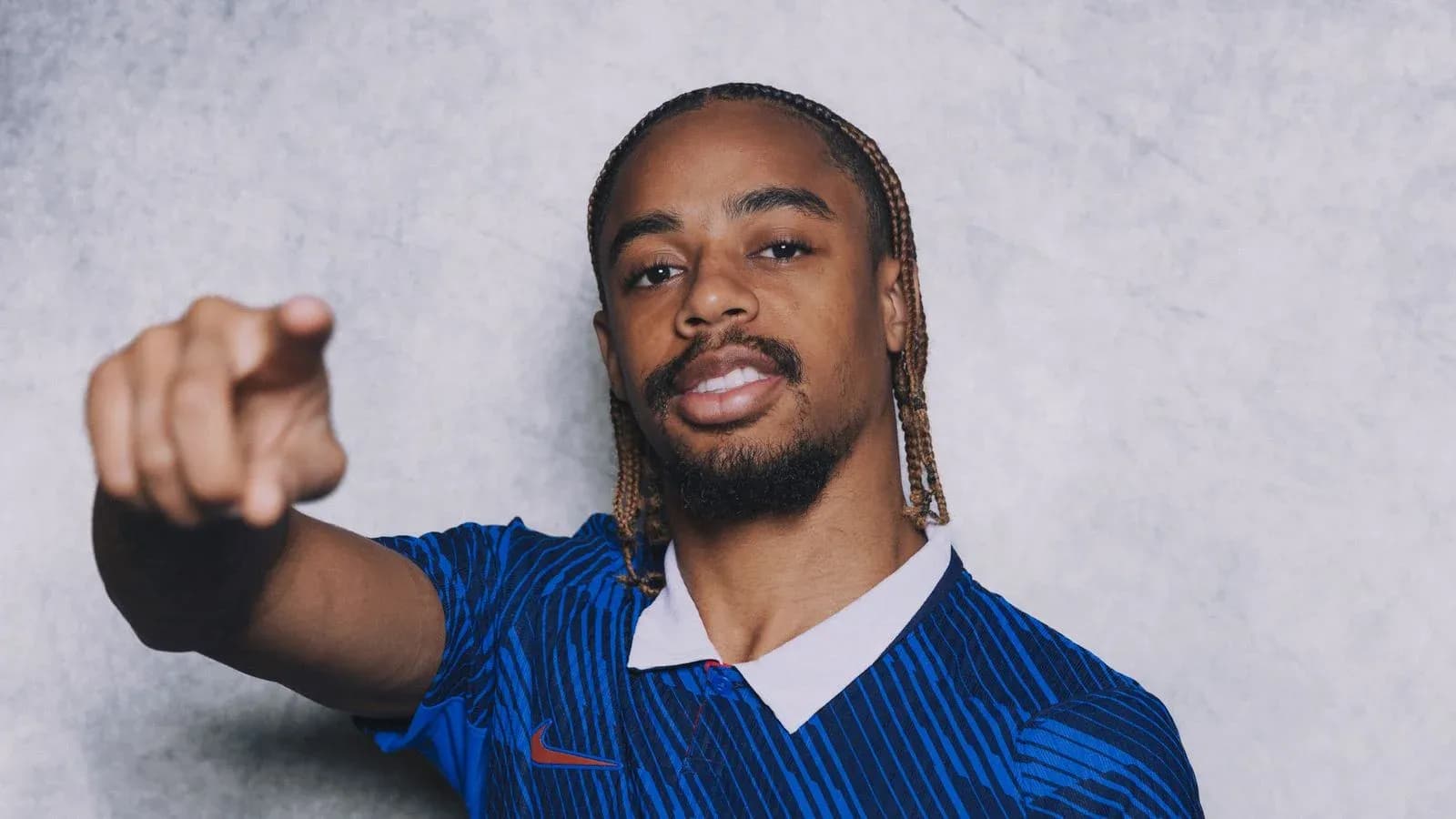
Bradley Barcola: The Rising Star of European Football
Bradley Barcola is about to become a very expensive answer to a very modern question: what do you pay for a wide forward who can think like a No 9, run like a sprinter and still has years of development ahead of him?
Liverpool want that answer. Arsenal do too. Paris Saint-Germain, fresh from winning back-to-back Champions League titles, know they already have it.
He is 23, a France international, and a two-time European champion at club level. Yet in both finals, he started on the bench. Khvicha Kvaratskhelia’s arrival from Napoli in January 2025 nudged him down the pecking order on the left, the Georgian quickly cementing himself as first choice.
But being second in line at PSG does not mean being second-rate. Not in this squad. Not with this ceiling.
Barcola is pace, power and sharp angles. He is a forward sculpted by Luis Enrique’s demands: keep the ball when it must be kept, break the line when it must be broken. His value lies not only in what he has done, but in the frightening sense that he has only just started.
A turning point in Lyon
His story did not begin like that of a prodigy. There were no age-group leaps, no fast-tracked promotions, no headlines from the under-15s.
At Lyon, under Laurent Blanc, Barcola hovered on the fringes of the first team. A talent, yes, but not an untouchable one. A Swiss club circled, sensing opportunity because he was not getting minutes. Lyon were prepared to consider it.
Then Karl Toko Ekambi decided he wanted out.
That choice changed Barcola’s career. With the Cameroonian pushing for a move, the club blocked the loan. They might need Bradley. One match later, an injury forced Blanc’s hand. Barcola stepped in.
The door had been left ajar. Circumstance kicked it open.
Jean-Francois Vulliez, who had worked with him in Lyon’s academy, watched it unfold with a different perspective. He knew the boy, knew the path. He would later follow him to Paris, becoming a development coach at PSG and seeing first-hand how elite youngsters grow — and how many do not.
Barcola, in his eyes, was never the obvious superstar in waiting. No Mbappé-style meteoric rise. No France youth caps to frame on the wall. Just a “normal kid” progressing one age group at a time, never skipping a level, never physically dominant enough to bully defenders.
So he had to think instead.
As a late physical developer, he could not rely on strength, so he learned to scan the pitch, to read space, to choose his moments. He became quick in the head before he became powerful in the legs. Only when the physique caught up did the full package start to emerge.
Patience, at Lyon, was deliberate. They knew the technical base was there. They waited for the psychological and physical maturation to join it. When it did, the improvement was rapid.
The numbers prove it. After Toko Ekambi’s exit, Barcola exploded: five goals in nine games in early 2023. Then came a strong European Under-21 Championship with France that summer. His body was in Lyon, but, as those around him admit, his head had already moved to Paris.
Paris, trophies and transformation
The move to PSG dragged on but eventually landed. Since then, the return has been relentless: 13 trophies, over 150 appearances, 39 goals. Those are not the figures of a luxury squad player; they are the output of someone trusted to carry threat in a team overflowing with it.
Under Luis Enrique, his game has sharpened. The reckless dribbler has been replaced by a more selective, more efficient forward. He knows when to run at a defender and when to recycle. When to burst inside and when to hold the width. When to shoot, when to slide the pass.
His base position in Paris is clear: left-sided wide forward. His instincts are not. They belong to a striker.
Until the age of 17 at Lyon, he played through the middle. That education never left him. From the left flank, he attacks the half-space like a centre-forward, cutting inside to aim for the far corner with his stronger foot. He does not just stretch teams; he threatens to finish them.
Coaches treasure those instincts in wide areas. It is no longer enough to look electric on the ball. The modern wide forward must live on numbers — goals, assists, shot volume. Barcola ticks those boxes. He scores and he creates. He does both often.
Last season, his shot output in Ligue 1 ranked him among the top 10 players per 90 minutes. Playing wide did not blunt him. It simply changed the angle of his attack. His runs inside, timed from deep or between the lines, carry the imprint of a former No 9.
This is where his intelligence bites. He knows when to drift infield and when to dart beyond the last defender. Put him in a system that recognises and feeds that movement, and he becomes a constant problem, arriving in zones that centre-backs hate and full-backs lose track of.
Coaches like working with him because he listens. Tactically flexible, positionally adaptable, he can slot into different game plans without losing his edge. That capacity to understand and apply instruction, developed early, is the foundation that allows his role to be tweaked later.
Edges to sharpen, positions to explore
He is not the finished article. His finishing, at times, lacks the cold precision of the game’s deadliest forwards. Luis Enrique has pushed him to become more ruthless, to turn promising positions into inevitable goals.
There is time. Many top attackers only find their most clinical version in their mid-20s, once repetition and experience harden instinct into habit. Barcola has already shown he can reach the right areas. The next step is punishing opponents more consistently once he gets there.
For now, the left wing looks like his best home. But there is curiosity — and not just outside PSG — about what comes next. Could he grow into a full-time No 9? Those who have watched him closely believe he has the tools to do it: movement, speed, intelligence, and the memory of having led the line as a teenager.
His versatility only adds zeros to his price. He has operated on the right as well, stretching play, burning full-backs to the byline when asked to stay wide. In last season’s Champions League, he clocked among the top 10 speeds in the competition. Give him grass to chase and he can simply knock it past you and run.
He is, quite simply, a better player than the one who left Lyon. Better than the one who first walked into PSG’s dressing room. Stronger, sharper, more rounded.
Nobody in his academy days could have drawn a straight line from “normal kid” to potential most expensive transfer of the summer. Yet here he is, a Champions League winner being circled by Premier League giants, his name sitting at the top of recruitment lists.
The trophies and the goals tell one story. The market is writing another.
The real question for Liverpool, for Arsenal, for anyone prepared to test PSG’s resolve is not what Bradley Barcola is now.
It is how much more dangerous he is about to become.