Brazil's Historic Olympic Gold: A Decade Later
Ten years ago, the Maracanã held its breath.
On August 20, 2016, with an entire nation leaning on their shoulders, Brazil’s Olympic team walked out to face Germany in Rio. Not a World Cup, not a Copa América, but a prize that had somehow always slipped away: Olympic gold in football. More than 63,000 fans packed into the stadium, carrying decades of frustration and expectation.
Ninety minutes, extra time, and penalties later, the wait was over.
Neymar’s Free-Kick and a Nation’s Roar
The final itself never settled into a comfortable script. It was tight, edgy, tense. Germany moved the ball with calm assurance. Brazil responded with urgency and tackles that crackled around the pitch.
Then came Neymar.
In the 26th minute of the first half, Brazil won a free kick. The No. 10 stepped up, curved his shot over the wall and under the bar, and the Maracanã exploded. One swing of his right foot, and Brazil led 1-0. For a while, it felt like the entire Olympic story might finally bend their way.
Germany refused to follow that narrative. In the 15th minute of the second half, Max Meyer found space and struck the equaliser, silencing the stadium and dragging the final back into a knife-edge contest. At 1-1, nerves tightened again. The clock ran down. Extra time arrived.
Nothing separated them. No mistake, no flash of genius, no late twist. So it came down to penalties.
Weverton’s Save, Neymar’s Strike, Brazil’s Release
Both teams started from the spot with ice in their veins. Four kicks each, four goals each.
For Brazil: Renato Augusto, Marquinhos, Rafinha and Luan converted, one after another, keeping the dream alive.
For Germany: Matthias Ginter, Serge Gnabry, Julian Brandt and Niklas Süle were just as ruthless.
Then came Nils Petersen, one of the tournament’s leading scorers. He stepped up for Germany’s fifth penalty, facing Weverton. One kick to keep the shootout level.
Weverton guessed right. He saved.
In that instant, the weight of history shifted. Neymar walked forward knowing exactly what his penalty meant. Score, and Brazil would finally have their first Olympic football gold.
He buried it.
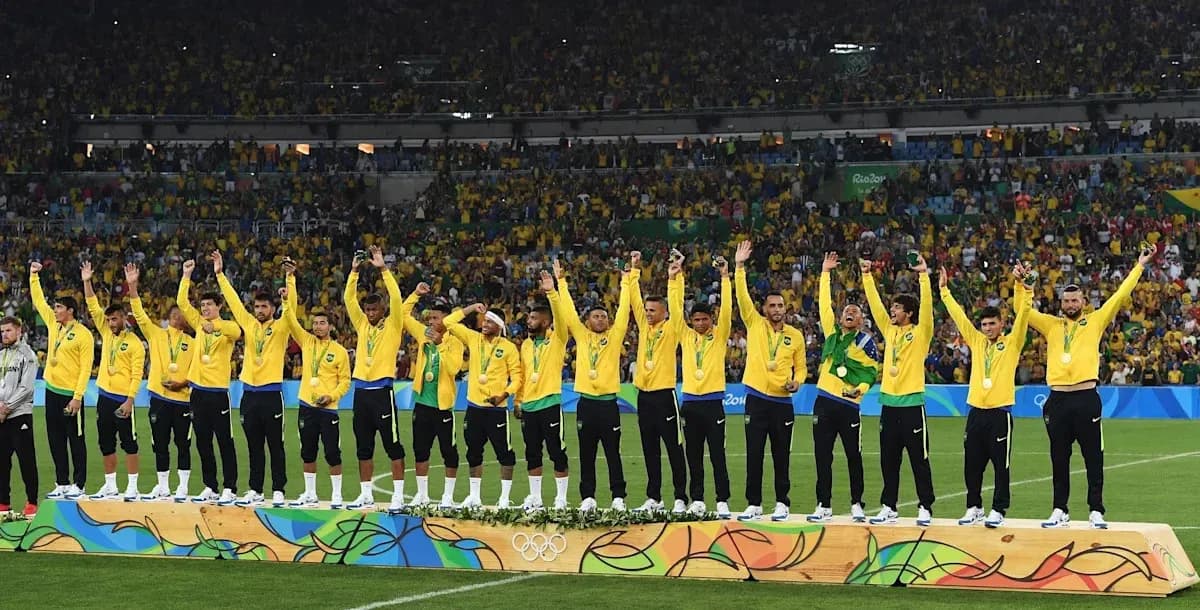
The stadium erupted. Neymar collapsed to his knees, overcome, as teammates sprinted towards him. Walace, Gabriel Jesus, Gabriel Barbosa, Rafael Alcântara and the rest of that young squad celebrated a moment that had eluded generations of Brazilian stars. Olympic gold at last, and on home soil.
A Stuttering Start, Then a Surge
The path to that final was anything but smooth.
Brazil opened the tournament in Brasília, and the first two group matches felt like a bad omen. Two games, two 0-0 draws – first against South Africa, then Iraq – and a storm of criticism outside the camp. For a team expected to dominate, the goals simply would not come.
Everything changed in Salvador.
Needing a win to top Group A and quiet the noise, Brazil produced exactly the kind of statement performance they had been missing. At Arena Fonte Nova, they dismantled Denmark 4-0. Gabriel Barbosa struck twice, Gabriel Jesus got on the scoresheet, and Luan added another. The attack finally clicked, and the campaign caught fire.
From there, the knockouts brought clarity.
In the quarterfinal at Arena Corinthians in São Paulo, Brazil met Colombia, who had emerged from Group B with draws against Sweden and Japan and a win over Nigeria. This time, the hosts controlled the moment. Neymar scored, Luan followed, and a 2-0 victory carried Brazil into the semifinals with at least a bronze medal assured.
Honduras awaited next. They had already shocked Argentina and Algeria in the group stage, advanced alongside Portugal, and then knocked out South Korea 1-0 in the quarterfinals. Any thought of another upset vanished almost immediately at the Maracanã.
Brazil tore through them.
A 6-0 demolition sent a message to everyone. Neymar and Gabriel Jesus scored two goals each, Marquinhos added his name to the list, and Luan continued his outstanding tournament with another strike. The final was set: Brazil vs Germany, in Rio, with history on the line.
The 18 Who Made History
Eighteen names were etched into Brazilian football history that night. One more, who never kicked a ball in the tournament, still deserves his place in the story.
Goalkeeper Fernando Prass had been called up for the Olympics, only to suffer an elbow injury during the warm-up for a friendly against Japan at Serra Dourada in Goiânia. He was ruled out before the group stage began, his dream cut short even as his teammates marched towards gold.
The medalists who finished the job:
- Goalkeepers
Weverton (Athletico-PR) – the man who saved Petersen’s penalty and opened the door to glory.
Uilson (Atlético Mineiro) - Full-backs
William (Internacional)
Douglas Santos (Atlético Mineiro)
Zeca (Santos) - Center-backs
Rodrigo Caio (São Paulo)
Luan Garcia (Vasco da Gama)
Marquinhos (Paris Saint Germain – FRA) - Midfielders
Thiago Maia (Santos)
Rodrigo Dourado (Internacional)
Rafinha Alcântara (Barcelona – ESP)
Renato Augusto (Beijing Guoan – CHI)
Felipe Anderson (Lazio – ITA)
Walace (Grêmio) - Forwards
Neymar (Barcelona – ESP)
Luan (Grêmio)
Gabriel Barbosa (Santos)
Gabriel Jesus (Palmeiras)
A decade on, that night at the Maracanã still stands apart. Brazil had won everything else in football. But only on August 20, 2016, did the Seleção finally climb the top step of an Olympic podium and wrap that missing gold around its shoulders.