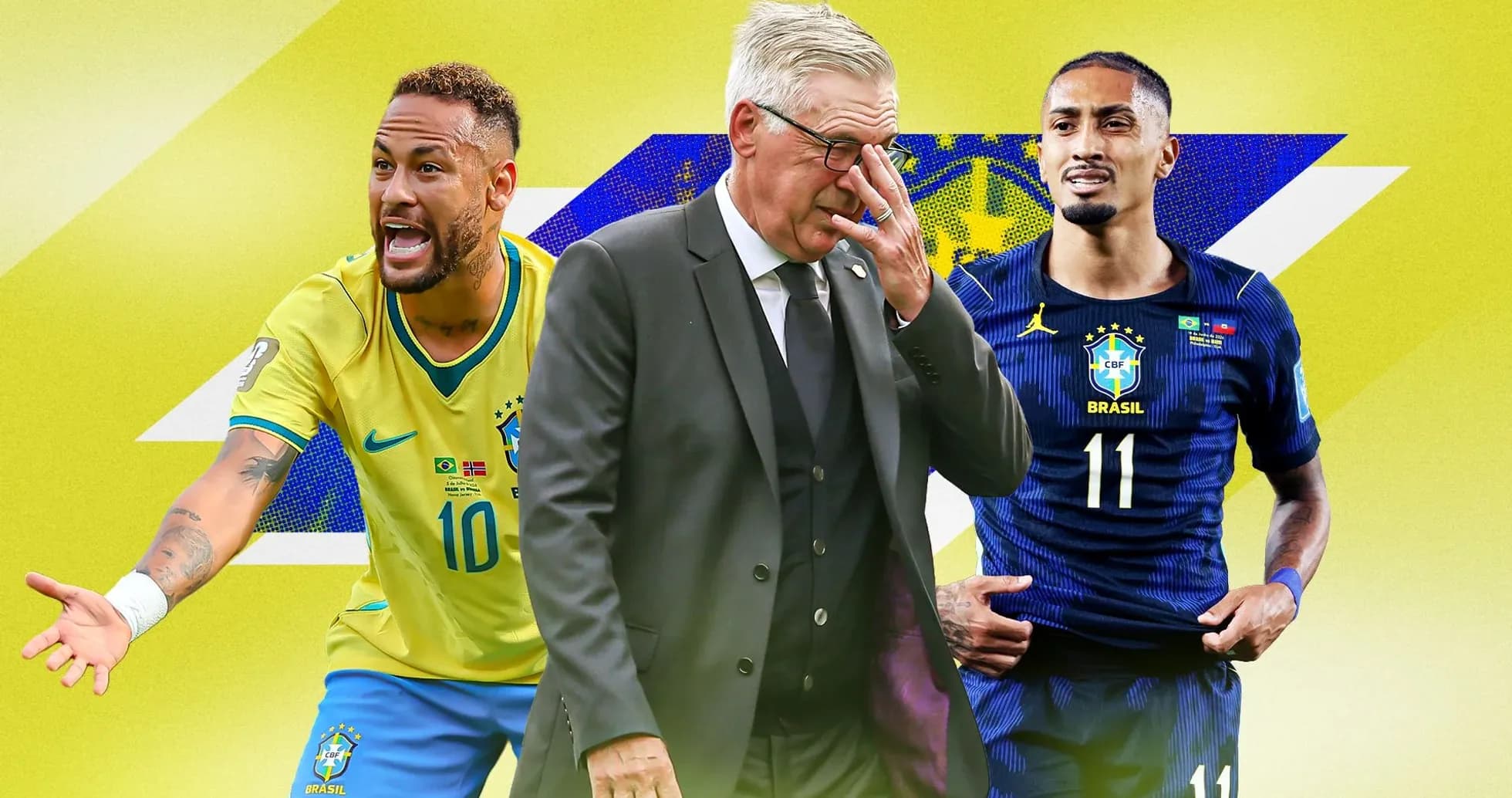
Brazil's World Cup Disappointment: Bad Choices and Missed Opportunities
Brazil came to this World Cup weighed down by history and expectation. They left it burdened by something more prosaic: bad choices.
Carlo Ancelotti’s first major tournament in charge of the Selecao will be remembered less for tactical nuance and more for the names on his team sheet. From front to back, Brazil looked like a side built to honour the past rather than conquer the present.
An old guard that stayed too long
The warning signs were there before a ball was kicked. Brazil’s three goalkeepers were 33, 32 and 38. The average age of the defenders: 31. Danilo and Alex Sandro, once among Europe’s elite full-backs at Juventus, now looked like echoes of another cycle.
In midfield, the pattern hardened. Casemiro, 34, was again asked to be the anchor and the enforcer. Fabinho, 32, carried a heavy load as well. Both have been great servants to the shirt. Both now play like men who know exactly what to do, but whose legs no longer always comply.
There were glimpses of tomorrow. Bournemouth’s 19-year-old Rayan, and Botafogo’s 25-year-old Danilo, hinted at a different, more dynamic Brazil. They were cameos, not centrepieces.
Ancelotti didn’t hide from the reality after the exit.
“We need some young talent, we need some high-level players coming into Brazilian football,” he admitted. “This national team has a very solid group, great players that continue and some new players that can come in.”
The message was clear: the future has to arrive faster.
The Neymar gamble that never made sense
And then there was Neymar.
At 34, without a cap since October 2023 and with a body that has become a running medical bulletin, his recall dominated the build-up. Media pressure. Fan pressure. Nostalgia. All of it pushed Ancelotti toward a decision that always felt more romantic than rational.
The risk backfired almost immediately. On the eve of the World Cup, Neymar suffered a calf injury, sidelined for “two to three weeks”. He missed Brazil’s first two group matches, then scraped together 14 subdued minutes against Scotland in Miami. The occasion felt less like a comeback and more like a testimonial – a legend being indulged, not unleashed.
Ancelotti’s subsequent choices told their own story. Neymar didn’t feature at all in the dramatic last-32 win over Japan. Against Norway in the round of 16, he was sent on with Brazil chasing the game, and even his late consolation penalty could not disguise the fact: this was an international farewell played in slow motion.
His selection looked even stranger because of the man left behind.
The Joao Pedro omission that won’t go away
Joao Pedro should have been on the plane. By the end of his debut season at Chelsea, it felt almost a given that he would be, and that he might even start as Brazil’s No.9.
Twenty-four years old. Versatile. A combined 29 goals and assists at Stamford Bridge. A forward in form, capable of linking play, stretching defences, and finishing moves. The kind of modern attacker a tournament side leans on.
Instead, he stayed at home.
Ancelotti himself admitted, when naming the squad, that Pedro “probably deserved to be on this list”. That line will follow him for a long time.
As Brazil crashed out, the decision was torn apart.
“I have to be honest, I think this elimination begins with the decisions from the bench,” Ronaldo Nazario said pointedly. “I still don’t understand why Joao Pedro was not part of this squad. He has had an exceptional season, he is in form, and Brazil needed a striker who could offer something different.”
In a World Cup where Brazil looked short of cutting edge and short of ideas, the absence of a fit, flexible, in-form centre-forward felt less like an oversight and more like a self-inflicted wound.
Midfield left exposed
The squad’s age profile didn’t just affect the back line. It hollowed out the middle of the pitch.
Brazil arrived with only five central midfielders, one of whom, Lucas Paqueta, is really a No.10. Manchester United-bound Ederson was only drafted in late, replacing injured right-back Wesley.
The result? A midfield that revolved almost entirely around Bruno Guimaraes.
The Newcastle captain was asked to do everything: build play, create chances, cover ground. He responded admirably, finishing the tournament with four assists. But he often looked like a man trying to plug multiple leaks at once. There was no sustained support, and Ancelotti clearly didn’t fully trust his alternatives. Ederson and Danilo were given only scraps of minutes.
After the loss to Norway, Ancelotti didn’t disguise the problem.
“We have to think about the future, but it is very evident that in the midfield, I think that we have to move some players,” he said.
The turning point of that Norway game came from the same area of the pitch.
Data, pressure and a missed penalty
Brazil earned a first-half penalty, a chance to take control of a knockout tie they would eventually lose. Most inside the stadium expected Vinicius Junior, their outstanding attacker and leading scorer at the tournament, to step up.
He didn’t.
Instead, Bruno Guimaraes placed the ball on the spot. His effort was saved. Brazil later fell behind and never found a way back.
The choice sparked instant debate. Ancelotti’s explanation was clinical.
“We did statistics for the players and according to that, Raphinha was the best option,” he said. “The best person would be Raphinha and then Neymar [who weren’t on the pitch], and after that, Bruno Guimaraes. After Bruno, it would be [Gabriel] Martinelli, so we chose Bruno Guimaraes as we felt he would be the best.”
On paper, it made sense. In the reality of a World Cup knockout match, with momentum, emotion and hierarchy in play, it looked like another example of Brazil leaning on numbers when they needed nerve.
Injuries bite, but don’t excuse
Ancelotti can, with justification, point to a brutal injury list. This was not Brazil at full strength.
Before the squad was even finalised, Eder Militao, Rodrygo and Estevao Willian were ruled out. That stripped the side of their starting right-back and two wingers who could have started or changed games from the bench.
The tournament itself brought more blows. Neymar’s calf problem was predictable, but still damaging. Raphinha pulled up with a hamstring issue in the first half of the second group game against Haiti and played no further part. Paqueta, so important between the lines, suffered his own hamstring injury and was forced off at half-time against Japan in the knockouts.
By the time Norway ended Brazil’s run, the squad looked stretched, thin and tired. Quality depth had become a theory, not a reality.
Even so, the core criticism remains: within those constraints, Ancelotti’s decisions often narrowed Brazil’s options instead of expanding them.
The start of something, or the end of an era?
For Ancelotti, this World Cup failure is both a stain and a starting point.
“A defeat is the beginning of a new adventure,” he insisted. “We have to keep improving, to find new ideas. It is not an end, it is the start of a new cycle.
“We will manage this defeat by bringing a fresh impetus to our work and the assessment of the players. We will try to improve and look for new ideas. The same as we did this year.
“I think the work we’ve done has been good. Football is like this; sometimes you have to manage the sadness of a defeat. I am used to this.”
The sadness is Brazil’s to carry now. The questions are his to answer.
Does he finally cut loose the old guard? Does he trust the next generation before another tournament slips away? Or does this World Cup become the moment when the most decorated coach of his era discovers that, at international level, reputation and loyalty are no match for timing and ruthlessness?