Brighton vs Manchester United: A Tactical Analysis of the Season Finale
Amex Stadium felt like a stage for contrasts as Brighton’s season of controlled evolution met a Manchester United side finishing with a ruthless edge. Following this result, the 3-0 away win underlined why United closed the Premier League campaign in 3rd on 71 points, while Brighton’s 8th-place finish on 53 points told of promise laced with fragility.
I. The Big Picture – Structures, Identities, Outcome
Both sides mirrored each other on paper in a 4-2-3-1, but the shapes told different stories once the ball rolled.
Brighton’s 4-2-3-1 was about orchestrated possession. With Lewis Dunk and Jan Paul van Hecke as the central pairing and Bart Verbruggen behind them, the hosts looked to build patiently from the back. Lewis Dunk, one of the league’s leading yellow-card collectors with 10 bookings this season, again sat on that thin line between composure and risk, anchoring a back line that had, overall, conceded 46 goals in total with a goal difference of +6 (52 scored, 46 conceded).
In midfield, Pascal Gross and James Milner formed the double pivot, a cerebral but aging engine room. Ahead of them, the trio of Diego Gomez, Jack Hinshelwood and Maxim De Cuyper supported Danny Welbeck, Brighton’s leading scorer with 13 league goals. Welbeck’s campaign, however, has been streaky: a solid 6.68 rating across 37 appearances but with two penalties missed out of three taken. That lack of penalty ruthlessness echoed a broader theme – Brighton can create, but not always kill.
Manchester United’s 4-2-3-1 under Michael Carrick was more vertical and transition-minded. Harry Maguire and Lisandro Martinez anchored a defence that, across the season, allowed 50 goals in total, but the team’s attacking power – 69 scored – gave them a +19 goal difference. Luke Shaw, a constant at left-back with 38 appearances and 9 yellows, and Noussair Mazraoui on the right provided the width.
Ahead of them, the Mount–Mainoo double pivot offered energy and progression, freeing the high-creative line of Amad Diallo, Bruno Fernandes and Patrick Dorgu behind Bryan Mbeumo. United’s away scoring rate of 1.6 goals on their travels matched what unfolded here: a side that does not always dominate the ball, but punishes every lapse.
By half-time, United led 2-0, and when the full-time whistle went at 3-0, the scoreline felt like a distilled version of their season: not flawless defensively, but devastating when their front unit clicked.
II. Tactical Voids – Absences and Discipline
Both managers had to navigate notable absences that shaped the tactical landscape.
For Brighton, the absence of Kaoru Mitoma (hamstring), S. Tzimas and Adam Webster (both knee injuries) stripped Fabian Hurzeler of a key dribbler, a depth forward and a senior centre-back. Without Mitoma’s direct running, Brighton’s left-sided threat was more about structure than chaos; De Cuyper and Kadioglu offered technical quality, but not the same one-vs-one fear factor. Webster’s absence meant van Hecke stepped into a more prominent role, leaving Dunk as the senior organiser of a back line that has kept 10 clean sheets in total this season but remains vulnerable to pace and quick combinations.
On the United side, Casemiro’s “Inactive” status, plus injuries to Benjamin Šeško and Matthijs de Ligt, removed both a destroyer and two powerful presences at either end of the pitch. Casemiro’s season profile – 90 tackles, 27 successful blocks and 10 yellow cards – highlights what United were missing at the base of midfield: a pure enforcer who breaks rhythm and protects transitions. Instead, Mount and Mainoo had to balance progression with protection, relying on collective pressing rather than a single defensive specialist.
Disciplinary trends fed into the game’s narrative. Heading into this game, Brighton’s yellow-card distribution showed a pronounced spike between 46-60 minutes at 27.91%, with another late-game swell between 76-90 minutes and stoppage (15.12% and 15.12%). United mirrored that late intensity: 21.88% of their yellows came in the 46-60 window and 20.31% between 76-90. This match followed that pattern – as Brighton chased and United countered, the contest became more stretched, more tactical-foul heavy, and more suited to United’s transition edge.
III. Key Matchups – Hunter vs Shield, Engine Room Battles
Hunter vs Shield revolved around Danny Welbeck versus United’s away defence. Brighton’s home attack averaged 1.6 goals at the Amex this season, but here Welbeck found himself isolated. His season numbers – 46 shots, 28 on target – show a forward who works for his chances rather than being served on a plate. Against Maguire and Martinez, he was often outnumbered, with United happy to compress space centrally and trust Shaw and Mazraoui to handle wide threats. The result was a Brighton side forced into lower-value shots and crosses, never truly testing S. Lammens.
On the other side, Bryan Mbeumo was United’s primary hunter. With 11 goals, 3 assists and 59 shots (32 on target) in the league, he has been a direct, decisive presence. Up against Dunk and van Hecke, Mbeumo’s movement across the line and willingness to drift wide dragged Brighton’s defensive block out of shape. Once United went ahead, his threat in transition pinned Brighton’s full-backs deeper than Hurzeler would have liked.
The Engine Room duel featured Pascal Gross and James Milner against Mason Mount and Kobbie Mainoo. Gross, Brighton’s metronome, tried to dictate tempo, but Mount and Mainoo’s athleticism and pressing angles repeatedly disrupted Brighton’s build-up. Mainoo’s positioning screened passes into Welbeck’s feet, while Mount stepped out aggressively onto Gomez and Hinshelwood, forcing Brighton into safer, slower circulation. Every time Brighton lost the ball in these central pockets, United sprang forward, often through Bruno Fernandes.
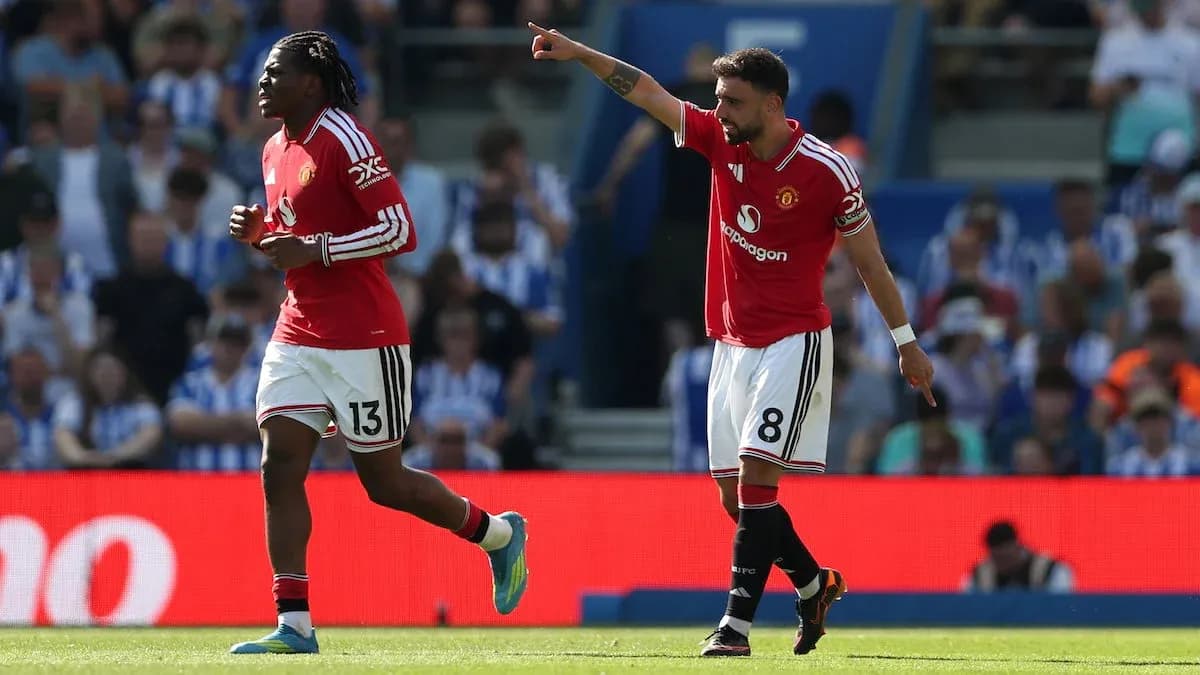
Bruno’s season has been extraordinary: 21 assists and 9 goals, underpinned by 1,994 completed passes and 137 key passes. Here, he operated in the half-spaces, constantly finding pockets between Brighton’s double pivot and back four. Without a Casemiro behind him, he also had to contribute defensively – 54 tackles and 20 interceptions across the campaign show that he is far more than a luxury 10. Against Brighton, his ability to turn regained possession into instant vertical passes broke the game open.
IV. Statistical Prognosis – xG Shape and Defensive Reality
Even without explicit xG values in the data, the underlying patterns are clear. United’s overall scoring rate of 1.8 goals per game, combined with Brighton’s total concession rate of 1.2 per match, pointed towards United creating the higher-quality chances if they could drag the game into transition. That is exactly what a 3-0 away scoreline suggests: United’s attacks were fewer but sharper, Brighton’s possession heavier but blunter.
Brighton’s 10 total clean sheets and 1.1 goals conceded at home on average hinted at a side capable of control, but their 9 total failures to score – and Welbeck’s two missed penalties this season – underscored a lack of clinical edge. Against a top-three attack, that margin for error vanished. United, who failed to score only 4 times in total this campaign and have scored in volume both at home (39) and on their travels (30), simply carried more guaranteed threat.
Following this result, the narrative is clear: Brighton’s structure and technical base under Hurzeler are strong enough to reach the European fringes, but they need more incision in the final third and greater athletic protection in midfield. Manchester United, meanwhile, leave the Amex and the season looking like a side whose attacking framework – powered by Bruno Fernandes, Mbeumo and a deep cast of forwards like Matheus Cunha – can overwhelm most defences, even if their own back line still concedes more than an elite unit would like.
On the final day, the numbers and the narrative aligned: Brighton the thoughtful architects, United the ruthless finishers. Over 90 minutes, ruthlessness won.