Tottenham's Narrow 1-0 Win Over Everton: A Season's Reflection
Under grey north London skies, the final act of Tottenham’s season unfolded at the Tottenham Hotspur Stadium with a strangely taut 1-0 win over Everton – a result that crystallised the contrasting identities of two flawed but intriguing sides.
I. The Big Picture – a narrow escape for a fragile host
Following this result, Tottenham closed their Premier League campaign in 17th place on 41 points, their overall goal difference locked at -9 from 48 goals scored and 57 conceded. The table tells the story: a team that, over 38 matches, averaged 1.3 goals for and 1.5 against, more often surviving than dictating.
At home, the numbers have been even starker. Across 19 league games in this stadium, Tottenham won only 3, drew 6 and lost 10, scoring 22 and conceding 31. An average of 1.2 goals for and 1.6 against at home underlines how fragile this ground has become as a fortress in name only.
Everton, by contrast, arrived as the more balanced mid-table outfit. They finished 13th with 49 points and an overall goal difference of -3, scoring 47 and conceding 50. On their travels, they were quietly competent: 7 wins, 5 draws and 7 defeats, with 21 goals scored and 23 conceded, an away average of 1.1 goals for and 1.2 against. The numbers pointed to a tight, attritional contest – and that is exactly what emerged.
Both managers mirrored each other structurally in a 4-2-3-1, but the personalities within those shapes told very different stories.
II. Tactical Voids – absences that reshape the chessboard
Tottenham entered this fixture shorn of a whole creative tier. B. Davies (ankle injury), M. Kudus (muscle injury), D. Kulusevski (knee injury), W. Odobert (knee injury), C. Romero (knee injury) and X. Simons (knee injury) were all listed as missing. That is not just depth; it is variety – the vertical passing of Kulusevski, the dribbling of Simons, the aggression and leadership of Romero.
In their absence, Roberto De Zerbi doubled down on structure and discipline. M. van de Ven and K. Danso formed the central defensive hinge, with D. Udogie and P. Porro as the full-backs. Ahead of them, J. Palhinha and R. Bentancur anchored the double pivot, while D. Spence, C. Gallagher and M. Tel supported Richarlison as the lone forward.
The disciplinary profile of this Tottenham squad has been volatile all season. Their yellow-card timing distribution shows a clear late-game spike: 24.75% of their yellow cards arrived between 61-75 minutes, with a further 16.83% between 76-90. Red cards have also clustered around stress points – 50.00% of their reds came between 31-45 minutes, and another 25.00% in the 91-105 window. Even without Romero and Simons, two of their most card-prone figures, this is a team that tends to fray under pressure as the match wears on.
Everton had their own key absentees. J. Branthwaite (hamstring injury), J. Grealish (foot injury) and I. Gueye (injury) were all ruled out. Branthwaite’s absence forced Leighton Baines to trust the experienced pairing of J. Tarkowski and M. Keane, flanked by V. Mykolenko and J. O’Brien. In midfield, the double pivot of J. Garner and T. Iroegbunam was tasked with both screening and initiating.
Garner’s season has been immense: 38 appearances, all from the start, 3426 minutes, 2 goals, 7 assists and 1792 passes at 87% accuracy. Yet he also carries an edge – 12 yellow cards, the highest tally in the league’s disciplinary charts. Everton’s card distribution reflects a side that grows increasingly combative as the game drags on: 20.27% of their yellows between 46-60 minutes and 21.62% from 76-90, with red cards also peaking late (50.00% of their reds between 76-90). This is a team that leans into chaos when chasing.
III. Key Matchups – Hunter vs Shield, Engine Room vs Enforcer
Hunter vs Shield: Richarlison vs Everton’s away defence
Tottenham’s attacking burden again fell on Richarlison, whose campaign reads as a personal salvage job amid collective underperformance: 11 league goals and 4 assists in 32 appearances, from 47 shots and 26 on target. His duel numbers – 325 contests with 137 won – underline a forward who thrives on contact, occupying centre-backs and drawing 33 fouls across the season.
He was up against an Everton back line that, on their travels, conceded 23 goals in 19 matches, an away average of 1.2. That is not elite, but it is solid, especially when paired with 5 away clean sheets. Tarkowski’s positioning and Keane’s aerial presence were designed to compress the space Richarlison loves to attack between full-back and centre-back.
The fine margins were always going to be decisive: one mistimed step, one late rotation, one duel lost. In the end, Tottenham’s narrow 1-0 win reflected precisely that sort of single-moment swing rather than sustained dominance.
Engine Room: Palhinha & Bentancur vs Garner & Iroegbunam
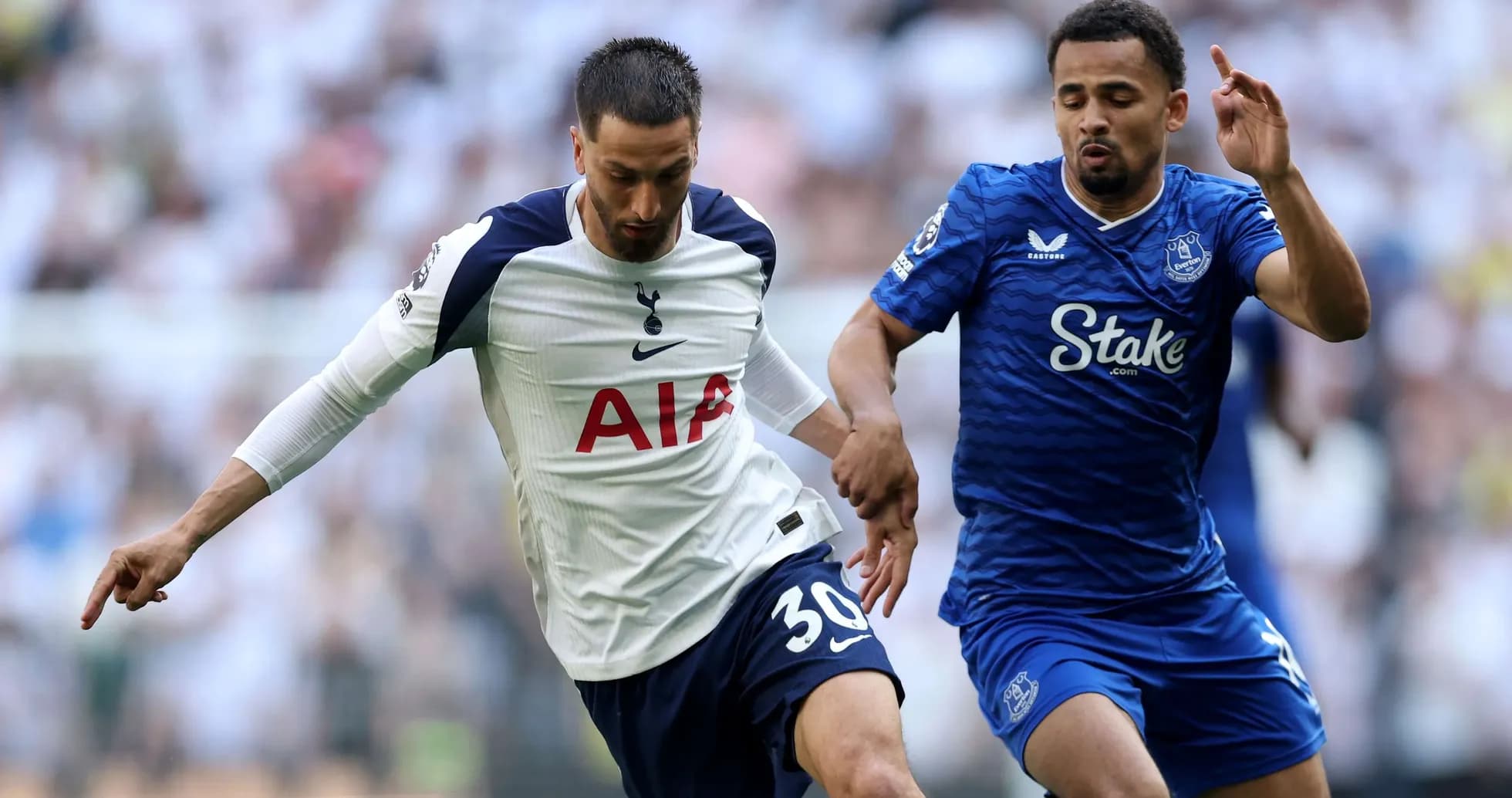
The game’s true theatre lay in midfield. J. Palhinha, whose entire profile is built on destruction, partnered the more elastic R. Bentancur. Their job was twofold: suffocate Everton’s counters at source and give C. Gallagher a platform to press higher.
Opposite them, Garner’s numbers show a complete, high-volume midfielder: 120 tackles, 10 blocked shots and 57 interceptions over the season, plus 56 key passes and 7 assists. He is both Everton’s metronome and their disruptor. T. Iroegbunam’s presence alongside him offered legs and coverage, allowing Garner to step out and engage Tottenham’s No.10 zone.
This duel shaped the rhythm. Tottenham, whose overall clean-sheet count of 9 hints at a defence that only looks secure when the midfield screen is intact, needed Palhinha and Bentancur to stay compact. Everton, with 11 clean sheets overall and a balanced 1.2 goals conceded on their travels, relied on Garner’s positioning to keep the game within one moment.
Out wide, the secondary battles mattered. P. Porro, a full-back who has combined 56 key passes with 75 tackles and 10 successful blocks this season, had to balance his natural attacking instincts against the threat of runners like I. Ndiaye and K. Dewsbury-Hall attacking the half-spaces. On the opposite flank, M. van de Ven’s mix of pace and recovery – 22 successful blocks and 23 interceptions – was vital in locking down T. Barry’s channels.
IV. Statistical Prognosis – a game decided on thin margins
Following this result, the season-long numbers still tell us more about the underlying balance of these squads than the single scoreline. Tottenham, with 48 goals for and 57 against, remain a side whose defensive instability (1.5 goals conceded on average overall, 1.6 at home) constantly undermines their attacking talent. Everton, with 47 scored and 50 conceded, are closer to equilibrium, their -3 goal difference reflecting a team that rarely collapses but struggles to impose itself.
Everton’s penalty record – 2 taken, 2 scored, 100.00% conversion with no misses – adds a layer of frustration for them: in such a tight contest, the absence of a spot-kick or a high-xG chance kept their reliable weapon holstered. Tottenham, conversely, finished the campaign without a single league penalty, their total of 0 taken and 0 missed underlining how reliant they have been on open-play improvisation rather than set-piece lifelines.
In xG terms – even if not explicitly quantified here – the profiles suggest a low-margin game: Tottenham’s modest attacking averages against Everton’s solid away defence, and Everton’s functional but unspectacular attack up against a Tottenham back line that only looks stable when its structure is perfectly aligned.
The 1-0 scoreline fits that statistical logic. It was never likely to be a free-scoring spectacle. Instead, it became a study in how one moment, one duel, one lapse can tilt a contest between two sides whose seasons have been defined by narrow edges and persistent imperfections.