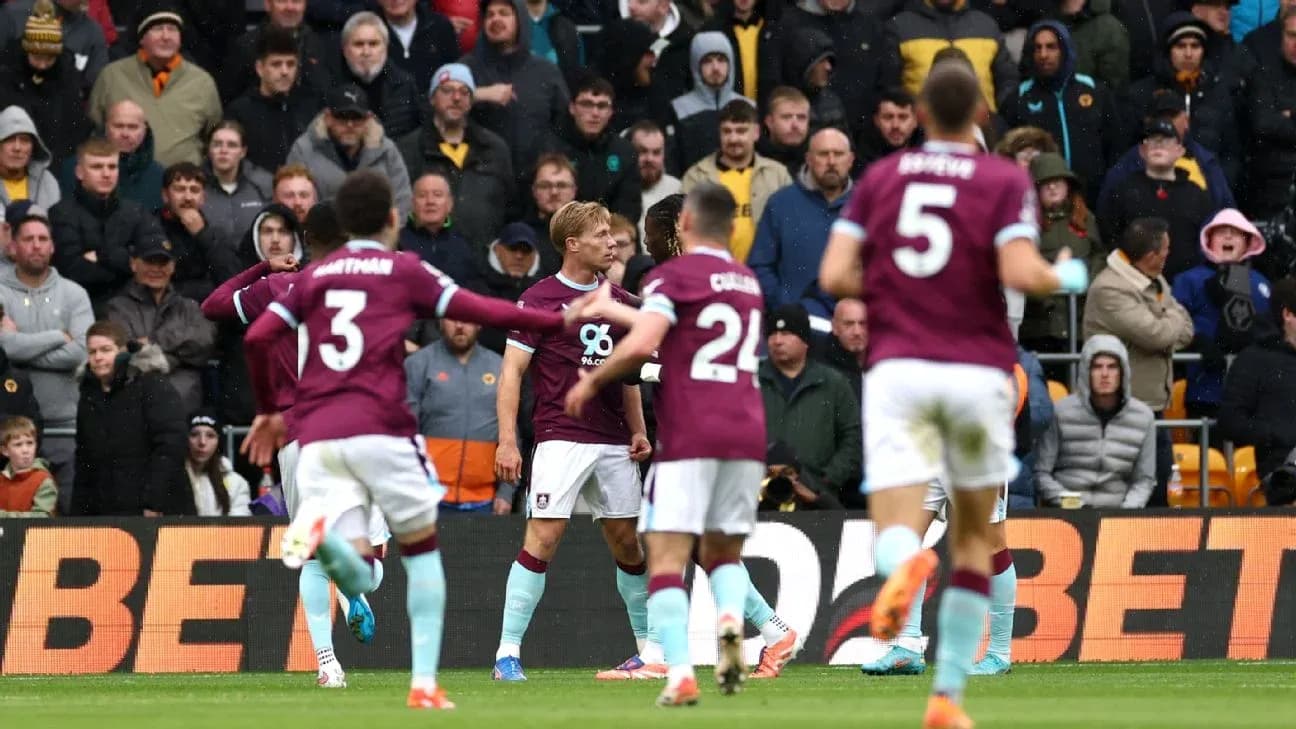
Burnley and Wolves End Premier League Season in Stalemate
Turf Moor’s final afternoon of the 2025 Premier League season ended in a stalemate, a 1–1 draw that felt less like a climax and more like an epitaph for two relegated sides. Burnley, at home, and Wolves, on their travels, finished 19th and 20th respectively, separated by two points and united by a season of structural flaws that this match quietly underlined.
I. The Big Picture – Two Relegated Identities Collide
Following this result, Burnley close the campaign with 22 points, a goal difference of -37 (38 scored, 75 conceded overall), their relegation long confirmed. At Turf Moor they have been fragile: only 2 wins from 19, with 18 home goals for and 29 against, an attacking average at home of 0.9 goals per game against 1.5 conceded.
Wolves finish bottom on 20 points, their goal difference an even more brutal -41, with 27 goals for and 68 against overall. Their away record is stark: 0 away wins from 19, just 8 goals scored and 34 conceded, averaging 0.4 goals for and 1.8 against on their travels. The 1–1 here, therefore, is almost a statistical compromise between two deeply blunted attacks and porous defences.
Burnley lined up in their most-used shape, a 4-2-3-1, a structure that has framed much of their campaign. Wolves matched the broader league trend that has defined them: a back three and 3-4-2-1, the formation they have turned to most often this season.
II. Tactical Voids – Absences and Discipline
Both managers came into this final day with key absences that shaped their benches and limited in-game variety.
For Burnley, J. Beyer (hamstring injury) and J. Cullen (knee injury) were both ruled out. Beyer’s absence reduced centre-back rotation, placing extra responsibility on A. Tuanzebe and B. Humphreys to hold the line, while Cullen’s injury removed a reliable midfield metronome, pushing more creative and ball-progression duties onto Florentino and L. Ugochukwu in the double pivot.
Wolves were without L. Chiwome (knee), M. Doherty (muscle injury), E. Gonzalez (knee) and S. Johnstone (knock). The missing Doherty, in particular, stripped Rob Edwards of a flexible wing-back option who can both lock down a flank and provide late surges into the box. Instead, the width had to be generated by R. Gomes and D. M. Wolfe, with L. Krejci and Y. Mosquera stepping out from the back line.
Across the season, discipline has been a quiet but telling sub-plot. Burnley’s yellow card timing shows a tendency to get dragged into scrappy phases late on: 19.70% of their bookings come between 16–30 minutes, 18.18% between 76–90, and another 19.70% in the 91–105 window. This pattern speaks of a side that often chases games and resorts to tactical fouls as fatigue and desperation creep in.
Wolves, by contrast, cluster their yellows around the restart: 27.50% of their cautions arrive between 46–60 minutes, then 20.00% between 61–75. That mid-game spike hints at a team that tries to increase intensity after half-time, often overstepping in duels as they push to change the rhythm.
Red cards underline Burnley’s volatility. J. Laurent, on the bench here, has already been sent off once this season and embodies a combative edge in midfield. Burnley’s red card distribution is split evenly across 31–45, 76–90 and 91–105 minutes (each 33.33%), another indicator of emotional and structural instability at key moments.
III. Key Matchups – Hunter vs Shield, Engine Room vs Enforcer
The clearest “Hunter vs Shield” narrative belonged to Z. Flemming. Burnley’s top scorer, officially listed as a midfielder but deployed here as the lone forward, finishes the season with 11 league goals from 29 appearances. His profile is that of a high-usage attacker: 38 shots with 21 on target, 10 key passes and a willingness to work without the ball (17 tackles, 5 successful blocks, 7 interceptions). Against a Wolves defence that has conceded 34 away goals, Flemming was always likely to find moments between the lines, particularly against S. Bueno and Y. Mosquera stepping out of the back three.
Mosquera, for his part, has been one of Wolves’ more assertive defenders: 62 tackles, 17 successful blocks and 29 interceptions across the season. He is aggressive in duels (280 contested, 160 won) but also heavily carded, with 12 yellows. His task was to manage Flemming’s clever positioning without getting drawn into reckless challenges around the box.
In the “Engine Room” duel, Burnley’s creative axis ran through H. Mejbri and Florentino, supported by L. Ugochukwu’s physical presence. Mejbri’s season numbers – 4 assists, 21 key passes and 34 dribble attempts with 20 successes – underline his role as a connector between midfield and the advanced trio. He also brings edge: 10 yellow cards, and one penalty committed. His willingness to take risks with and without the ball set the tone for Burnley’s attempts to break Wolves’ block.
Opposite him stood André, Wolves’ yellow-card magnet and central stabiliser. Across the season he has produced 1306 passes with 18 key passes at an impressive 91% accuracy, alongside 82 tackles and 13 successful blocks. His job at Turf Moor was twofold: screen Flemming’s drops into midfield and disrupt Mejbri’s rhythm. The duel between André’s positional discipline and Mejbri’s restlessness shaped the central corridor.
Alongside André, A. Gomes (not in this specific XI but a key reference point in Wolves’ card data) and here R. Gomes and D. M. Wolfe added energy and width. Yet Wolves’ broader attacking anemia – only 8 away goals and 12 away matches without scoring – meant that even when they controlled central spaces, turning that control into high-quality chances remained their great unsolved problem.
IV. Statistical Prognosis – xG Shadows and Defensive Fragility
There is no explicit xG data in the snapshot, but the season-long numbers sketch a clear expected goals landscape. Burnley’s total attacking average of 1.0 goals per game overall, against 2.0 conceded, suggests that across 38 matches they have consistently produced fewer and lower-quality chances than they allow. Their 14 matches failing to score overall, including 9 at home, underline how often their possession has been sterile.
Wolves’ offensive profile is even starker. Overall they average 0.7 goals per game, with that figure collapsing to 0.4 on their travels. Nineteen matches failing to score, 12 of them away, point to an xG profile that rarely climbs into dangerous territory. Even with a back three and industrious midfield, their attacks have been predictable and under-loaded.
Defensively, both sides concede at a rate that would alarm any analyst. Burnley’s 1.5 goals against at home and Wolves’ 1.8 against on their travels suggest that in most simulations of this fixture, at least one goal each way is likely, even with low attacking numbers. The 1–1 draw fits that probabilistic picture: neither side has the structure to secure clean sheets consistently (both with only 4 clean sheets overall), and both are prone to lapses at key phases.
Following this result, the narrative is less about what was at stake and more about what has been revealed over 38 games. Burnley’s 4-2-3-1, anchored by Flemming’s cutting edge and Mejbri’s volatility, never quite masked a soft underbelly. Wolves’ 3-4-2-1, with André and Mosquera as symbols of industry and aggression, could not compensate for a chronically blunt attack.
The final whistle at Turf Moor closed the book on two flawed projects. The numbers suggest that, in the Championship to come, both squads will need more than tweaks in shape; they will need a recalibration of risk, control and discipline if they are to turn these xG shadows into promotion realities.