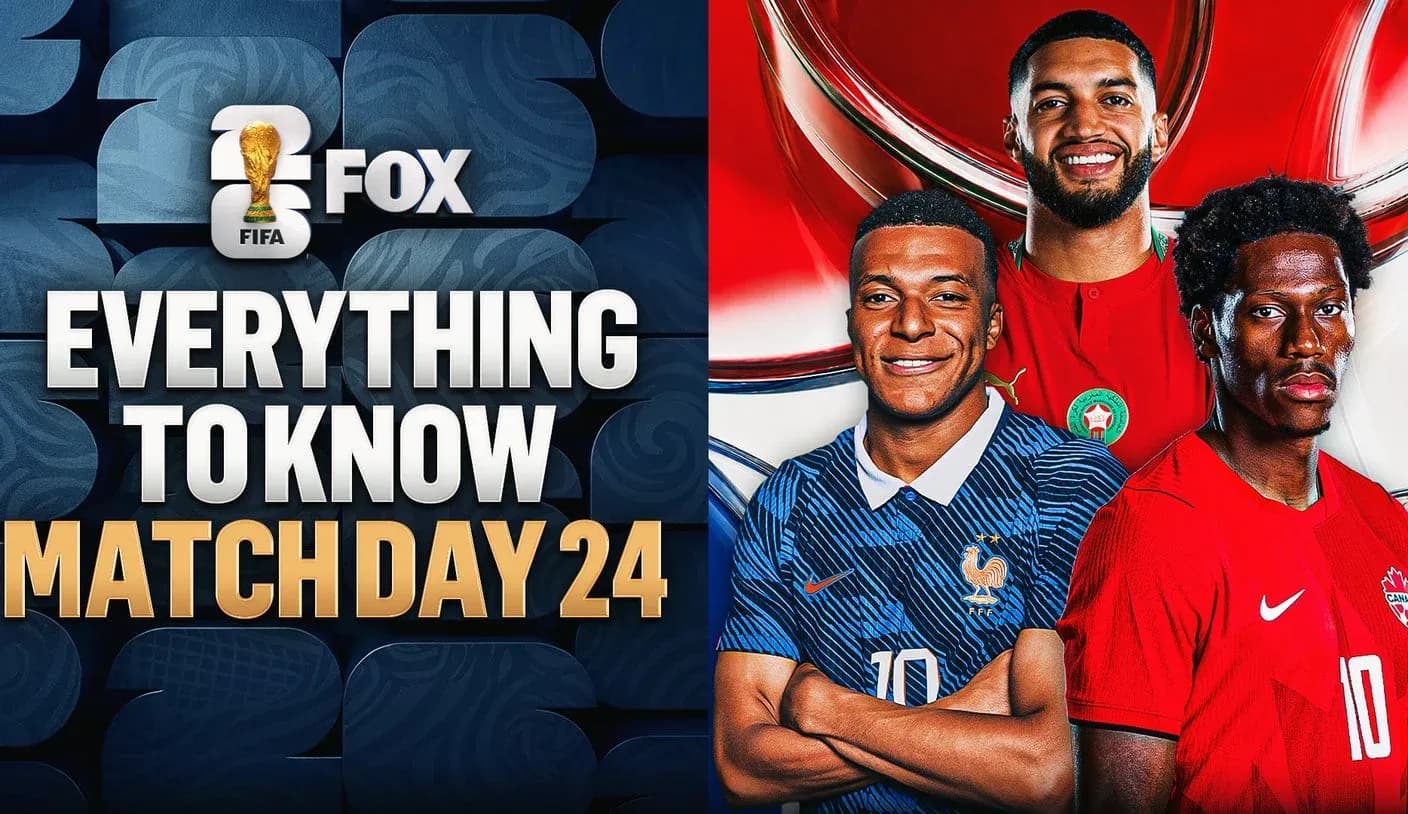
Canada faces Morocco in World Cup knockout clash
On a day the host nation marks 250 years since its birth, the World Cup leaves the safety of the group stage and walks straight into jeopardy.
Houston at lunchtime. Philadelphia in the furnace of an East Coast heat wave by night. Canada, Morocco, France, Paraguay. Two tickets to the quarterfinals. No margin for error.
Canada’s coming‑of‑age test against ruthless Morocco
The round of 16 opens in Houston, where Canada meets Morocco in a rematch loaded with history and imbalance.
Four years ago in Qatar, Morocco beat Canada 2–1 in the group stage on its way to a fairytale run to the semifinals. Back then, Canada was a wide‑eyed guest at the party, exiting with three defeats from three. This time, Jesse Marsch’s side arrives with scars, belief, and something it has never had before at a World Cup: a knockout win.
The route here has been anything but smooth.
Canada stumbled out of the blocks with a flat draw against Bosnia and Herzegovina, a performance that revived old doubts about whether this team could really live on this stage. The response was emphatic. A 6–0 demolition of Qatar secured a place in the knockouts and showcased the attacking ceiling of this group.
Then came another jolt. A limp defeat to Switzerland in the group finale dragged Canada back into survival mode. Again, they found a way. Against South Africa, with nerves fraying and the tournament on the line, Stephen Eustáquio struck late to deliver a gritty 1–0 win and a place in the last 16.
This is what has defined Marsch’s Canada: imperfect, occasionally erratic, but stubborn. When the walls close in, they push back.
The talent is there. Jonathan David, Cyle Larin and Tajon Buchanan give Canada a front line that can hurt anyone on the counter. The problem? None of them has truly stitched together a complete tournament yet. Moments, yes. Dominance, no. Against Morocco, that won’t be enough. Canada needs all three to hit their level on the same night.
Then there is the Alphonso Davies question.
The Bayern Munich star finally returned from his hamstring injury in the win over South Africa, coming off the bench in the 75th minute for his first minutes of this World Cup. His presence alone changes the geometry of a pitch. But is he ready to start? And if he does, can he sustain the high‑octane surges that make him one of the most devastating right backs in the game?
Canada’s hopes might rest on how many of those questions get a positive answer.
Because on the other side stands a Morocco team that no longer feels like a romantic outsider. It feels like a contender.
Morocco arrived in North America with the weight of expectation after its 2022 semifinal run, and has worn it comfortably. A sharp 1–1 draw with Brazil — a game in which the Africans were superior for long spells — set the tone. A controlled 1–0 win over Scotland and a 4–2 victory over Haiti followed, confirming the depth and balance of Walid Regragui’s squad.
Then came the thriller against the Netherlands in the round of 32, one of the tournament’s standout games so far. The Dutch snatched the lead against the flow, only for Morocco to hammer away until the final seconds. Deep into stoppage time, central defender Issa Diop, who only switched allegiance from France to Morocco just before the final squad deadline, powered home the equalizer. Morocco had dominated the contest, and in the shootout it finally got its reward.
This is a side rich in both storylines and quality.
Ismael Saibari, fresh from a three‑goal group stage and a sealed transfer from PSV Eindhoven to Bayern Munich, brings power and directness up front. Achraf Hakimi, the Spanish‑born Paris Saint‑Germain right back, is one of the most complete fullbacks on the planet, relentless in his forward bursts. Brahim Díaz offers guile and incision from the wing for Real Madrid. In midfield, teenage sensation Ayyoub Bouaddi has emerged as one of the breakout stars of the tournament, playing with a composure that belies his age.
Morocco has the look of a team that knows how to live in the late rounds of a World Cup.
Canada, technically the “home” side in this World Cup, gave up a true home‑field path by failing to top its group. Even so, a strong Canadian presence is expected in Texas. They will need every voice.
Because this, by any measure, would be a historic upset. For Canada to reach the quarterfinals, it must take down a Morocco team that has been better, deeper, and more ruthless — and do it on a day when Hakimi may have acres to attack if Davies is missing or below full speed.
Hakimi has played every minute of Morocco’s four matches. He has driven them forward from the right flank all tournament. If Canada cannot find a way to slow him, the celebration in Houston might feel very one‑sided.
France’s juggernaut meets Paraguay’s iron wall in the Philly heat
If Houston is about ambition and belief, Philadelphia is about survival.
On a sweltering night just miles from where the Declaration of Independence was signed in 1776, France and Paraguay will fight for a place in the last eight. The conditions will be brutal. The stakes, higher.
France came into this World Cup as a pre‑tournament favorite and has played like it. There are no obvious weak spots. There are barely any quiet ones.
Kylian Mbappé has turned the group stage and early knockouts into his personal showcase. Six goals already, delivered in three separate braces. In the one match he didn’t score — against Norway — he simply shifted roles and supplied two assists. His pursuit of Lionel Messi’s World Cup goals record hangs over every French match, a subplot that only grows louder with each game.
Yet if Mbappé is the headline, Ousmane Dembélé has been the twist that makes this French side feel unstoppable.
Before the second group game against Iraq, Dembélé had never scored at a World Cup. That narrative is gone. He struck a goal and an assist against Iraq, then exploded with a hat trick against Norway. In the 3–0 win over Sweden in the round of 32, he added another assist, stretching defenses until they snapped.
On the ball, Michael Olise has been the conductor. The Bayern Munich midfielder has five assists and has quietly been one of the tournament’s most influential playmakers, threading passes into spaces others don’t see. Winger Bradley Barcola has added yet another layer, using his skill to unbalance backlines and open lanes for the stars around him.
Everywhere you look, France has a threat. For Paraguay, the challenge is clear and daunting: hold the line longer than anyone expects.
La Albirroja arrive in Philadelphia as the tournament’s great disruptors.
Their World Cup began with a 4–1 beating at the hands of the USA, a result that could have broken a lesser group. Under Gustavo Alfaro, it became a turning point instead. Paraguay tightened its structure, leaned into its defensive identity, and started to embrace the grind.
The first shock came in the group stage: a 1–0 win over Türkiye, secured despite playing with 10 men for the entire second half. It was a victory forged in concentration and sheer defensive will.
The second shock was even bigger. In the round of 32, Paraguay stood up to Germany and refused to blink. Germany had the ball, as expected. What it didn’t have were clear chances. Paraguay’s shape, discipline, and collective work rate strangled space and rhythm. After a 1–1 draw over 120 minutes, Paraguay held its nerve in the shootout and delivered the biggest upset of the tournament so far.
The backbone of this run lies in midfield and the back line.
Matias Galarza has been at the center of almost everything. His loan to Atlanta United ended during the World Cup, but his influence for Paraguay has only grown. He assisted Julio Enciso’s goal against Germany, converted his penalty in the shootout, and scored the winner against Türkiye. He has become the heartbeat of a team built on resilience.
Around him, the defensive unit has been rock solid. José Canale, Gustavo Gómez, Juan Cáceres and Júnior Alonso have formed a back line that rarely loses its shape. Behind them, goalkeeper Orlando Gil has provided the last layer of resistance, the final answer when everything else is breached.
That structure now faces the most complete attack in the competition.
To survive France, Paraguay will need its best defensive performance yet — and then some. The margins will be thin. One lapse against Mbappé’s acceleration, one mistimed step against Dembélé’s dribble, one missed read on an Olise through ball, and the plan can unravel in a heartbeat.
The heat adds another wild card. A severe heat wave has gripped the East Coast, and no one truly knows how 90 or 120 minutes in those conditions will affect legs, minds, and decision‑making. Deep‑lying teams expend enormous energy in concentration and constant shifting. High‑pressing favorites can wilt if the tempo drops.
In that furnace, creativity becomes priceless.
Olise, again, feels central. With Paraguay likely to sit deep in a compact block, it will take elite playmaking to pick the lock. His five assists already tell part of the story; the rest is in the timing of his passes, the way he releases Mbappé and Dembélé at just the right moment. If he dictates the game as he has so far, France will expect to punch its ticket to the quarterfinals.
Paraguay has already torn up the script once against a European giant. It has already done it twice, if you count Türkiye. To do it again against this France, in this heat, with this firepower bearing down?
That would be the kind of shock that doesn’t just live in a tournament, but in a nation’s footballing memory for generations.