Canberra United's New Era: Owners Plan Permanent Home and Men's Team
Canberra United has a future again. Not just for this A-League Women season, but in a way the capital has been chasing for almost two decades.
Australian Sports Group (ASG) has bought the club’s licence from Capital Football, stepping in late but firmly enough to guarantee United’s place in the 2026-27 ALW campaign. The deal, believed to total around $15 million across the women’s and a future men’s team, includes a commitment to underwrite the women up to $3 million over multiple years.
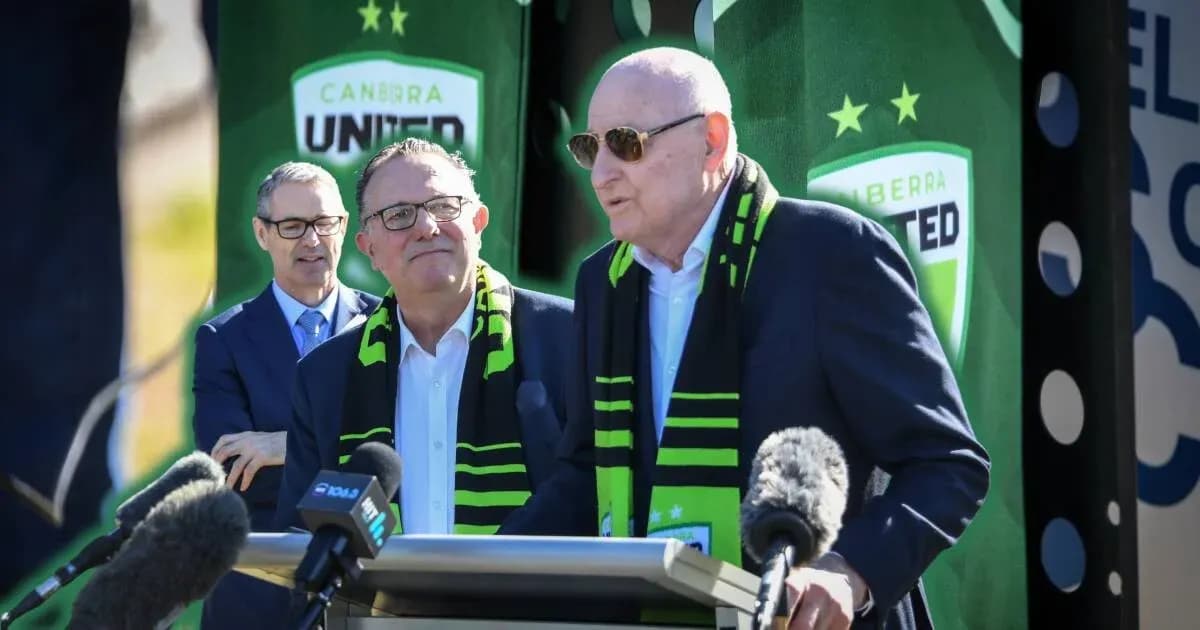
On Friday at McKellar Park, ASG chief executive Theo Fotopoulos and chairman Morris McAlister stood on the turf that has carried Canberra United for 18 years and made one thing clear: this is not a holding pattern. It is a reset.
McKellar at the heart of the plan
Home, for now and for the foreseeable future, remains McKellar Park.
Fotopoulos described the venue as United’s “spiritual home” and confirmed the club will keep playing there. Next door, Belconnen Soccer Club will become a “strategic partner”, with ASG installing its office inside the venue.
The ambition goes further. ASG is actively exploring the creation of a dedicated training base at McKellar, turning the six-hectare private ground into something closer to a true home of football for the club.
Capital Football and the ACT government once had grand plans for a training hub at the Throsby Home of Football, only for the project to collapse when Capital Football could no longer afford it. ASG now sees an opening.
“It’ll come down to what we can get approved in terms of the facility here,” Fotopoulos told The Canberra Times. “It’s one of the few private grounds in Canberra. It’s roughly about six hectares. I’ve spoken to the relevant people, so it looks very positive what we can do here.
“But football needs a home and it’d be great to be able to develop that here.”
The message was unmistakable: McKellar is not just a match-day venue. It’s the centrepiece of the rebuild.
Coaching call and a race against the clock
The takeover arrives with the season bearing down fast. The ALW draw is due out next month, with the campaign kicking off on October 16. Pre-season starts in six weeks. United cannot afford to drift.
ASG has already moved on the key football question. The new owners have spoken with coach Antoni Jagarinec, who has steered Canberra to the finals in each of the past two seasons, and want the coaching situation resolved quickly.
“That is our priority to get that finalised,” Fotopoulos said. “In fact, we had some recent meetings with the coach.
“I believe the PFA are also working with all the players at the moment and we’d like to get that wrapped up quicker than later. We feel very confident with the reaction we’ve had so far from the players that that will happen in haste.
“It’s never a no-brainer, but yeah, look, I think [Jagarinec’s] results speak for themselves. We’re looking for continuity and consolidation. We’ll have those announcements out pretty soon.”
The clock is ticking. Contracts must be sorted, a squad locked in, and a club that has lived with uncertainty for two years given something solid to build around. ASG insists that stability is coming – and fast.
Men’s team promise finally has a date
For Canberra football, the question has always lurked behind every announcement: what about the men?
ASG’s deal includes an option, not yet a full licence, to introduce an A-League Men side in the 2028-29 season. On paper, that’s still three seasons away. In a city that has watched bid after bid stall over 18 years, any delay raises eyebrows.
Fotopoulos didn’t flinch.
“Well, we’re here today, so that’s your best guarantee,” he said. “That is part of our twin strategy. When we started speaking to the APL … that was part of our mix. We believe the strength comes from both.
“It would be almost discriminatory not to work with the men. It’s always been part of our plans.”
APL chair Steve Conroy backed the move, thanking the ACT government and the local football community while describing ASG as the group to “secure the future of the women’s team and establish a pathway to introduce a new A-League Men’s team in Canberra”.
For bid leader Michael Caggiano, who has pushed Canberra’s cause for eight years, ASG’s arrival and the 2028-29 marker may finally close the chapter on a saga that has stretched back to the old NSL days.
United by name – and maybe by a new identity
One thing won’t change: the name.
Canberra United will remain Canberra United, for both women and any future men’s side. Eighteen years of history, Fotopoulos argued, is not something you throw away.
“The name will remain the same, Canberra United,” he said. “You’ve got 18 years of Canberra United. Why would you change it?
“Unless somebody or the general public have got a negative view towards the team – I don’t think that’s the case.”
What might change is the badge on the scarf. Fotopoulos wants the city to help craft a nickname, floated as part of a public campaign that could run through The Canberra Times. Cosmos, Arrows, Greens, Lakers, Green Machine – the suggestions are already flying.
“If the Canberra community want a nickname for their team, Green Machine, whatever they come up with, we’re happy to look at that and we’ll run a public campaign, possibly through your paper.”
The club’s identity, in other words, will be built with the terraces, not imposed on them.
Who are ASG?
Behind the new era is a partnership steeped in football’s older structures.
ASG chairman Morris McAlister comes from a commerce background. He is governing director of Petron Plus 7 Australian and New Zealand, which supplies lubricants and grease products, and a senior consultant at MEC Team Consultants, linking Australian businesses with Chinese markets.
Fotopoulos, ASG’s chief executive, is a marketing executive and CEO of FOS Group Australia. On the football side, the pair have history. They were involved in Sydney Cosmos, where Fotopoulos served as chief executive, and in Newcastle Breakers in the NSL era. Fotopoulos also held the chief executive role at Sydney Olympic.
Now they have two years to shape the framework for a men’s team and, more urgently, to turn Canberra United into a stable, professionally run club after years of financial strain under federation control.
End of the uncertainty – and a bigger vision
Capital Football has carried Canberra United since the club’s birth in 2008. The federation kept the team alive and competitive, but the cost became unsustainable. Last season was its last in charge. For months, the women’s side hovered in limbo, its future dependent on finding a private buyer.
That buyer is now in place. The A-Leagues will formally unveil ASG as United’s new owners, locking in the club’s presence in the 2026-27 ALW season and ending the immediate threat of Canberra disappearing from the national women’s stage.
Fotopoulos’ ambitions stretch well beyond survival.
“Canberra is home to a thriving football community – a huge participant and passionate supporter base who have made Canberra United one of the most strongly supported A-League Women teams for the last 18 years,” he said.
“We’re thrilled to be leading the next generation of professional football in Canberra, taking on the ownership of the Canberra United women’s team with a renewed focus on growth and investment, and progressing towards an integrated professional club with the introduction of an A-League Men’s team in season 2028-29.”
He has also pledged to rebuild academy pathways after Capital Football scrapped United’s academy three years ago, a decision that cut off a crucial development route for the region’s best young players.
“We’re excited to be part of growing the A-Leagues and building a strong club focused on community engagement, football excellence, commercial growth, new infrastructure and strengthening the football development pathways for boys and girls in the territory and the capital region,” Fotopoulos said.
The pieces are on the table now: a committed private owner, a promised men’s team, a potential training base at McKellar, and a renewed focus on pathways.
For a club that has lived on the brink, the question shifts from “Will Canberra United survive?” to something far more ambitious: just how big can this capital-city club become by the time that men’s side finally walks out in 2028-29?