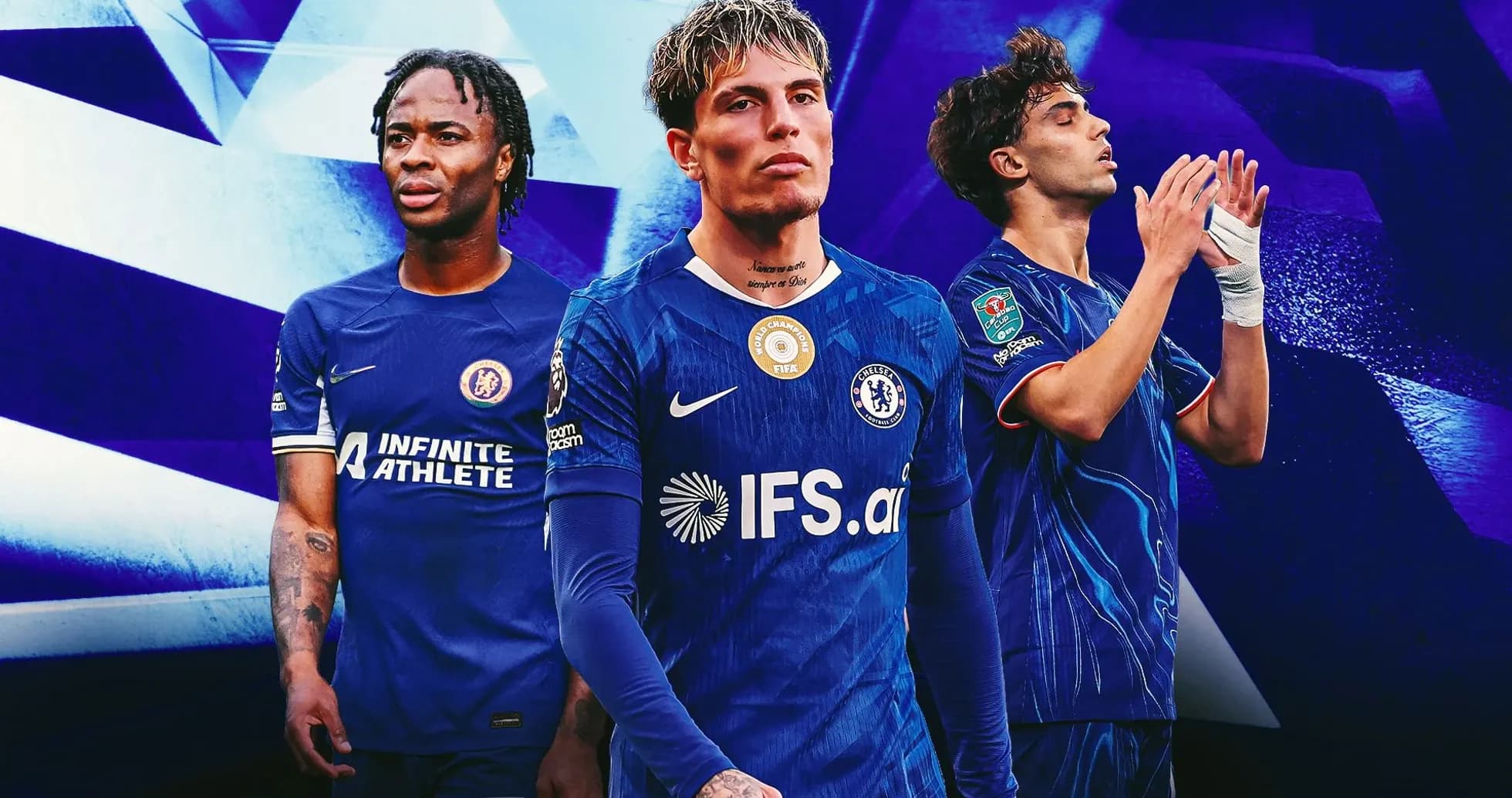
Chelsea's Expensive Non-Events: The BlueCo Misfires
Carney Chukwuemeka arrived as a statement of intent. England youth champion, £20m from Aston Villa, a midfielder supposedly built for the future. Stamford Bridge barely noticed.
Injuries clipped his momentum, managers looked elsewhere, and his Chelsea career dissolved into background noise. Thirty-two appearances in two-and-a-half years is not a platform, it’s a footnote. By the time he left for Borussia Dortmund last summer, initially on loan, his time in blue felt less like a chapter and more like a line in the credits.
Christopher Nkunku was meant to be different.
Chelsea moved early in 2023, paying £52m to prise him from RB Leipzig, where he had become one of the Bundesliga’s most dangerous forwards. This was the man who would lead the new-look attack, the marquee forward to grow with the project.
Then pre-season bit back. A serious knee injury almost as soon as he joined up with the squad set the rhythm of his Chelsea story: stop-start, mostly stop. He missed half of 2023-24, and when he did return, the team had moved on without him. Cole Palmer seized the spotlight, the goals, the responsibility. Nkunku never really got close to dislodging him.
By 2024-25 he was a bit-part presence, a big name on the teamsheet but rarely a central figure on the pitch. Twenty-seven Premier League appearances in total, then a sale to AC Milan last summer. A major coup on paper, a quiet exit in reality.
Alejandro Garnacho’s move from Manchester United felt like opportunism dressed as vision.
Frozen out by Ruben Amorim at Old Trafford, the winger crossed the divide for £40m, Chelsea gambling that a change of scenery would restore the spark that once lit up United’s left flank. It never came.
The verve, the swagger, the fearless one-v-one play that had made him such a livewire at United simply didn’t travel south. Under Enzo Maresca, then Liam Rosenior, Garnacho hovered on the fringes, unable to nail down a starting place and delivering a string of anonymous displays.
Chelsea now look ready to cut their losses, hoping for £43-£45m. Hope is the key word. On current evidence, recouping that kind of fee would be a minor miracle.
Pierre-Emerick Aubameyang’s Chelsea career was effectively over before it began.
Thomas Tuchel wanted him. Chelsea signed him from Barcelona in the summer of 2022. One day after his debut, Tuchel was gone. The signing instantly lost its logic.
Graham Potter never truly trusted him. Aubameyang drifted to the margins, then out of the picture altogether. Twenty-one appearances, three goals, no real imprint on a team crying out for a reliable finisher. He eventually left on a free to Marseille, his single season in west London remembered more for its odd timing than anything he did on the pitch.
Kalidou Koulibaly arrived with a reputation, not a question mark.
A rock at Napoli, one of Europe’s most respected centre-backs, he was supposed to anchor Chelsea’s defence in the first BlueCo window of 2022. Instead, he became another symbol of a chaotic year.
Managers changed, lineups shifted, the team’s structure never settled. Koulibaly made high-profile errors, struggled to impose the authority he had shown in Serie A and never grew into the commanding presence the club had envisaged.
After just one season, Chelsea moved him on to Al-Hilal, part of the early wave of big names heading to Saudi Arabia. A transformative signing in theory; a one-year experiment in practice.
Raheem Sterling’s move should have been the flagship transfer of the new regime.
Proven Premier League scorer, multiple title winner, £47.5m from Manchester City. This was supposed to be the sure thing, the grown-up in a dressing room full of projects. It never clicked.
Two flat seasons, flashes of quality but little consistency, and the patience ran out. Maresca sent him to the infamous “bomb squad”, then out on loan to Arsenal in 2024-25, where he again failed to reignite his career.
When he returned in the summer of 2025, nothing had changed. Still an outcast, still surplus. His contract was terminated in January 2026, 18 months after his last appearance for the club. A marquee name reduced to a cautionary tale.
Joao Felix was the signing Chelsea wanted so badly, they did it twice. They probably shouldn’t have done it once.
His first stint, a short-term loan from Atletico Madrid in that wild January 2023 window, started with a red card on debut against Fulham. It never truly recovered. There were moments, but not enough of them, and not enough substance behind the style.
Even so, Chelsea went back in 2024, lured by his productive spell at Barcelona. This time, under Maresca, he barely lasted half a season before heading off again, loaned to AC Milan after failing to make a lasting impression.
By the summer of 2025 he was gone for good, sold to Al-Nassr. Two spells, two false dawns, and a lingering question about why the club was so determined to make it work.
Facundo Buonanotte’s Chelsea career passed almost in silence.
Signed on loan from Brighton late in the 2025 summer window, he looked like a depth move, a creative option for Maresca to rotate into a busy schedule. He barely got near the pitch.
Eight appearances in total, only one in the Premier League, and regular omissions from the matchday squad. By January, the loan was cut short. An equally muted half-season at Leeds followed. Another name on the long list of players who came and went without leaving a mark.
Deivid Washington is still a Chelsea player. You’d be forgiven for forgetting.
Signed from Santos in 2023 for £17m, one of a cluster of youngsters tied to long-term contracts, he has managed just three first-team appearances, all back in 2023-24. The rest of his time has unfolded quietly in the development squad.
He returned to Santos on loan in 2025, but even there failed to generate any momentum and was recalled. Now 21, he looks like a striker with no clear pathway at Stamford Bridge. A permanent move feels less like a possibility and more like an inevitability.
And then there is Mykhailo Mudryk, the most dramatic and troubling story of the lot.
His £89m arrival from Shakhtar Donetsk in January 2023 electrified the fanbase. Raw pace, fearless dribbling, a winger who looked tailor-made for the Premier League. Instead, his Chelsea career became a slow unravelling.
On the pitch, he rarely resembled the player who had convinced the club to spend so heavily. Confidence drained away, managers came and went, and he never found a stable role. He drifted in and out of the side, more promise than product.
In November 2024, the story took a darker turn. Mudryk was provisionally suspended for a doping offence. He has not played since.
In April 2026, the Football Association handed him the maximum four-year ban. He has appealed and reportedly believes a return in 2026-27 could be possible. Even if that happens, the idea of him restarting his career in a Chelsea shirt feels remote.
For a club that spent so much to launch a new era with fireworks, too many of these signings fizzled out in silence. The question now is not how much they spent, but how long the hangover from those decisions will last.