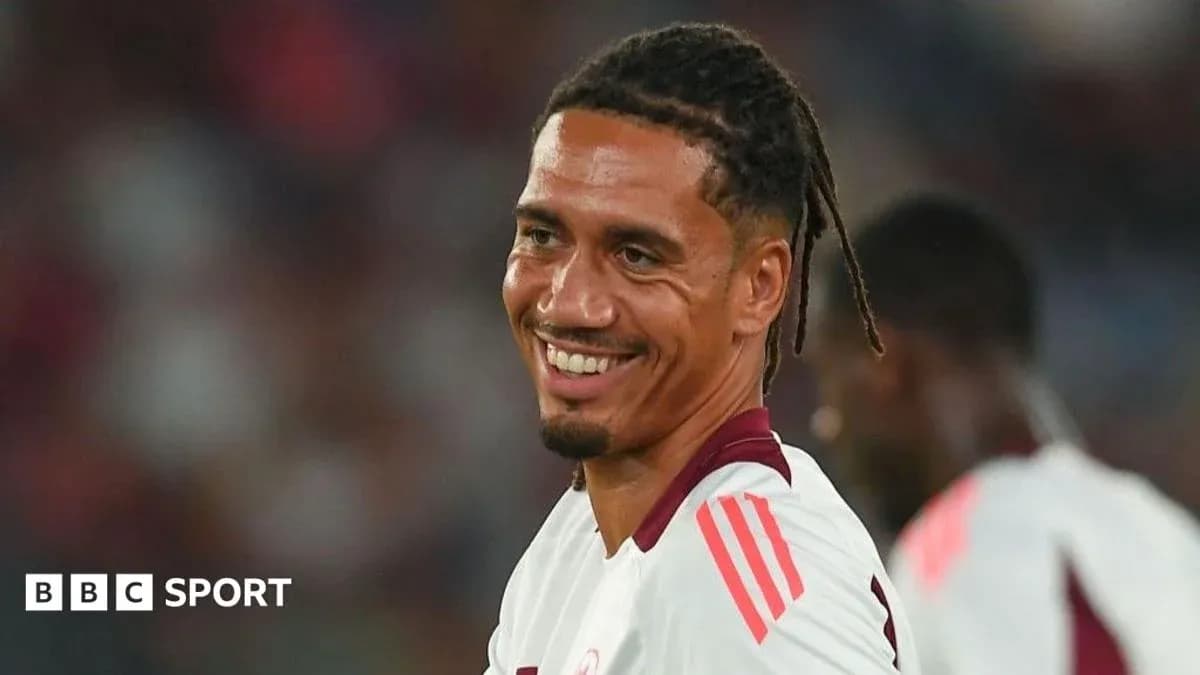
Chris Smalling: A Unique Journey from Non-League to Elite Football
Chris Smalling pauses for barely a beat before his first answer. It’s enough. You can tell straight away this is not a standard-issue footballer.
At 36, he has lived a career that shouldn’t really happen: from non-league Maidstone to a Champions League final in three years, 580 club appearances across three countries, 31 England caps, trophies with Manchester United and Roma, seasons under Sir Alex Ferguson and Jose Mourinho. Now he is back in the north west of England with his family, not to wind down, but to decide where the next chapter starts.
The boots are very much still on.
A veteran who feels younger
Smalling talks like someone who has studied his own body as carefully as any opponent.
"I know my body now better than when I was 26 and that's shown in the games I'm playing," he says. The line is delivered without bravado. It sounds like a conclusion.
He remembers Ferguson pushing the squad towards details that, at the time, felt left-field. Ryan Giggs doing yoga. Extra work beyond the training pitch. The sort of stuff that only makes full sense when 30 has come and gone.
"When you get beyond 30, each year is precious in terms of enjoying playing and being passionate about football," he says. Actual training, he points out, is a tiny slice of a player’s life. The real work is the unseen part – recovery, food, supplements, what happens between sessions.
At most clubs, pre-season means blood tests and club recommendations. Smalling went further. Genetics testing. Deep-dive data. A tailored supplement plan based on what his body actually needs, not what the label promises.
Last season, the payoff was clear to him: an ever-present campaign with Al-Fayha in the Saudi Pro League, something he is genuinely proud of. For a player whose story has so often been about proving people wrong, simply being available every week at 36 feels like another quiet win.
From Maidstone to Manchester United
Rewind 18 years and none of this looked remotely likely. Top-flight football wasn’t Plan A. It wasn’t Plan B or C either.
"It wasn't even plan D," he recalls.
He was at Maidstone, playing non-league, and preparing to go to university to study financial economics. A-levels done. Life mapped out. He was even looking at other non-league clubs around Leicester so he could keep playing while he studied.
Then, late in the summer, the door that never opens for most players suddenly swung wide. Fulham wanted to take a look.
Smalling knew the odds. He went anyway.
Roy Hodgson watched a single practice game, called him into the office and offered a contract. "It wasn't even a full week," Smalling says. "I didn't have any time to get my head around it. I was just in total shock."
It would not be the last time Hodgson dragged him into a room and changed his life.
The hotel knock that changed everything
On 17 January 2010, Smalling travelled with Fulham to Blackburn for a Premier League game. He didn’t kick a ball in the 2-0 defeat. The important moment had already happened.
The night before, he was on the team coach. There had been rumours about other clubs, but not Manchester United. Then Hodgson pulled him off the bus.
Fulham had accepted a bid. Sir Alex Ferguson was on his way to the team hotel. He would be there in 45 minutes.
Smalling rang his mum. Then he sat alone, trying to work out how you prepare to meet the man who manages Rio Ferdinand and Nemanja Vidić when you’re a 20-year-old with a handful of senior games.
He needn’t have worried. "Literally, we were there for about at least a couple of hours," he says of that first meeting. Ferguson was, as so many of his former players say, calm and reassuring.
Smalling had doubts. United were stacked with elite centre-backs. Where did he fit? Would he play? Ferguson told him he would get his chance. Told him he believed in him. For a young defender who thought university was his most likely destination, it was surreal.
"To be able to share the dressing room and the pitch and have conversations with him, is just incredible," he says now. The awe hasn’t really faded.
Inside the minds of elite managers
Listen to Smalling long enough and a theme emerges: the truly great managers get the personal side right.
Outside Old Trafford, his relationship with Mourinho is often reduced to one moment – the public criticism in November 2016 about his reluctance to play through injury. Smalling doesn’t recognise that as the defining image.
"For United or Roma, Jose picked me for most games because we had a good relationship and he trusted me," he says. Trust, for him, is the currency that matters.
He talks about how Ferguson and Mourinho could bend not just young players but senior professionals to their will, not through fear, but belief. "A lot of managers can give good team talks," he says, but the difference with the very best is what happens when you lock eyes with them and see that they truly believe "it's going to happen". When the senior players buy in, the rest follow.
Smalling lived that to the extreme. At one point, he was having injections in a broken toe to keep playing. Mourinho had created such a hardened mentality in him that he felt he could do anything, even when, as he admits, maybe he shouldn’t.
Eventually, he reached the medical limit on injections. He had to stop in a warm-up. Mourinho was disappointed. For some, that would be a breaking point. For Smalling, it was confirmation.
"It gave me even more belief because it was easy to choose another centre-back but he wanted me," he says.
The respect has endured. Smalling is still in contact with Mourinho and wished him good luck when he took over at Real Madrid this summer.
A future away from the dugout
Given the managers he has worked under, you might expect Smalling to drift naturally towards coaching. He doesn’t.
"I don't think it will be my route," he says. The certainty in his voice matches the clarity he once had about university.
He is already building the next phase. One of his main projects is an education programme for young players in partnership with the Global Institute of Sport, due to launch soon. There are three or four similar ideas in the works, all geared towards helping others navigate a world he entered almost by accident.
Those plans can wait. For now, he insists, everything is centred on playing. The passion is still there. So are the physical numbers he tracks so closely.
More than just a centre-back
Whoever signs Smalling next will not just be adding a defender with a big-game CV.
At Al-Fayha, his influence stretched well beyond matchdays. He pushed for improvements to the gym to meet the standards he believes an elite player should expect. It matters to him that, at every club he has left, people remember not just the tackles and clearances but the way he carried himself.
He is proud of that. Proud that he has made a positive impact on and off the pitch in Manchester, Rome, Riyadh and beyond.
It all comes back to that decision as a teenager, staring at the safer path.
"It would have been the safer route," he admits of the university offer. In his first year at Fulham, he wasn’t earning big money. He was playing for the reserves, travelling as the 19th man with the first team, not even making the bench. There was no guarantee of a payoff.
Then came United. A four-year contract. At the end of the first year, a new deal. Another a year later. Another 18 months after that. Each time, a fresh challenge, a fresh incentive. "There was always this carrot," he says. "I never took anything for granted."
He still doesn’t. Somewhere in the north west, a 36-year-old centre-back who once planned to study financial economics is training, testing, preparing. One more club. One more dressing room to influence. One more set of doubts to dismantle.
The question now is simple: which team is ready to bet that his story still has another twist left in it?