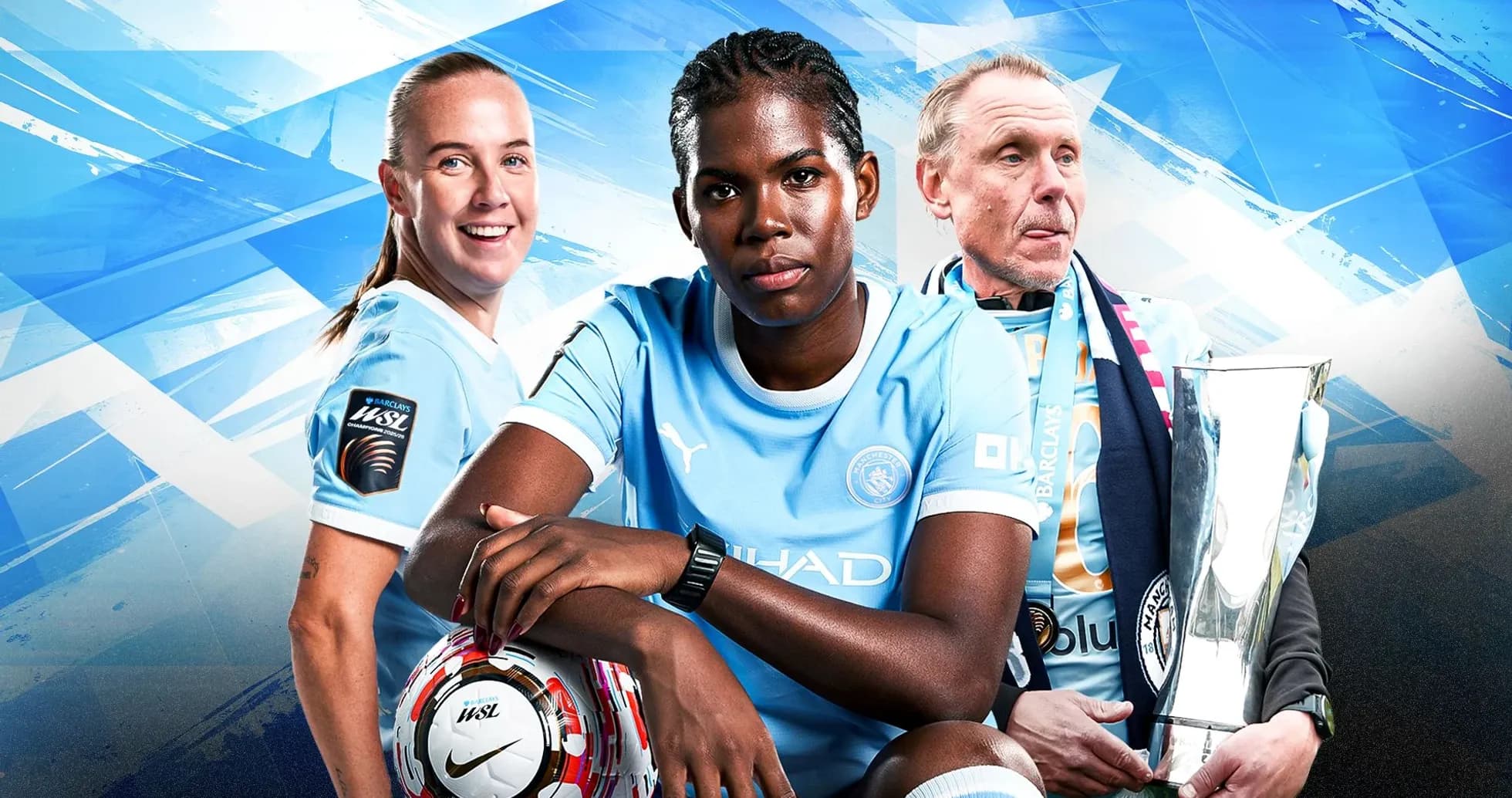
City's WSL Triumph: A Culture Shift Under Jeglertz
For years, City were everyone’s dark horse. The squad had the talent, the budget, the ambition. The WSL trophy, though, kept slipping through their fingers – late collapses, chaotic seasons, a nagging sense that something was missing when it really mattered.
Jonas Jeglertz changed that in a single campaign.
A culture shock that stuck
What he delivered in his first season in charge shouldn’t be brushed aside as inevitable progress. This was a reset. A hard one.
Alex Greenwood called it a “shift in culture” and spoke about how even “the language used” around the club had to change as City began to talk openly about trophies and dominance, not just potential. It was uncomfortable at times. It had to be. “Crossing that hurdle and being able to do that has shifted so many mindsets in this building,” she said.
The result? A WSL title. City’s first silverware in four years. And, crucially, it didn’t feel like a one-off. It felt like the start of something that can be repeated.
Mary Fowler admitted that, in previous years, belief wavered. “Maybe we fell short because there was a bit of a lack in the mindset where we felt we were really capable of winning,” she told GOAL. Now that they’ve done it, the doubt has gone. “It feels like, ‘You are very capable and you can do that again’.”
That’s the environment Jeglertz walked back into after a short summer break. Not a group relieved by ending a drought, but one restless to go again.
“I've seen it already in the players,” he told GOAL. “They already have a confidence that is great, that is calm, but curious about how we take the next step. What do we do to become a little bit better? I already see it and that's something that we need to keep having the whole year.”
This is not a squad easing off. It’s a squad tightening the screws.
Champions arrive to a champion’s dressing room
To that mindset, City have added two serial winners who know what it takes to stay at the top.
Niamh Charles comes from a Chelsea side that turned winning into a habit. Five straight WSL titles. Seven domestic cups in six years. She’s lived inside a machine that simply refused to drop standards.
“That means that she has a little bit of a leader in her,” Jeglertz believes. He sees her as someone who can help show “how you win from one year to the next year” in training as much as on matchdays.
Beth Mead brings a different kind of pedigree. Back-to-back European Championship titles with England. A starring role in Arsenal’s run to the 2025 Champions League crown, capped by that win over Barcelona. She knows the sharp end of elite football and what it demands.
“You can see in her eyes, she's still very eager to be part of this and to learn more,” Jeglertz noted. A champion who still wants to grow is a powerful thing in a dressing room already smelling blood.
On paper, City look perfectly built for a title defence in terms of mentality, culture and environment. But this season brings a test last year didn’t: the Champions League.
A thinner squad, a heavier load
During their title-winning run, City had a clear advantage over Chelsea, Arsenal and Manchester United. No European football. No midweek travel. No extra strain.
That luxury has gone.
The club’s only senior additions, beyond Mead and Charles, are Carlotta Wamser and the returning loanees. Wamser offers depth on either flank at full-back, a useful piece after Leila Ouahabi’s departure, but the overall picture is stark: three arrivals, nine first-team exits.
It’s not the overhaul some expected. It was never meant to be.
“The depth is there,” sporting director Nils O’Neill insisted at the end of last season. “It’s not about a squad transformation. It’s about adding in the key positions we need.”
The theory sounds good. The early injury list makes it look fragile.
Vivianne Miedema’s situation is the big one. The Guardian understands she may not be back until 2027. For a player pencilled in as a transformational attacking option, that’s a huge blow. City did try to act on deadline day, but no deal got over the line. That alone tells you there is concern inside the club about how stretched this group might become.
Still, there has been targeted work. Left-back has been refreshed with Charles and Wamser. Mead replaces Kerolin in the forward line after the Brazilian’s move to Barcelona. Beyond that, Jeglertz is putting his faith in internal growth.
Risa Shimizu returns from a loan at Liverpool to bolster full-back options. Sydney Lohmann and Grace Clinton are expected to deliver far more after stop-start first seasons hampered by niggles and missed chances. Fowler, back from an ACL injury and already flashing her quality since February, is being talked about as one of the players to watch across the league.
Up front, there is flexibility everywhere. Mead, Fowler, Lauren Hemp, Aoba Fujino and Iman Beney can all shift roles, several of them capable of operating through the middle. That versatility eases the pressure to sign a pure No. 9 to sit behind Khadija Shaw and wait.
There is also a small wave coming from the academy. Sacha Lewis, Amelia Oldroyd and Aoibhe Brennan have all signed their first professional deals. Mayzee Davies, already a senior Wales international, did so last year and could become a useful depth option.
At the top of the hierarchy, the core remains intact. Shaw, Greenwood, Hemp, Kerstin Casparij, Jade Rose and Yui Hasegawa form one of the most complete starting XIs in the WSL. Add Miedema to that picture when she finally returns, and the first-choice team looks fearsome.
The question is what happens when that first-choice team can’t all play.
Built for more games – or built to the limit?
City’s title run last season was not just about quality and mentality. It was underpinned by something they hadn’t enjoyed for a while: a near-perfect injury record. Key players stayed fit. Rotations were controlled. The machine kept humming.
Can that really hold when the Champions League is back on the schedule?
“We’ve learned and we will absolutely be ready next season,” O’Neill insisted. Jeglertz, for his part, felt the opposite problem last year: too many players, not enough minutes.
“We have too many good players to play these few games we are playing,” he said in May. “Next year will be different because it's more games. The squad is built for that.”
Now comes the truth test. There are positions where a single injury could do serious damage, and others where the risk multiplies if those tipped for “bigger seasons” don’t deliver. Lohmann has already had hip surgery. Clinton still has to prove she can grab games by the throat. Several players are carrying knocks into the new campaign, and Miedema will start it on the sidelines.
It’s a tightrope. City believe they can walk it.
Title defence in a harder league
Elsewhere in the WSL, rivals look deeper on paper. More bodies, more options. But they also carry questions City have already answered: about culture, about cohesion, about how to win when the margins are thin.
A Chelsea-style dynasty, built on years of relentless dominance, will be harder to construct in this new era. The league is stronger, smarter, more ruthless. The days of one team strolling away with it feel over.
What City can do, though, is stay right at the heart of every major conversation. They were the best team in England “by a country mile” last season. They know it. The belief that came with finally lifting the WSL again, combined with the arrival of proven winners and a manager obsessed with marginal gains, suggests those long, barren stretches without a title should be a thing of the past.
Now comes the real challenge: can this group turn one breakthrough season into an era?