Club Brugge vs Atletico Madrid: A Tactical Analysis
This was a clash between territorial control and space control. Club Brugge held 58% possession and completed 650 passes at 87% accuracy, clearly dictating the ball. Atletico Madrid, with 42% possession and 484 passes at 85%, were more selective, focusing on compactness and transition. The first half reflected Atletico’s plan: concede territory but exploit moments, especially with their 4-3-3 front line. Brugge’s 4-2-3-1 gradually pushed higher, particularly after the break, turning possession into sustained pressure. Over 90 minutes, Brugge controlled the rhythm, but Atletico repeatedly threatened in fewer, more direct phases.
Offensive Efficiency
Brugge’s game plan revolved around volume and territory. Their 17 total shots, including 10 on target and 11 from inside the box, show a side determined to work the ball into high-quality areas rather than settling for hopeful efforts. An xG of 2.33, matched exactly by Atletico’s 2.33, underlines that the hosts did not merely shoot from distance; they generated chances comparable in quality to their opponents. Four corners further illustrate their territorial advantage, but not an overwhelming set-piece focus.
Atletico were more economical. With 13 total shots and only 4 on target, they created slightly fewer attempts but similar expected goals, indicating a more ruthless shot selection and dangerous situations when they did attack, especially inside the box (9 shots). Their 6 corners show that, despite lower possession, they reached the final third with purpose. The 3–3 scoreline, against equal xG (2.33–2.33), suggests both teams finished slightly above expectation, but Brugge’s 10 shots on goal versus Atletico’s 4 highlight how the home side’s sustained pressure eventually matched the visitors’ early clinical edge.
Defensive Discipline & Intensity
The match was not especially chaotic or foul-heavy. Brugge committed only 5 fouls and received 1 yellow card, indicating a controlled, position-based defensive approach rather than aggressive pressing or tactical fouling. Atletico, with 8 fouls and 2 yellow cards, were marginally more disruptive, consistent with a side protecting space and breaking up Brugge’s rhythm when necessary.
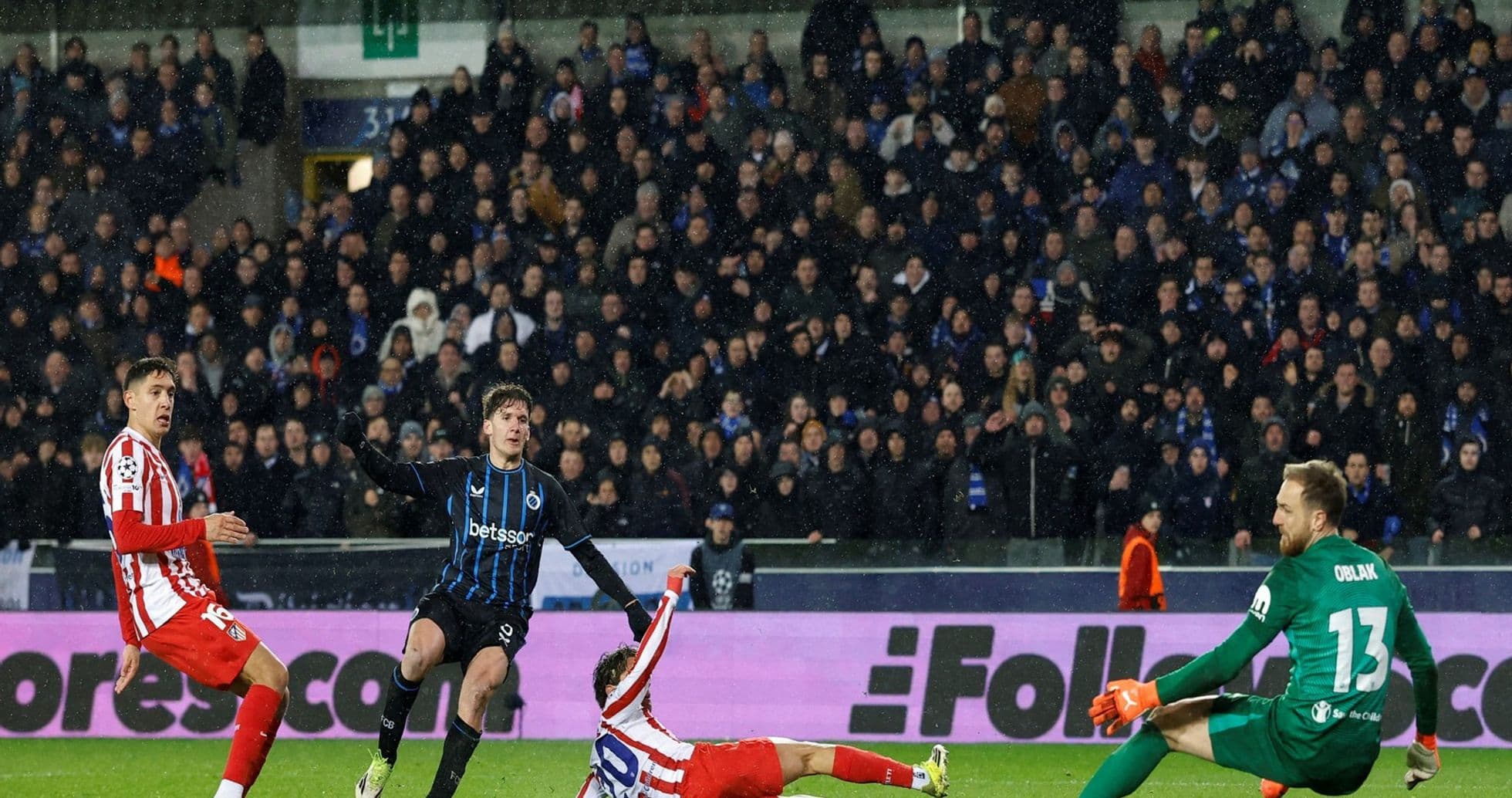
Goalkeeping and last-line defending were decisive. Atletico’s Jan Oblak made 7 saves, facing 10 shots on target; that workload reflects Brugge’s dominance in the final third and forced Atletico into a deep, reactive block for long spells. Brugge’s keeper had just 2 saves to make, with 3 Atletico shots blocked by defenders, suggesting that while Atletico were dangerous when they arrived, their phases were more sporadic. Both teams show 1 goal prevented in the data, underlining that each goalkeeper produced at least one high-impact intervention.
Brugge’s sustained possession and shot volume counterbalanced Atletico’s more selective, transition-based threat. The hosts’ territorial control and 10 shots on target eroded Atletico’s compact block, while the visitors’ efficiency in limited attacks ensured a high-scoring stalemate where efficiency matched possession, not replaced it.