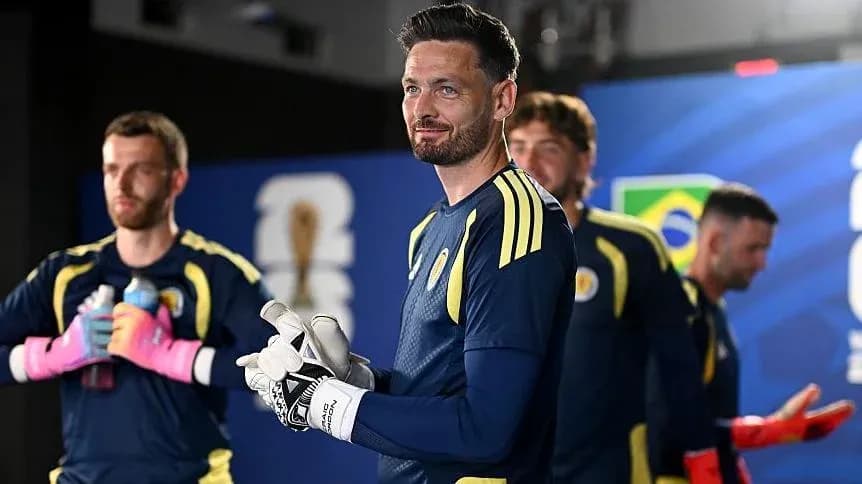
Craig Gordon’s Extraordinary Comeback: Beating a Broken Leg
Craig Gordon has spent a career defying logic. On Thursday, he did it one last time by choosing his own ending.
The former Celtic, Hearts and Sunderland goalkeeper confirmed his retirement from playing, bowing out as a World Cup squad member with Scotland just four years after a double leg break that would have finished most careers stone dead. For Rory Loy, who knows that injury from the inside, the scale of Gordon’s comeback borders on the extraordinary.
“It was incredible,” Loy said on the BBC’s Scottish Football Podcast, and he was not dealing in hyperbole.
Loy suffered the same break in his early twenties. That is supposed to be the age of resilience, when the body heals faster, the mind brushes off fear and the road back, while brutal, still feels long enough to be worth the pain.
“I did the same thing, but I did it when I was 20, 23,” he explained. Gordon’s reality was very different. He suffered his double leg break at 39, an age when most goalkeepers are already calculating their exit, not planning a return.
At that stage, everything is stacked against you: the recovery, the doubts, the simple grind of getting out of bed and trusting a leg that once “just snaps basically”, as Loy put it. The bone heals, but nothing is quite the same again.
Loy described the aftermath in stark terms. The shin goes, the surgeons fix it, and then the real battle begins. Your biomechanics change. The way you walk, the way you move, the way you dive and push off – all of it is rewritten. He spoke of needing orthotics in his boots just to adapt to a new version of his own body, a reminder that the injury doesn’t end when the cast comes off.
“There’s just so many different layers to it,” he said. The physical scars are obvious; the psychological ones run deeper. Trusting the leg. Trusting yourself. Trusting that one more challenge, one more collision, won’t send you back to square one.
For Gordon to go through that in his late thirties, then climb all the way back to the top level, is precisely why fellow professionals talk about mindset when they talk about him. He did not just return to play. He returned to play for Scotland, to reach a World Cup finals squad, and to close his international chapter on the biggest stage the game can offer.
“To do it at his age, in his late 30s and still manage to come back from it… it just sums up the type of mindset he had,” Loy said. That is the respect of a peer who has felt the same pain and knows how steep the climb truly is.
Strip away the medical reports and the rehab schedules and the story is brutally simple: a 39-year-old goalkeeper snapped his shin, rebuilt his body, rebuilt his game and made it all the way back to a World Cup. That alone would be a career-defining feat.
Yet Gordon’s legacy was never going to rest solely on his resilience. Loy was quick to point out that behind the narrative of recovery stood a goalkeeper of genuine class, a player whose level never dipped when he finally pulled the gloves back on.
“Away from all of that,” Loy said, “the level of goalkeeping and saves he had was incredible.”
The injury, the comeback, the World Cup farewell – they frame the story. The saves, in the end, are why it mattered.