Cristiano Ronaldo Honors Diogo Jota in World Cup Win
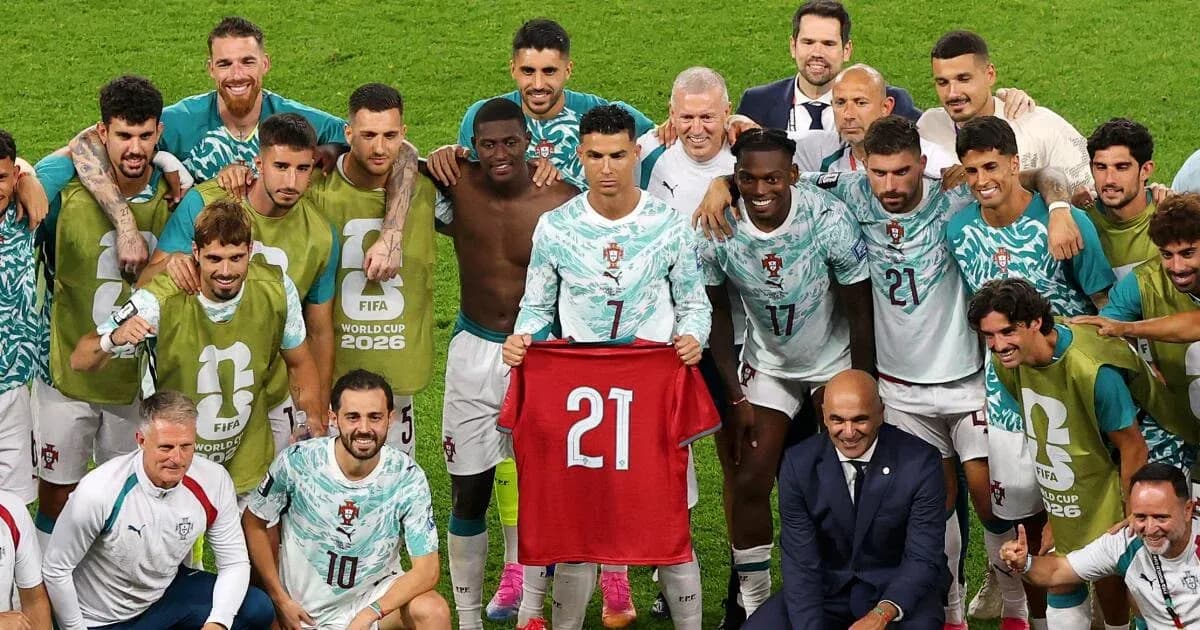
Cristiano Ronaldo stood alone in the glare of the floodlights, a red No. 21 jersey stretched between his hands and a stadium holding its breath.
Portugal had just escaped Croatia with a 2-1 win in a World Cup knockout tie at Toronto Stadium on Thursday, a match that swung wildly in the final minutes. Yet in the immediate aftermath, the result felt secondary. This night belonged to Diogo Jota.
On the eve of the one-year anniversary of Jota’s death, Portugal’s players gathered in the center circle for a team photo. Ronaldo took his place at the front, face set, the No. 21 shirt raised in tribute while teammates around him smiled through the emotion of the moment. Then he pulled the jersey over his own, walked slowly across the pitch and soaked in the noise, visibly moved as he acknowledged the crowd.
“It’s a special day, for our Jota, who is up there illuminating us,” he told Portugal’s Sport TV later. “We know he’s present with us and it only made sense to win today to honor him in the best way.”
He had done his part when the pressure tightened. At 41, in a World Cup knockout match, with Portugal trailing 1-0, he stepped up to the spot in the 68th minute and buried the penalty to drag his team level. The roar felt cathartic, a release of tension and memory.
The game tilted. Croatia, who had led for much of the night, suddenly found themselves hanging on as Portugal poured forward. The pressure finally told in stoppage time. Gonçalo Ramos met a cross with a firm header, guiding in what proved to be the winner as Portuguese substitutes exploded from the bench.
There was still one last jolt. Deep into added time, Croatia thought they had snatched an equaliser, only for the effort to be ruled out for offside just before the final whistle. Relief washed over the Portugal players. For Ramos, the significance of the night stretched far beyond the scoreline.
“We think about him every day,” he told Fox Sports, speaking of Jota. “It’s even more special to win this game in this day. And he gives us strength every day and for every game.”
The tributes had begun long before kick-off. As Portugal’s national anthem played, Jota’s image appeared on the big screen, a reminder of the forward who had worn his country’s shirt nearly 50 times and travelled to the 2022 World Cup only to be denied by injury.
In the 21st minute, the stadium rose again. Portugal fans stood as one, a spontaneous, aching ovation in the number that defined him. A banner bearing his image unfurled in the stands. Balloons marked with his jersey number floated into the night sky, drifting above the stadium as the match raged below.
For many, the pain of July 3, 2025, still sits close to the surface. Just after midnight that day, Jota and his brother, André Silva, died in a single-car crash near Zamora, Spain. Jota was 28. Silva was 25. The details remain stark; the sense of shock has never quite faded.
On the pitch, Jota built a reputation as a clinical finisher, a forward whose movement and timing made him a constant threat. For Portugal, he became a reliable presence in the final third. For Liverpool FC, he turned into a fan favourite, scoring 65 goals in 182 games and carving out his own chapter in the club’s modern history.
Liverpool marked the anniversary this week in their own way. On Wednesday, at Anfield, the club unveiled a memorial dedicated to “Jota and Silva.” Sculptor Emma Rodgers designed the monument, titled “Forever 20” in reference to Jota’s Liverpool shirt number, a permanent fixture at a stadium where his goals once ignited the Kop.
“Today, as every day, we remember Diogo Jota and André Silva, who tragically passed away one year ago,” the club wrote on X on Friday. The message spoke of “immeasurable loss and incalculable pain,” but also of the impact and legacy the brothers left “not only within the footballing world, but in the hearts and minds of so many around the world.”
“All of our love, support, thoughts and prayers continue to be with Diogo and André’s families, friends and all those whose lives were touched by them,” the statement added. “Forever in our hearts, forever our number 20.”
Back in Toronto, as the stands emptied and the cameras lingered on Ronaldo in that No. 21 shirt, the night felt less like a simple World Cup win and more like a promise kept. Portugal played, fought, and survived in the name of a teammate who should have been there with them.
The tournament will move on. The stakes will rise, the games will grow sharper, the margins thinner. But for this Portugal side, every step from here carries a shadow and a source of strength: a memory in red, No. 21, running ahead of them.