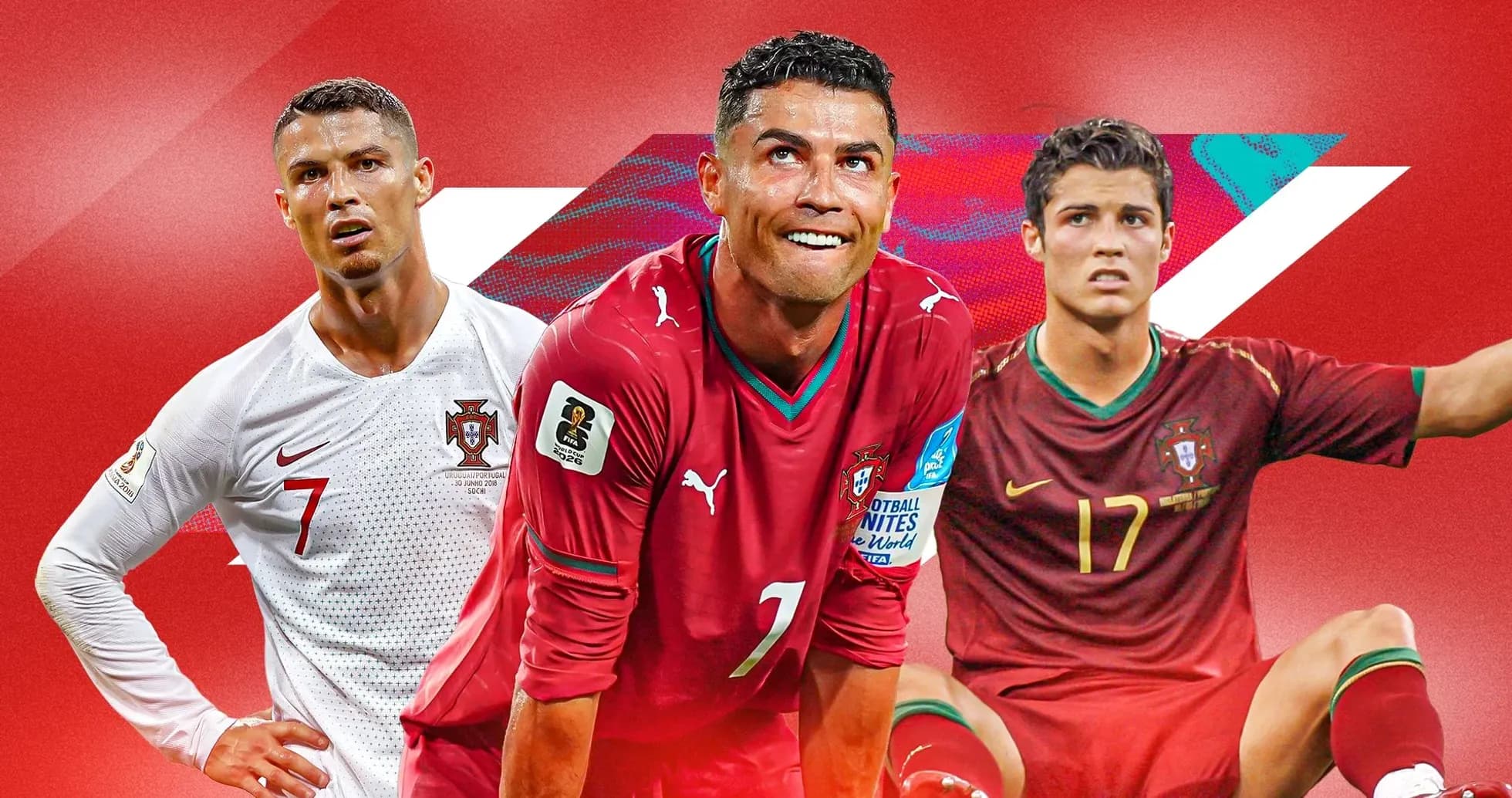
Cristiano Ronaldo's World Cup Journey: A Tale of Triumph and Turmoil
Cristiano Ronaldo’s World Cup story has never been simple. It has been loud, polarising, relentlessly scrutinised – a 20-year collision between genius and expectation on football’s biggest stage.
It began in 2006 with a penalty against Iran. A 21-year-old winger, all stepovers and sharp angles, became Portugal’s youngest scorer at a World Cup. It was a neat slice of history, but only a footnote in a tournament that would end with Portugal finishing fourth and Ronaldo failing to score in four knockout games. Nobody raged about his numbers back then. He was still a prospect, not yet a machine.
What people did rage about was his character.
In Germany, the football world turned on him. During the semi-final defeat to France, every touch he took was drowned in boos. The anger had been brewing since the quarter-final against England, when Wayne Rooney was sent off for a foul on Ricardo Carvalho and Ronaldo was seen appealing to the referee – then winking towards the Portugal bench.
In England, that wink became a national obsession. Steven Gerrard did not hold back. “I saw him going over to the referee and giving him the card and I think he was bang out of order,” he said. “If he were one of my team-mates, I would be absolutely disgusted with him.” Frank Lampard followed, questioning how a Manchester United team-mate could behave like that towards Rooney. The sense of betrayal was total.
Ronaldo insisted he had done nothing wrong. FIFA’s technical study group did not quite agree. In a nod to sportsmanship, they handed the young player of the tournament award to Lukas Podolski instead. “Players should be role models and fair play is a consideration,” said Holger Osieck, the group’s head. The message was clear: Ronaldo’s talent was undeniable, his behaviour less so.
2010 World Cup
By 2010, the kid had become the captain. The World Cup in South Africa was supposed to be his stage. It wasn’t. His only goal came in a 7-0 demolition of North Korea, a late strike that ended a 16-month drought at international level. When Spain knocked Portugal out in the last 16, 1-0, the defeat cut deep.
“I feel completely disconsolate, frustrated and an unimaginable sadness,” Ronaldo admitted. Cameras then caught him appearing to deflect responsibility. “How can I explain this defeat? Ask that question of Carlos Queiroz,” he was heard saying.
The backlash at home was swift. A captain, blaming the coach? Ronaldo moved quickly to explain. He said he was only pointing reporters towards Queiroz’s press conference, that he meant no disrespect. “I am a human being, and like any human being I suffer and I have the right to suffer alone,” he said. He insisted he always assumed his responsibilities.
Queiroz drew his own line. “Portugal needs Ronaldo, and Ronaldo needs the national side,” he said, before adding that anyone unnerved by the shirt had no grounds to be there. Even then, the relationship between Ronaldo and the idea of Portugal – not just the team, but the shirt, the burden, the symbolism – felt fraught.
2014 World Cup
Four years later, he dragged them to Brazil almost single-handedly. Ronaldo scored all four of Portugal’s goals in a thrilling play-off victory over Sweden, a tie that felt like a personal duel between him and Zlatan Ibrahimović. He arrived at the 2014 World Cup insisting he was “100 percent fit” despite knee and thigh concerns. The pitch told a different story.
Germany smashed Portugal 4-0 in their opener. Ronaldo drifted through the game, a shadow of his usual self. He created a late equaliser for Silvestre Varela against the United States and then scored an 80th-minute winner against Ghana, but it was too late. Portugal finished third in Group G and went home early.
The criticism came, as it always does. Missed chances, lost duels, questions over his fitness. Coach Paulo Bento refused to turn it into a witch-hunt. “I don’t think it’s fair to make things individual,” he said. “I shall never hold any individual responsible for this. The responsibility for failing to reach our goal is mine.” Ronaldo, he reminded everyone, was “usually really effective” – this time, he simply wasn’t.
2018 World Cup
In 2018, Ronaldo opened the World Cup as if determined to rip up the old script. He scored a hat-trick in a breathless 3-3 draw with Spain, including his first free-kick goal at a major tournament. It was one of those nights when he seemed to bend reality to his will.
He called it “a personal best” and then, typically, turned the spotlight towards the team. Portugal had gone toe-to-toe with one of the favourites and emerged with a point. The belief was that they would grow from there.
They didn’t. Portugal reached the last 16, but Ronaldo went quiet again when the stakes rose. No goal, no assist, and a 2-1 defeat to Uruguay in Sochi. At 33, with miles in his legs and medals in his cabinet, many wondered if that was his World Cup farewell. He refused to confirm anything. “It is not the right time to talk about it,” he said, instead backing Portugal’s “fantastic group” and its ambition to triumph.
2022 World Cup
If 2018 was a near-miss, 2022 in Qatar was a rupture.
Ronaldo arrived under a cloud after the chaotic end to his second spell at Manchester United, but still talking about the one trophy that had always escaped him. He scored from the spot against Ghana in Portugal’s opener, becoming the first man to score in five different World Cups. It felt like another record for the scrapbook.
Then the tension spiked. Fernando Santos substituted him in the shock defeat to South Korea and Ronaldo reacted furiously. In the last 16, he was dropped. Gonçalo Ramos came in, scored a hat-trick in a 6-1 demolition of Switzerland, and the story changed overnight. Reports emerged that Ronaldo had threatened to leave the camp. His public demeanour – the sulks, the stares, the storming off – only fuelled the narrative.
After the quarter-final loss to Morocco, he left the pitch in tears and went straight down the tunnel. Later, on social media, he tried to reclaim the narrative. “My dedication to Portugal has never wavered for an instant,” he wrote. He insisted he would never turn his back on his team-mates or his country. Then came the line that felt like a curtain falling: “Now, we have to let time be a good adviser and allow everyone to draw their own conclusions.”
His own conclusion, at least in that moment, was bleak. “To win a World Cup for Portugal was the biggest and most ambitious dream of my career,” he wrote. Five tournaments, 16 years, everything left on the pitch – and the dream gone. He sounded like a man saying goodbye, or at least accepting that the stage had shifted away from him.
The consensus hardened quickly. Ronaldo, 37, benched in the knockout rounds, one open-play goal in his last three World Cups, looked finished at the very top. For once, the narrative seemed to have outrun even his iron will.
Then came the twist.
In a 5-0 win over Uzbekistan, as the final whistle sounded, Ronaldo turned to a camera and roared, “I’m back! I’m back!” It was pure theatre, classic Ronaldo. But the context mattered. He had struggled in the opening draw with DR Congo. Uzbekistan were ranked 60th in the world. Two goals against them did not convince everyone that the old fear factor had returned.
The caution proved justified when Portugal met Colombia. Roberto Martinez’s side were held to a 0-0 draw in Miami, second best in the group and short of ideas. Ronaldo laboured again. The performance underlined the uncomfortable reality: he can still score, still dominate moments, but he no longer dictates entire tournaments on his own.
Now comes Croatia. Luka Modric’s team, like Ronaldo himself, are past their peak but still armed with enough know-how to hurt anyone. Portugal’s route has become harder than it needed to be. Their captain’s task has become brutally simple.
At 41, Ronaldo has already done what many thought impossible just by being here and still finding the net. Yet one glaring gap remains. Across five World Cups, for all the goals and all the noise, he has never scored in a knockout game.
That is the last great question hanging over his international career. Not the debates about winks, walk-offs or social media posts. Not even the arguments about whether he is finished at the “very highest level”.
Can Cristiano Ronaldo, in what feels like the final act of this sprawling World Cup saga, finally deliver when the tournament turns ruthless?
Over to him.