Dortmund's Efficient Strategy Against Atalanta
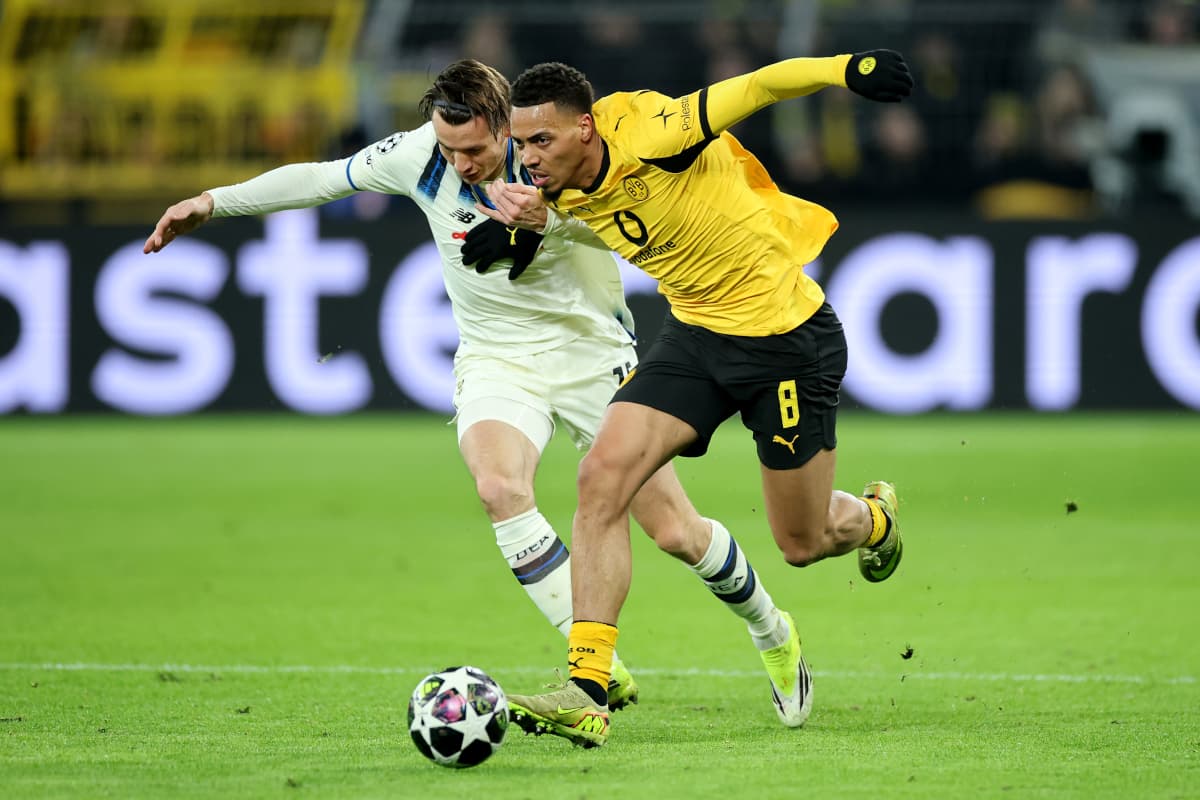
This was a classic case of control of the ball versus control of the scoreboard. Atalanta saw more of the ball with 56% possession and completed 452 of 521 passes (87%), suggesting a patient, circulation-based approach in Dortmund’s half. Borussia Dortmund, with only 44% possession and 419 passes at 83% accuracy, were more selective, focusing on verticality and transition rather than long settled spells. The 3-4-2-1 mirror formations created a territorial arm-wrestle, but Dortmund’s early lead allowed them to drop into a compact mid-block, inviting Atalanta to have the ball while protecting central spaces and waiting for moments to break.
Offensive Efficiency
Dortmund’s attacking plan was built on doing more with less of the ball. They produced 9 total shots to Atalanta’s 7, and crucially generated far better quality: an expected_goals figure of 2.09 versus Atalanta’s 0.46. Six of Dortmund’s attempts came from inside the box, underlining a focus on penetrating runs and high-value chances rather than speculative efforts. With only 3 corners, they did not rely heavily on set-piece volume; instead, quick combinations around S. Guirassy and the two “tens” (J. Brandt and M. Beier) created clean looks, reflected in 2 shots on goal being enough to convert twice.
Atalanta, despite their territorial edge, were the side showing “sterile domination.” Their 7 shots included 5 inside the box, but the low xG of 0.46 indicates these were often from poor angles or under pressure. Three shots on goal tested G. Kobel but did not truly stretch him, consistent with Dortmund’s back three protecting the central lane. Atalanta’s 2 corners also show they struggled to pin Dortmund back for long phases. Overall, Dortmund’s ruthlessness contrasted sharply with Atalanta’s inability to turn possession into clear chances.
Defensive Discipline & Intensity
Without the ball for longer stretches, Dortmund’s defensive work was structured rather than overly aggressive: 11 fouls and 2 yellow cards point to controlled interventions rather than a disruptive foul-fest. Kobel needed only 3 saves, aligning with Atalanta’s low xG and showing that Dortmund’s block limited high-danger shots more than the raw possession numbers suggest.
Atalanta, chasing the game after falling behind, were more physical and increasingly stretched. Their 13 fouls and 3 yellow cards reflect attempts to stop Dortmund’s transitions and break rhythm, especially around half-time and early in the second period. Notably, Atalanta’s goalkeepers recorded 0 saves while conceding twice, indicating that Dortmund’s best chances were either unsavable or finished from positions where defensive structure had already been broken.
Dortmund’s compact defensive block and high-quality chance creation (2.09 xG from 9 shots) outperformed Atalanta’s higher possession and low-impact attacking. Atalanta controlled the ball, but Dortmund controlled the spaces that mattered, proving that efficiency and structure trumped sterile domination.