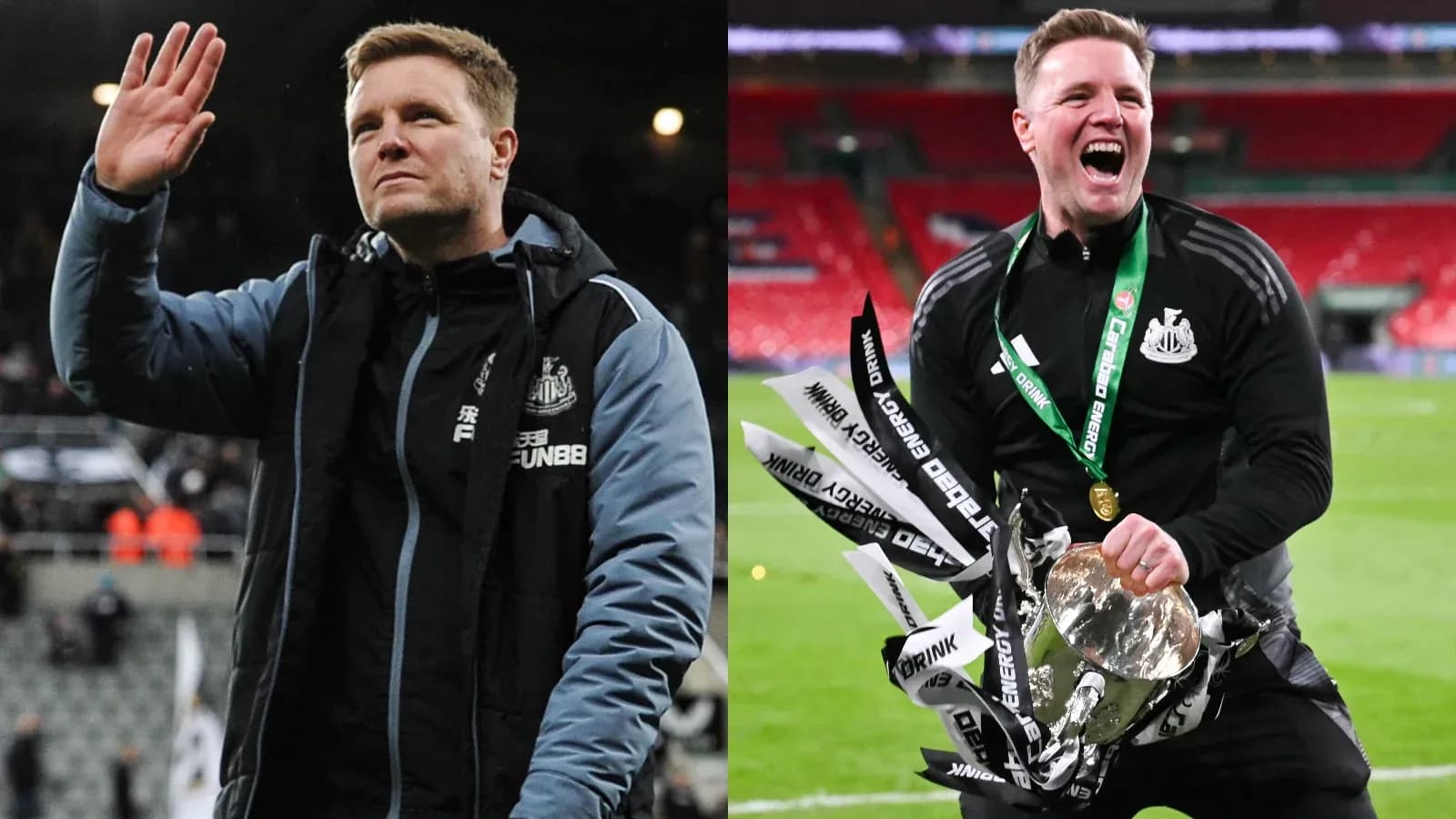
Eddie Howe's Newcastle Journey: From Relegation to Champions League
Eddie Howe’s Newcastle era is over. Nearly five years after walking into a club staring down the barrel of relegation, he leaves a very different institution behind – richer, sharper, and reintroduced to the elite, but suddenly without the man who stitched it all together.
From relegation scrap to Champions League nights
When Howe replaced Steve Bruce in November 2021, Newcastle were stuck in the bottom three, five points from safety and drifting. The Saudi-led takeover had changed the mood, but not yet the football. Howe’s job was clear: keep them up. Anything else could wait.
He did far more than survive.
Newcastle surged away from danger, finishing the 2021/22 season in 11th. It was not just the position that mattered, but the way they got there: aggressive pressing, front-foot football, a team transformed in belief and intensity. St James’ Park, long dulled by frustration, roared again.
The real leap came the following year. In Howe’s first full season, Newcastle finished fourth in 2022/23, crashing the Champions League party and ending a 20-year exile from Europe’s top table. Those midweek nights, the flags, the noise, the sense that Newcastle were back among the heavyweights – all of it carried Howe’s fingerprints.
The momentum held. Newcastle qualified for the Champions League again and, last season, went one better by reaching the round of 16. It was the club’s first ever appearance in the knockout stages of the competition, a landmark that would have felt fanciful when Howe first walked through the door with the team marooned near the bottom.
He leaves with 84 Premier League victories, more than any other Newcastle manager in the competition’s history, and a win percentage of 46.9 per cent – second only to Kevin Keegan’s 51.2 per cent in the club’s Premier League era. In raw numbers and in mood, Howe has reset what Newcastle expect of themselves.
Ending a 56-year wait
For all the tactical shifts and league climbs, one moment will define his tenure above all others.
In 2025, Newcastle finally ended their 56-year trophy drought, beating Liverpool 2-1 in the EFL Cup final. Under the arch at Wembley, Howe delivered what generations of managers had failed to bring back to Tyneside: silverware.
The significance of that win stretched far beyond the day itself. It turned hope into something more solid. Under Howe, Newcastle were no longer just ambitious; they were winners again.
“Heart and soul” – why Howe walked away
Given that backdrop, the timing of Howe’s exit lands with a jolt. Yet his own words leave little room for doubt about the strain of the job.
“After a period of personal reflection, I have decided that now is the right time for me to step away from my role as head coach of Newcastle United," he said, describing nearly five years of “giving my life, heart and soul into the club with unrelenting energy”.
He framed the decision as one taken for both himself and Newcastle: a need to “step away, recharge and take a break,” and, crucially, another instance of putting “the best interests of Newcastle before my own”.
“It has been the privilege of my lifetime to have been the manager of Newcastle United," he added. There was no hint of a rift, no public airing of grievances. Just the sense of a manager who had emptied the tank.
The club’s statement struck a similar note of respect, thanking him for an “extraordinary contribution” and confirming they had accepted his decision. Behind the formal words lies a simple truth: Howe has taken Newcastle from survival mode to trophy lifts and Champions League knockouts. That is a hard act to follow.
A squad turning the page
His departure does not happen in isolation. This summer already carried the feel of a reset.
Two major figures have gone: Anthony Gordon to Barcelona and Sandro Tonali to Tottenham Hotspur. Both were key pieces in Howe’s evolution of the side, both symbolic of the level Newcastle were operating at. Their exits underline that this is not just a change in the dugout, but a shift in the project’s direction.
The recruitment tells its own story. Newcastle have gone young – very young. Bazoumana Toure from Hoffenheim, Sean Steur from Ajax, Ewen Jaouen from Reims and Alhadji Bamba from Monaco form a core of up-and-coming talent, with an average age of just 19.5 years.
This is a squad being recalibrated for the long term, and that makes the timing of Howe’s exit feel less abrupt and more like a line in the sand. The man who dragged Newcastle from the brink and accelerated them into the Champions League has stepped aside just as a new, youthful cycle begins.
The next man in
The search for his successor is already well advanced. Newcastle say the process to recruit a new head coach is at an “advanced stage” and that updates will follow soon.
The leading candidate is 38-year-old German coach Matthias Jaissle. His résumé fits the ownership’s preferred template: young, modern, schooled in high-intensity football and player development.
Jaissle has just won back-to-back AFC Champions League titles with Al-Ahli, guiding a squad that includes former Premier League names Ivan Toney and Edouard Mendy, as well as coaching Riyad Mahrez and former Newcastle favourite Allan Saint-Maximin in Saudi Arabia. Before that, he dominated Austria with Red Bull Salzburg, claiming consecutive Bundesliga titles and the Austrian Cup after cutting his teeth with their feeder side, FC Liefering.
If appointed, he would inherit both expectation and upheaval: a fanbase now accustomed to competing with the best, a squad tilting younger, and a club that has tasted trophies and wants more.
A quiet farewell, a demanding future
Howe’s final act in charge was an oddly low-key one: a 4-1 pre-season defeat away to Bristol City on 29 July. No grand farewell at St James’ Park, no final lap of honour. Just a friendly, then a full stop.
Newcastle still have four warm-up games before the new Premier League campaign: Valencia away on 8 August, Everton at a neutral venue on 12 August, then back-to-back home fixtures against Bayer Leverkusen and Strasbourg on 15 and 16 August.
They open their league season on Sunday 23 August, with five matches to navigate before the first international break of 2026/27. By then, the new head coach will need more than a title and a philosophy. He will need to convince a crowd that has seen what progress looks like under Eddie Howe – and now expects the next chapter to be even bigger.