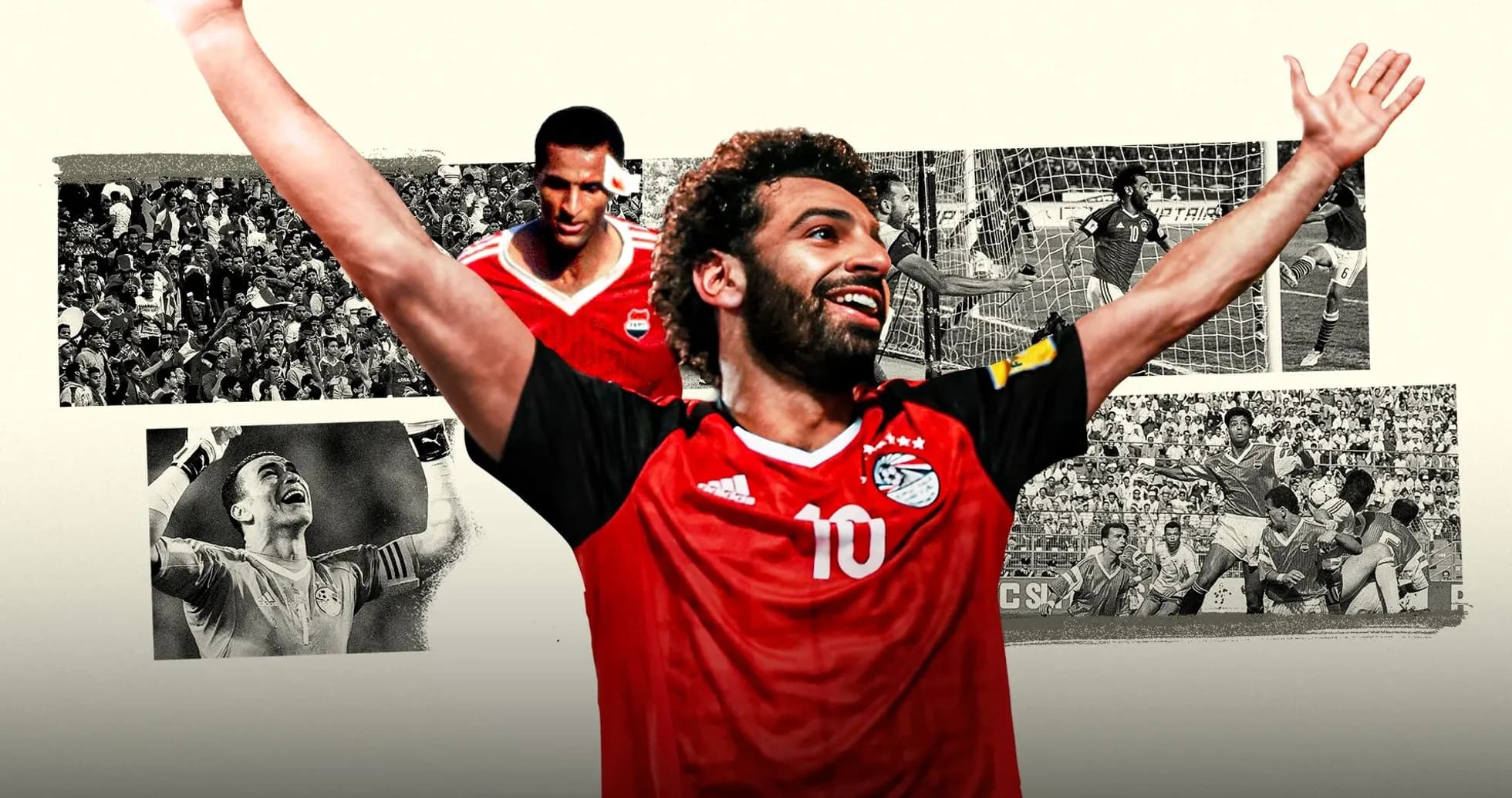
Egypt's Journey to World Cup Glory: From 1934 to 2026
In 1934, before television, before replays, before football became a global spectacle, there was only a radio hissing through the Cairo night and a small, stubborn dream.
Eleven Egyptians boarded an old ship to Italy, carrying that dream with them. Egypt, the first Arab and African nation to reach a World Cup. The journey took days. The legs were tired, the cabins cramped, but the excitement cut through the fatigue. They had beaten Palestine to get there; the rest of the world was about to hear their name.
In Rome, they met Hungary, one of Europe’s great powers. Egypt lost 4-2, but the scoreline never told the whole story. Abdelrahman Fawzi scored twice and, with those goals, wrote Africa into World Cup history. The first African to score on that stage.
Back in Cairo’s alleys, people pressed their ears to radios, catching fragments of commentary through the static. They clapped, they smiled, they felt a pride they had never tasted before. In that moment, the dream stopped being a whisper and became a promise.
Then the world burned.
War drowned out football. Guns replaced cheers. Egypt rebuilt itself while the World Cup lived only in black-and-white photos and newspaper columns. The tournament grew; Egypt watched from afar.
Generations of talent rose and fell. Saleh Selim. Taha Ismail. Hassan Shehata. Mahmoud El Khatib. In Africa, Egypt were kings, lifting continental trophies and filling stadiums. Yet the World Cup remained distant, like a star that glowed brilliantly but always out of reach.
Until 1990.
After 56 years in the wilderness, the Pharaohs came back. Under Mahmoud El Gohary, Egypt clawed their way through brutal qualifiers. The turning point came in a fevered night against Algeria. Hossam Hassan struck the goal that shattered the glass ceiling. Cairo exploded. Streets overflowed, flags flew from every balcony, car horns merged with chants. It wasn’t just a win; it was a release.
In June, Egypt returned to Italy, this time to Palermo, and walked into a clash with the reigning European champions, the Netherlands. No one expected them to stand tall. They did more than that.
The first half ended goalless. Egypt were disciplined, stubborn, unafraid. In the 58th minute, Wim Jonk finally broke through after a cross from Marco van Basten. The script seemed set.
But Egypt refused to bow.
In the 83rd minute, Hossam Hassan burst into the box and was dragged down. The referee pointed to the spot. A country held its breath.
Magdy Abdelghany stepped up. One breath. One swing. Goal.
“Goal for Egypt!” the commentator roared, a cry that would echo across decades. Abdelghany would later turn that moment into a running joke, retelling it in every interview as if it were the only thing Egypt had ever done in football. On that night, though, it was no punchline. It was a bridge — from Fawzi in 1934 to Abdelghany in 1990, from one generation of believers to the next.
The match finished 1-1. On paper, a draw. In Egyptian hearts, a victory.
The second game, against Ireland, was a different kind of battle. Less glamour, more grit. Ninety minutes of tension, sweat, and shouting. Egypt dug in. Ahmed Shobeir turned into a wall, saving everything as if the World Cup itself depended on each catch and punch.
His time-wasting that day became infamous. He rolled, delayed, provoked, pushed every second to the edge. Around the world, many later linked that performance to FIFA’s decision to introduce the back-pass rule. The match ended 0-0. To Egypt, it felt like another win.
People started to ask: who are these Africans fighting like lions? The media gave them a name: “The solid Egyptian team.”
England came next. A tight, suffocating contest, with Egypt under relentless pressure. A single goal separated them in a 1-0 defeat, but El Gohary refused to see it as a failure. “We’ve planted the seed today… Someone will harvest it tomorrow,” he said.
That “someone” grew up in a small village called Nagrig.
Mohamed Salah’s journey took him from Al Mokawloon to Basel, then to Chelsea, Fiorentina, Roma, Liverpool. Every stop added another layer. Every goal seemed to carry a message, not just for clubs, but for a country.
During the 2018 World Cup qualifiers, Salah became more than a star. He became the heartbeat. His goals revived hope that had grown tired of waiting. His runs, his left foot, his celebrations — they made people believe again.
Then came the night at Borg El Arab.
Egypt needed a win against Congo. The score was 1-1 heading into stoppage time. The stadium trembled with nerves. Commentator Medhat Shalaby’s voice rose with each attack: “Give us something, ya akhi!” In the 94th minute, Trezeguet went down in the box. Penalty. Shalaby screamed: “Allahu Akbar!”
Salah picked up the ball. He placed it on the spot. A faint smile. Then he struck.
Goal.
The roar shook Alexandria. People poured into the streets. Strangers hugged, children cried from joy, fireworks lit the sky. After 28 years, Egypt were going back to the World Cup.
One month before Russia 2018, Kyiv glittered under the lights of the Champions League final. Real Madrid vs Liverpool. The world’s cameras hunted one man: Salah. “The Egyptian King” rang around the city. Commentators reeled off his record-breaking Premier League season. This was supposed to be his coronation.
Instead, it became a nightmare.
Midway through the first half, Salah tangled with Sergio Ramos and crashed to the turf, clutching his shoulder. He tried to rise, but the pain won. As he walked off in tears, the dream of a perfect build-up shattered.
Cairo fell silent. Cafes that had been bursting with noise froze. Screens glowed, but no one moved. Children who had danced minutes earlier sat in stunned quiet. It felt as if all of Egypt had gone down with him.
Weeks later, Salah returned. The shoulder was still sore, the body not quite right, but he came anyway. “Bodies may fall… But dreams never do,” he told the world.
Russia, though, was unforgiving.
Egypt opened against Uruguay without their talisman in the starting XI. Salah sat on the bench, watching as his teammates fought with everything they had. For 89 minutes, they held firm, defending with courage, looking more likely to score than suffer. Then, in the cruelest fashion, they conceded late. The performance hinted at something more, but tournaments do not reward hints.
The belief remained: when Salah returns, everything will change.
He started the second match against hosts Russia, smiling in the line-up, but the smile masked the pain. His shoulder still complained with every movement. Russia raced into a three-goal lead. Salah scored from the spot in Saint Petersburg, a familiar calm from 12 yards, but by then the damage was done. Egypt’s World Cup was effectively over with a game to spare.
He scored again in the final group match, against Saudi Arabia. Another goal, another reminder of his quality. It still ended in defeat. The Pharaohs left Russia with no points, only questions and regret.
The next chapter at home proved even harsher.
AFCON 2019 arrived with Egypt as hosts and expectations sky-high. Same generation, same core, same icon leading the line. The script promised glory. Instead, it delivered shock. South Africa sent Egypt out in the last 16. The nation stood stunned. The dream had not just been delayed; it had been ripped up.
Two years later, in Cameroon 2021, the Pharaohs came back with scars and a different kind of steel. Performances were far from perfect, but the spirit had changed. Salah led a side that played with heart and defiance. They lost to Nigeria in their opener, then clawed their way through the tournament, knocking out Ivory Coast, then Morocco, then hosts Cameroon.
Three heavyweight duels. Three penalty shootouts.
In the final against Senegal, the drama returned to the spot. Egypt were dragged once more to penalties. This time, Salah never got his chance. The shootout ended before he could step forward. Senegal lifted the trophy. Egypt were left to watch, knowing their leader still had a kick inside him that would never be taken.
Weeks later, the same opponents, the same stakes, a different stage: a place at the 2022 World Cup. Again, it went all the way to penalties. This time Salah walked to the spot, face lit by a storm of green lasers from the stands. He looked calm, almost defiant.
He struck.
The ball flew over the crossbar and into the night. Egypt froze. In that single heartbeat, the dream of another World Cup vanished. Yet something deeper refused to die. Dreams built over nearly a century do not disappear in one missed kick.
So the story moved on to the 2026 qualifiers.
This time, Salah was not carrying the burden alone. Around him stood a new generation who had grown up watching his rise, his heartbreak, his comebacks. They did not see him as an untouchable superstar. To them, he was an older brother.
From the first match against Djibouti, the difference was obvious. Egypt looked organised, hungry, connected. Salah still scored, but now Omar Marmoush and Ahmed Sayed “Zizo” danced alongside him, adding pace, flair, and fearlessness.
On the touchline, Hossam Hassan prowled. He shouted, waved, barked orders: “Press! Don’t back down!” He didn’t just coach; he lived every pass, every tackle. Under him, Egypt rediscovered an identity they had lost — aggressive, united, unafraid of anyone.
Young players who had once watched Salah on television were now exchanging passes with him on the pitch. The fear that had crept into previous campaigns vanished.
Match by match, the unbeaten run grew. Ten qualifiers. Eight wins. Two draws. Top of the group, not by miracle, but by control. By the time the final whistle blew in the last qualifier, the job was done with a quiet authority.
On the sideline, Hossam Hassan simply smiled. No wild celebration, no theatrics. The first mission was complete. On the pitch, the players celebrated, but not wildly. Their joy was measured, almost restrained, as if to say: this is only the beginning. The real test lies ahead.
Now, once again, the World Cup waits.
Hassan is already plotting. Salah, older now but still burning with the same fire, has made his promise: “This time, it won’t just be about taking part.”
From Fawzi’s crackling goals on a 1934 radio to Salah’s penalties under a sky of lasers, Egypt’s World Cup story has always lived on a thin line between heartbreak and hope. The next chapter will tell whether this generation finally turns that century-old dream into something permanent on the biggest stage of all.