English Football's Premier League Dominance and Its Hidden Challenges
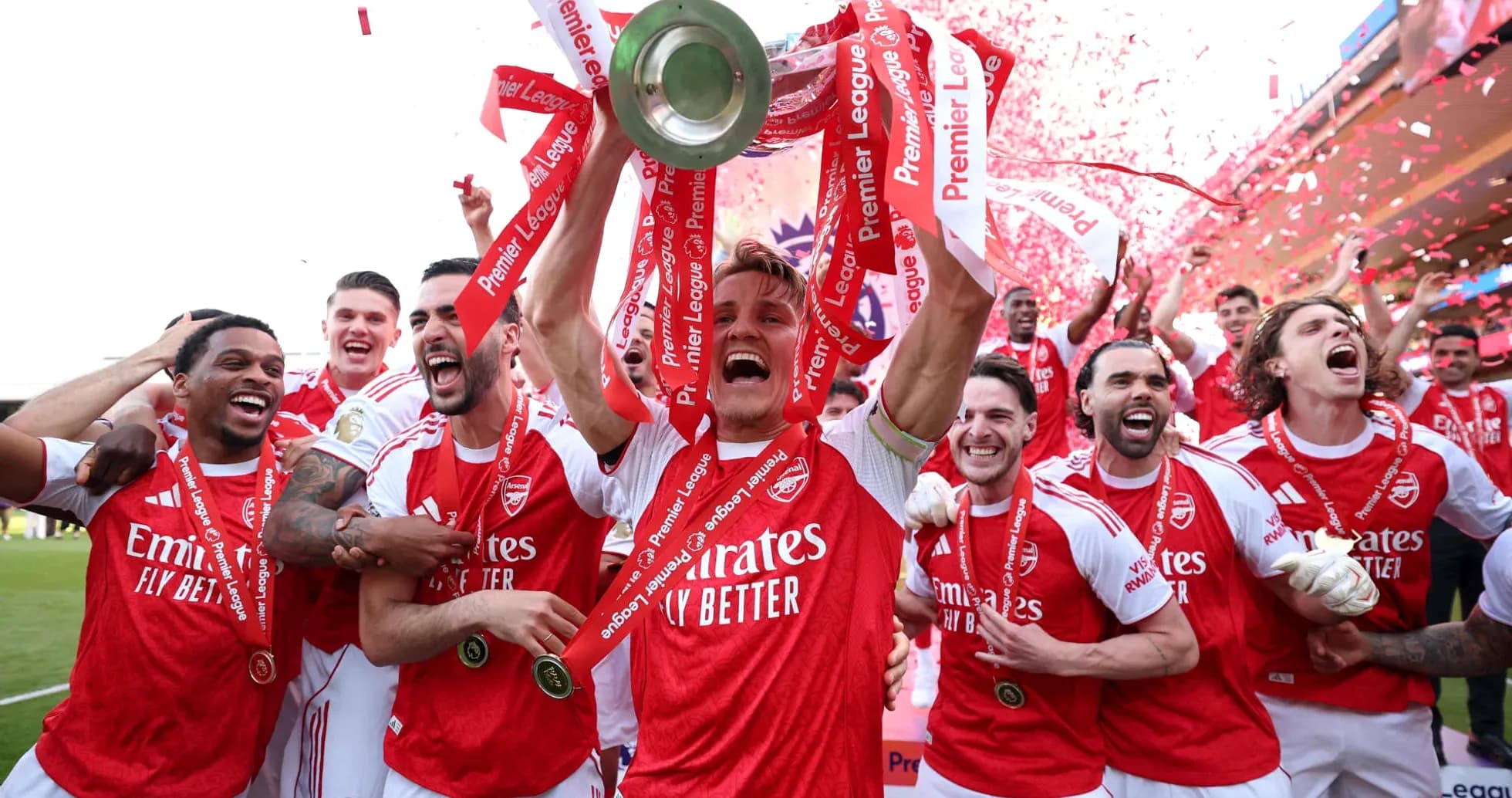
Martin Ødegaard held the Premier League trophy aloft under the Selhurst Park lights and, for a moment, English football looked invincible. Arsenal, champions again after 22 long years, had their 14th league crown in their hands and a new era at their feet. Three different champions in three seasons — Manchester City, Liverpool, now Arsenal — a title race that keeps changing its winner, a league that sells itself as the toughest on earth and, on nights like that, looks every inch of it.
Scratch the surface and the picture changes.
A League That Others Can’t Live With
On the pitch, England’s top flight is out on its own. While La Liga remains largely a two-horse race between Barcelona and Real Madrid — 20 titles between them in the last 22 seasons — the Premier League keeps rotating its winners. In Germany, Bayern Munich have turned the Bundesliga into a private fiefdom, taking 13 of the last 14 titles. In France, Paris Saint-Germain have done something similar, claiming eight of the last nine Ligue 1 trophies.
Only Serie A comes close to matching the Premier League’s churn at the top. Juventus, Inter Milan, AC Milan and Napoli have all taken turns as champions over the last seven years, a rare patch of variety on the continent. Yet even there, the financial gravity still points towards England.
English clubs are not just dominating domestically; they are contesting and collecting trophies abroad. Only a penalty shootout defeat for Arsenal against PSG in the Champions League final stopped an English clean sweep in Europe, after Aston Villa and Crystal Palace lifted the Europa League and Europa Conference League respectively. Chelsea sit as current holders of FIFA’s Club World Cup. The trophies keep piling up in English boardrooms.
It is not hard to see why. The Premier League’s TV rights — domestic and international — dwarf those of any other competition. Half of the clubs in Deloitte’s latest list of the 30 richest sides on the planet are English. Even relative newcomers to the elite, clubs like AFC Bournemouth, Brentford and Brighton & Hove Albion, now operate in a financial stratosphere that used to be reserved for the old giants.
Yet the money, and the medals, tell only half the story.
Talent Drifting Out, Not Just In
For years, the Premier League was the destination. The place where the world’s best arrived and stayed. Now, some of England’s best are heading the other way.
Harry Kane, the England captain, leads a growing group of national-team regulars who no longer play their club football at home. With Anthony Gordon’s move from Newcastle United to Barcelona last week, six members of England’s squad for the upcoming World Cup are now based abroad.
Martin Samuel of The Times framed the unease. Once, English football wore foreign interest as a badge of honour. When Real Madrid or AC Milan came calling, it felt like validation. Now, with almost a quarter of the national squad playing overseas, it looks more like an exodus. The problem is not simply that players are leaving; it is that the flow of comparable quality in the opposite direction is not matching it.
The Premier League remains a magnet for global stars, but the idea of England as the automatic home for its own leading lights is slipping.
The Numbers Behind the Neon
Even the money story is more fragile than it first appears. For all the record-breaking revenues, only four Premier League clubs — Newcastle, Aston Villa, Bournemouth and Liverpool — actually turned a profit in the most recent season with published accounts. The rest are burning through cash in the chase for success, or simply for survival.
Drop below the top tier and the picture darkens. Administration has claimed a string of famous names in recent years. Derby County and Sheffield Wednesday, clubs with deep histories and loyal fanbases, have both been dragged through financial crisis. The glamour of the Premier League sits atop a pyramid that creaks and groans.
To stay on the right side of financial fair play rules, many clubs have turned to creative accounting. Sale-and-leaseback deals on stadiums and training grounds keep balance sheets looking healthier than the underlying reality. The regulations were designed to prevent a handful of ultra-wealthy owners, including sovereign wealth funds, from distorting the market by inflating transfer fees and wages to unsustainable levels. In practice, they have pushed some clubs towards financial gymnastics just to keep pace.
And the very owners whose spending power once looked like a safety net may not always be there.
Relegation Bites Back
This season delivered a sharp warning to the investor class. Tottenham Hotspur, one of the six Premier League clubs that flirted with the breakaway European Super League in 2021, came perilously close to relegation. A club built around a gleaming new stadium and a global brand almost fell through the trapdoor.
West Ham United, the Premier League’s eighth-longest serving club and ranked 20th in Deloitte’s Money League, did fall. Relegation for a club of that size, with that revenue, sent a shudder through boardrooms far beyond east London.
For many American investors in particular, the concept of relegation remains the great unknown. Their domestic sports franchises operate in closed leagues, insulated from the existential threat of dropping out. The idea that a billion-pound project can crash into the second tier because of a bad season, a few injuries, or a couple of poor transfer windows is a risk profile they are not used to entertaining.
Samuel pointed to the current marketplace: Liverpool, Manchester United, Crystal Palace, Chelsea and Newcastle are all, in one form or another, on the block. Potential buyers will have watched West Ham go down, seen Tottenham flirt with disaster, and felt the chill. If clubs with those resources can tumble, nothing is guaranteed.
Some of those in Premier League headquarters will have felt it too. The league sits at the peak of the global game, richer and more competitive than any rival. Yet beneath the silverware and the TV deals lies a model stretched by cost, distorted by wealth, and increasingly vulnerable to the very jeopardy that makes it so compelling.
The question now is not whether English football can keep winning. It is whether it can keep living like this.