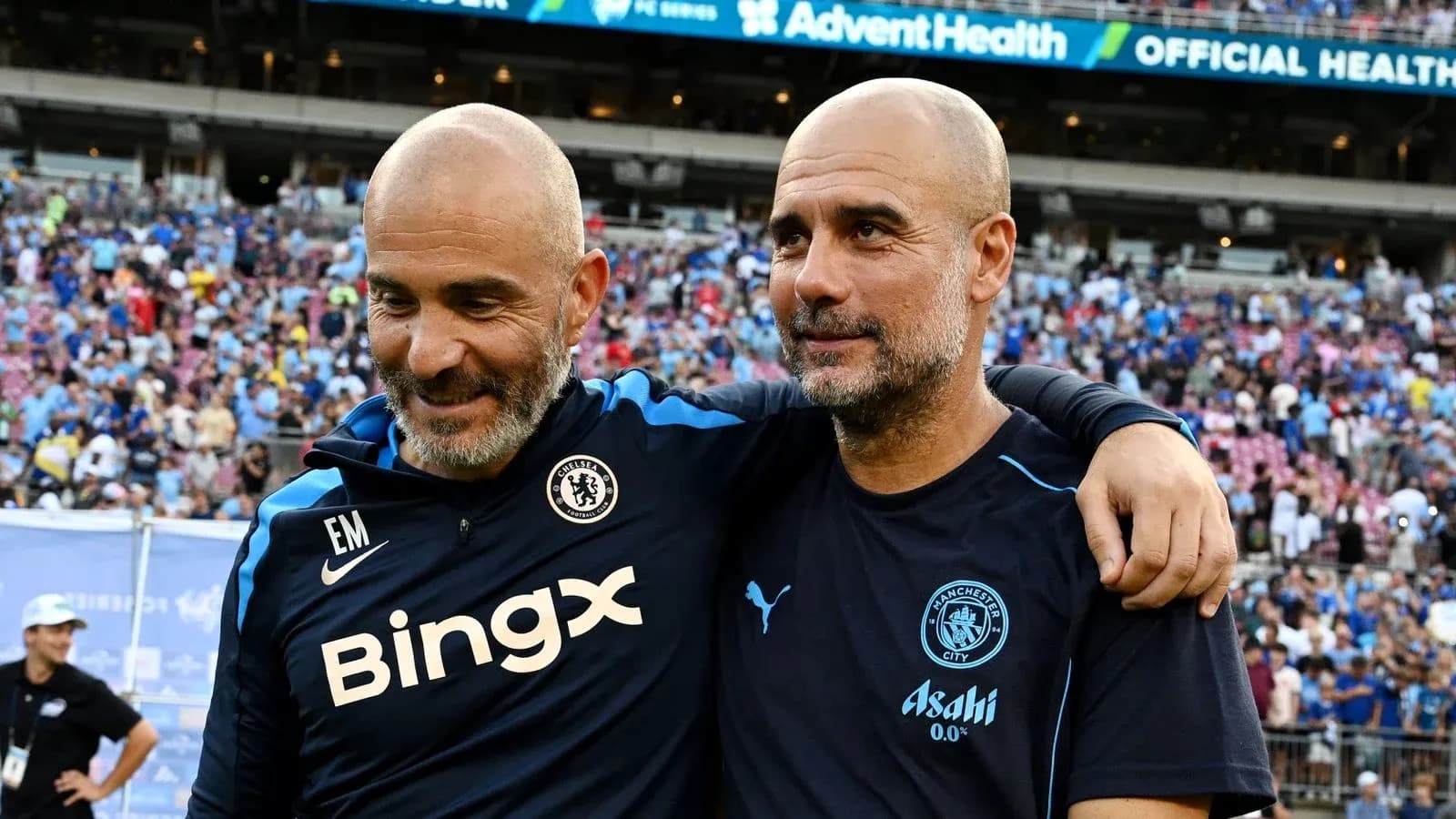
Enzo Maresca Takes Over Manchester City: A New Era Begins
Enzo Maresca walks back into Manchester City with the treble still echoing around the Etihad and Pep Guardiola’s shadow stretching the length of the Premier League. This is not a rebuild. It’s an inheritance – glittering, demanding, and utterly unforgiving.
City have rolled the dice on continuity with a twist. Now we find out if the man who once helped design the blueprint can run the whole operation.
A Gentle Opening – With a Hard Edge
On paper, the fixture list has smiled on Maresca. Bournemouth, Crystal Palace and Coventry City in his first three league games: as soft a landing as the Premier League usually allows a new manager, and a rare luxury for someone taking over from Guardiola rather than clearing up after chaos.
It’s a run that should let City find rhythm without panic. It also hands Maresca something else he badly needs – time to manage tired legs.
Rodri, the metronome of Spain’s World Cup triumph, has pushed his body to the edge over the past year. If any player in this squad is a candidate for fatigue-induced trouble, it’s him. Those early fixtures are kind enough that City can, in theory, survive without their midfield anchor while he eases back in.
But that kindness cuts both ways. Dropped points in August will not be brushed off as “early days” when the schedule tightens. Manchester United and Liverpool arrive in two of the three league games that follow in September. Those are more than just six-pointers; they are emotional barometers for a fanbase adjusting to life after Guardiola.
For a manager who called this a “dream situation” – a squad built to win, an infrastructure designed for dominance – there will be precious little patience if that dream starts with a stumble.
Same Principles, Sharper Edges
Maresca is not ripping up the Guardiola manual. He helped write chapters of it during the 2022-23 treble season, and his football is cut from the same cloth: possession, control, aggression without the ball.
But there are differences, and they matter.
Guardiola’s City often felt like a moving puzzle. Defenders drifted into midfield. Midfielders morphed into full-backs. Wingers tucked inside to create overloads around Rodri, who sat at the centre of it all like a calm eye in a tactical storm. Roles blurred, zones overlapped, and opponents were suffocated by the sheer fluidity.
Maresca prefers clearer lines. His football leans towards a more defined 4-2-3-1, with wingers staying high and wide to stretch the pitch. That structure demands a classic No 10 – a connector, a creator, someone who can live between the lines and dictate the final third.
At Chelsea, that was Cole Palmer. At City, the options are elite. Phil Foden can own that space with his touch and vision, while Rayan Cherki offers a different, more unpredictable flavour if Maresca wants a similar profile to Palmer.
The shift might sound subtle, but it will change the feel of this team. Less constant rotation of positions, more clarity of roles. Some players will thrive on that certainty. Others, conditioned by years of Guardiola’s shape-shifting, will need time to adjust.
How quickly that adaptation happens will decide whether City look like City by October – or like a side still trying to remember their lines.
A Younger Core, With a Leadership Gap
City’s squad has been quietly reshaped over the last few windows. Under Hugo Viana’s guidance, the average age has dropped from 29 to just over 25. That’s a significant shift for a team built on seasoned winners.
The cost of that evolution is obvious. Bernardo Silva and John Stones have gone this summer. Kevin De Bruyne left before them. Three of the dressing room’s loudest and most influential voices, gone in quick succession.
What remains is still formidable. Rodri and Ruben Dias are natural leaders. Erling Haaland has been nudged further into that role, not just as a goalscorer but as an emotional reference point. Marc Guehi and Josko Gvardiol bring calm, experience and reliability at the back, while Mateo Kovacic adds nous in midfield.
The spine is strong. The question is whether it’s vocal enough when the pressure rises and the football doesn’t flow.
Recruitment has been expensive but targeted. Elliot Anderson, prised from Nottingham Forest for huge money, arrives to harden and future-proof the midfield. Jeremy Monga, taken from Leicester, is one for the present and the years ahead.
City still want a right-back and a winger. They continue to watch Lille’s teenage midfielder Ayyoub Bouaddi, outstanding for Morocco at the World Cup and admired by Arsenal too. That is the market they now live in: the best young talent on the planet, bought early and integrated into a machine that rarely stops.
To balance that, several names could be moved on if offers match City’s valuation: Savinho, Omar Marmoush, Nico Gonzalez, Jack Grealish, Tijjani Reijnders and Rico Lewis are all in the conversation. With the World Cup now over, the market will speed up. So will the decisions.
Maresca must knit all of this into something coherent, fast.
Life After Pep: Vision Without a Blueprint
For the first time since the Abu Dhabi takeover, the long-term plan is not laser-focused on Guardiola. A decade of work went into attracting him, building the club’s identity around his philosophy, then sustaining it.
That chapter is over. The question is simple, and brutal: what now?
City’s culture is welded to winning. Cups, titles, records – they are not ambitions, they are expectations. The Etihad crowd turns up not just to be entertained, but to see their team impose themselves, dominate, collect three points. Anything less is tolerated only briefly.
That’s where Maresca’s Chelsea tenure offers a warning. His ideas were clear, his football ambitious, but he struggled to balance control with cutting edge over a full season. At City, there is less room for that kind of learning curve.
He does, at least, enter a league in flux. Andoni Iraola at Liverpool, Xabi Alonso at Chelsea, Michael Carrick at Manchester United – all are stepping into, or consolidating, major jobs with questions hanging over them. The established order is wobbling, the hierarchy not yet reset.
For a coach with conviction and a ready-made squad, that landscape is an opportunity. It is also unforgiving. This is not a season to drift into. It is a season to grab.
Sink or swim feels less like a cliché and more like the job description.
The 115 Charges: A Storm He Can’t Control
Hovering over everything are the 115 Premier League charges that still cloud the club. They are not Maresca’s making, and they are not within his control, but they will shape his first year.
Guardiola turned that scrutiny into a shield, fronting up in press conferences, confronting critics, and using the noise as fuel. He knew the media, understood the rhythm of the questions, and was ruthless in shutting down anything he didn’t want to entertain.
Maresca’s experience at Chelsea was different. He faced pressure, but it revolved mainly around football – results, selections, style. This is another level entirely: legal complexity, reputational stakes, and a narrative that will not go away until a verdict lands.
How he handles those questions – how often he chooses to engage, how firmly he protects his players from the swirl – will shape the tone of his first 12 months, assuming the case moves forward within that timeframe.
He cannot win trophies in a press room. But he can lose control of the story there.
Maresca steps into a “dream situation” with a catch: this dream comes with Guardiola’s standards, City’s demands, and a league ready to punish hesitation. The squad is strong, the fixtures kind, the pathway open.
Now we find out whether the man who once assisted greatness can live with the expectation of recreating it – without the safety net of being anyone’s understudy.