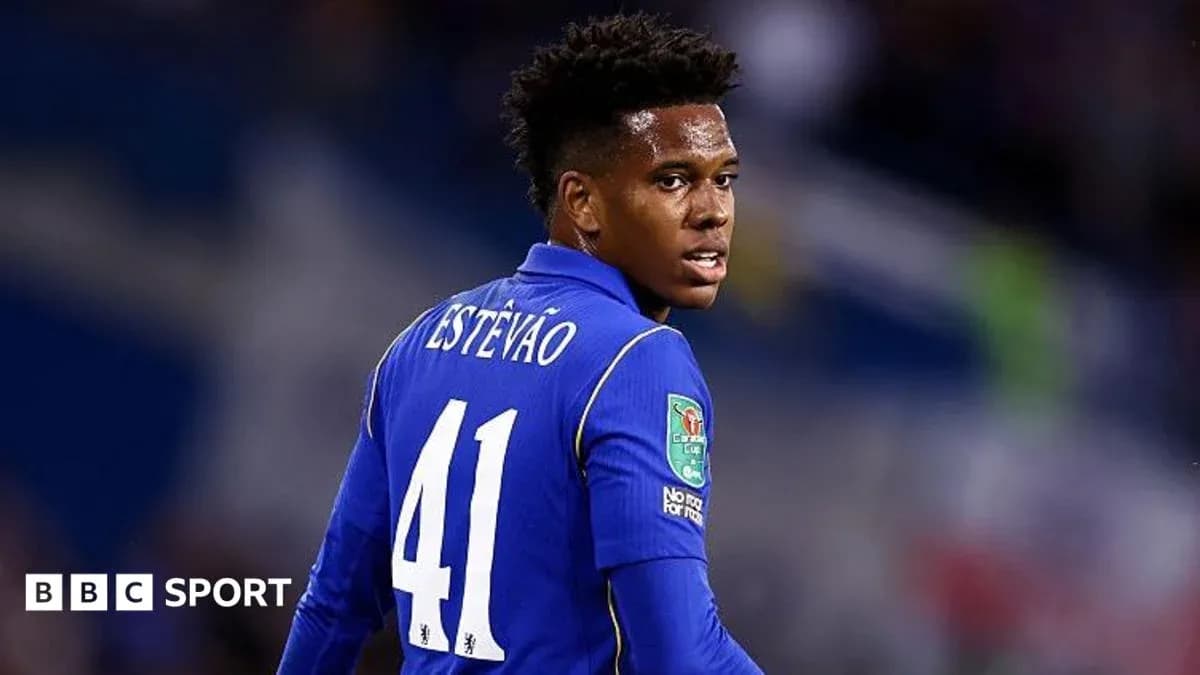
Estevao Willian: The £51m Talent Waiting for His Chance
The ball bent, the away end held its breath, and David Raya’s fingertips kept Arsenal in front.
Estevao Willian’s late curler at the Emirates on Sunday did not rescue Chelsea a point, but it did something else. It jolted everyone’s memory. This 19-year-old from Brazil is not here to make up the numbers in Xabi Alonso’s project.
Right now, though, he is living on scraps.
A £51m talent waiting his turn
Chelsea paid £51m to bring Estevao from Palmeiras. So far this season, he has played just 96 minutes in all competitions. Eighty of those came in the Carabao Cup against League One side Luton Town. The rest? Brief cameos off the bench against Fulham and then Arsenal.
He did not get on the pitch in the narrow win over Brighton, watching from the sidelines as Chelsea ground out three points in their third league game.
His path is blocked by big money and big form. The club smashed their transfer record to sign Morgan Rogers from Aston Villa for £117m. Cole Palmer has picked up where he left off. Joao Pedro looks settled and trusted. In that attacking pecking order, Estevao is still knocking on the door.
Reports in Brazil have painted a picture of a frustrated teenager, unhappy with his lack of minutes. Those inside Stamford Bridge push back hard on that idea. People close to the player have also played down any talk of unrest, even speaking positively about Chelsea’s summer recruitment, including the arrival of Rogers.
Inside the club, Estevao is not seen as expendable. Far from it.
“I count on Este 100%”
Chelsea view him as one of a small, protected core – alongside Palmer, Joao Pedro and Moises Caicedo – that they simply do not plan to sell. He is built into the long-term blueprint drawn up by Alonso and the club’s leadership.
There have already been early conversations about a new contract. Chelsea want to lock down their key pieces on improved terms over the coming months, as they have already done with Joao Pedro.
Asked directly whether Estevao’s reduced role meant he was unhappy, Alonso was blunt.
No, Este is ready, training well. The other day he had a great impact,” the Chelsea head coach said. “He is fully involved with a very good attitude every day. I count on Este 100% because of his potential. He is so young but he is learning and adapting quickly. The season is long.
That last line matters. The season is long, and Estevao is building back from more than just competition for places.
Late last season he suffered a serious grade-four hamstring tear, bad enough to rule him out of the World Cup. Chelsea always expected his involvement to ramp up gradually as this campaign unfolded, not explode from day one.
Out of position, but not out of mind
At Arsenal, Estevao came on for Pedro Neto, who has been used as a wing-back in Alonso’s new system. That in itself told a story.
Thrown on as Chelsea chased an equaliser, the Brazilian was asked to operate in a role that is unlikely to be his long-term home. The defensive workload, the physical duels, the constant running demanded of wing-backs make it a strange fit for a teenager whose game is built on craft between the lines.
His natural zone is the inside-right pocket, a number 10 drifting in off the flank. At Chelsea, that territory belongs to Palmer.
Alonso sees Palmer as more than just a creator. He is a dressing-room voice, a reference point in attack, and dislodging him in league games will be one of the toughest tasks in this squad.
When Alonso has switched to a back four, Estevao and Palmer have shown flashes of real chemistry. The problem? That shape has only appeared once so far, against Luton in the Carabao Cup.
For now, Estevao must live with the reality that his ideal position is occupied by one of the first names on the teamsheet.
A big squad, small windows
Alonso has not treated the Carabao Cup as a testing ground. With no European football this season, he has consistently named strong sides, using every game to hammer home his tactical ideas and build rhythm.
That approach squeezes opportunities for those on the fringes. Estevao is not alone.
Palmer and Rogers have started every match. Joao Pedro has begun all three league fixtures. Danny Welbeck led the line against Luton, which left Emmanuel Emegha – signed from Strasbourg in the summer – with just one appearance on the bench.
Defender Aaron Anselmino is still waiting for his debut and has only made one matchday squad, though both he and Emegha are managing fitness issues.
Other attacking options have barely had a taste. Geovany Quenda has played eight minutes across four games. Jamie Gittens has ten. Quenda, signed despite strong interest from Manchester United in 2024, has already been left out of two of Alonso’s squads entirely.
In midfield, injuries to Caicedo and Jordan Henderson have at least opened a crack in the door. Even then, summer signing Valentin Barco has been limited to one start and one substitute outing, while right-back Malo Gusto has been pushed into midfield instead. Wing-back Marco Palestra remains sidelined.
If Chelsea had a fully fit squad, six outfield players would have to miss out on the matchday 20 every game. The numbers are brutal: 11 starters, nine substitutes, and a long list of disappointed faces.
History favours a trusted core
The pattern is not new. Successful teams without European football tend to lean on a tight group.
Leicester City’s shock title win in 2015-16 came with only 14 players making more than 15 appearances in all competitions under Claudio Ranieri. The following year, Antonio Conte’s Chelsea, also without European distractions, used just 13 players for more than 1,500 minutes on their way to the Premier League crown.
Even in the five-substitution era, the trend holds. When Newcastle United qualified for the Champions League in 2022-23, only 14 players passed the 1,500-minute mark.
Perhaps the clearest comparison for Chelsea is last season’s Manchester United, who finished third without European football. Just 13 players recorded more than 1,500 minutes across all competitions, helped by early exits from both domestic cups.
Alonso is following a familiar blueprint: build a core, trust it, and live with the noise from those left waiting.
Leeds, the cups and Estevao’s opening
That is why Wednesday’s Carabao Cup tie against Leeds United at Stamford Bridge suddenly carries extra weight.
Lose, and Chelsea’s next cup fixture will not arrive until the FA Cup in January. For a 27-man squad, that is a long time to survive on league minutes alone.
Win, and the door stays open. More games, more rotation, more chances for Estevao and the rest of the supporting cast to turn cameos into something bigger.
For now, Estevao is the symbol of Chelsea’s balancing act: a £51m winger, treated as untouchable, yet fighting for minutes in a squad built to compete immediately.
His shot at the Emirates did not go in. The next one might change his season.